
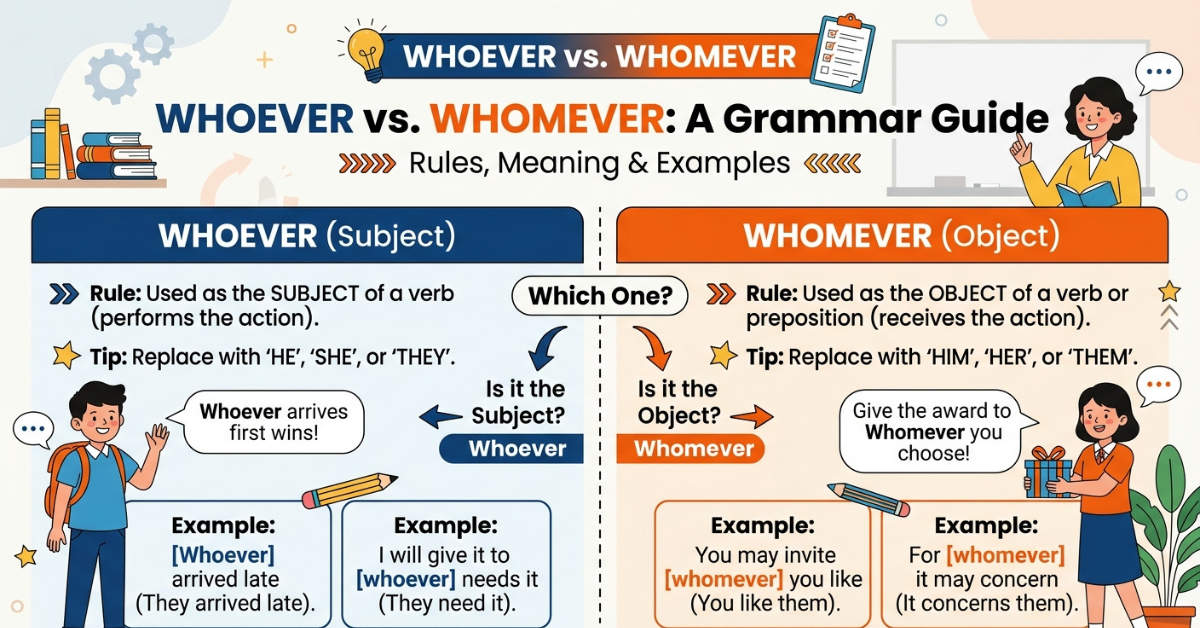
If whoever vs. whomever makes you stop in the middle of a sentence and question everything you learned in English class, you are definitely not alone.
These two words look similar, sound formal, and are often used in situations where even confident English speakers hesitate. Should you write, “Give it to whoever arrives first,” or “Give it to whomever arrives first?”
The answer depends on one important grammar rule: the role the word plays in its own clause.
Simply put:
- Whoever works like he, she, or they.
- Whomever works like him, her, or them.
That sounds easy enough, right? The tricky part is recognizing which role the word has in a longer sentence. This guide breaks down the whoever vs. whomever difference with simple explanations, practical examples, and an easy trick you can use almost every time.
Whoever vs. Whomever Meaning
Before getting into complicated grammar terms, let’s look at what these words generally mean.
Both whoever and whomever can refer to an unspecified person or people.
For example:
- Whoever wins the competition will receive a prize.
- Give the prize to whomever you choose.
In both sentences, we are talking about an unknown or unspecified person.
The difference is not really about meaning. Instead, it is about grammar and function.
The basic difference
| Word | Grammar Role | Similar Pronouns |
| Whoever | Subject | he, she, they |
| Whomever | Object | him, her, them |
This is the foundation of the whoever vs. whomever grammar rule.
When to Use Whoever vs. Whomever
Use Whoever When It Is the Subject
Use whoever when the person being referred to is doing the action.
Think of whoever as similar to:
- he
- she
- they
Examples of whoever
- Whoever calls first can speak to the manager.
- Whoever finishes the project will receive credit.
- Invite whoever wants to come.
- Whoever wrote this email did an excellent job.
In each example, whoever is connected to the person performing the action.
For instance:
Whoever calls first…
The unknown person is doing the calling. Therefore, whoever is correct.
Use Whomever When It Is the Object
Use whomever when the person receives the action.
Think of whomever as similar to:
- him
- her
- them
Examples of whomever
- Hire whomever you believe is best for the job.
- Give the package to whomever you choose.
- The manager can interview whomever she wants.
- Send the invitation to whomever you selected.
Here, whomever is the object of a verb or preposition.
For example:
Give the package to whomever you choose.
The person is receiving the package, which makes them the object.
The Most Important Whoever vs. Whomever Grammar Rule
Here is where many people get confused.
When deciding between whoever and whomever, you should focus on the word’s role inside its own clause, not just the role of the entire phrase in the sentence.
Consider this sentence:
Give the award to whoever wins.
At first glance, you might think whomever should be used because the phrase comes after to.
However, look at the clause:
whoever wins
Who is performing the action of winning?
Whoever.
So the correct sentence is:
Give the award to whoever wins.
This is one of the most important rules when learning whoever vs. whomever usage.
The He/Him Trick for Whoever vs. Whomever
The easiest whoever vs. whomever trick is the he/him test.
Replace the word with he or him.
If “he” sounds correct → use whoever.
If “him” sounds correct → use whomever.
Let’s look at an example.
___ is responsible should contact me.
Try:
He is responsible.
That works.
So the correct word is:
Whoever is responsible should contact me.
Now try another example:
Give the job to ___ you prefer.
Try:
Give the job to him.
That works.
So:
Give the job to whomever you prefer.
This simple substitution is one of the fastest ways to check whoever vs. whomever.
Whoever vs. Whomever Examples
Examples are often the best way to understand grammar rules in real situations.
Examples Using Whoever
1. Whoever arrives first can open the office.
The person is doing the action of arriving.
2. Whoever wants pizza can order some.
The person is doing the wanting.
3. Whoever made this decision should explain it.
The person performed the action of making the decision.
4. I will support whoever wins the election.
Even though whoever comes after the verb support, it is the subject of the clause:
whoever wins
The person performs the action of winning.
5. Whoever said that was wrong.
The person performed the action of saying something.
Examples Using Whomever
1. Choose whomever you like.
The person is receiving the action of choosing.
2. Give the documents to whomever you trust.
The person is the object of to and is being trusted.
3. The company can hire whomever it wants.
The person is the object of the verb hire.
4. Invite whomever you think would enjoy the event.
This sentence can feel tricky, but the structure matters. In formal grammar, you analyze the role carefully within the relevant clause.
5. Send the message to whomever you contacted earlier.
The person is receiving the action connected to the preposition to.
Whoever vs. Whomever in a Sentence: The Tricky Cases
Some sentences are more difficult because the word appears inside a longer clause.
Example: Give it to whoever needs it.
Many people incorrectly choose whomever because of the word to.
However, look at the clause:
whoever needs it
Who is doing the needing?
Whoever.
Therefore:
Give it to whoever needs it.
Example: Give it to whomever you choose.
Now look at the clause:
you choose whomever
Who is doing the choosing?
You.
The unknown person is receiving the action of choosing.
Therefore:
Give it to whomever you choose.
This comparison makes the whoever vs. whomever difference much easier to see.
Whoever vs. Whomever Usage Rules Explained Simply
You do not need to memorize dozens of complicated grammar terms. These simple rules will usually help.
Rule 1: Use Whoever for the Subject
If the unknown person performs the action, use whoever.
Examples:
- Whoever speaks first wins.
- Whoever studies will improve.
- Whoever is responsible should respond.
Rule 2: Use Whomever for the Object
If the unknown person receives the action, use whomever.
Examples:
- Choose whomever you prefer.
- Hire whomever you want.
- Give it to whomever you select.
Rule 3: Look Inside the Clause
Do not choose based only on the word before whoever or whomever.
Instead, identify the complete clause.
Correct:
Give the award to whoever wins.
Why?
Because whoever is the subject of wins.
Correct:
Give the award to whomever you select.
Why?
Because whomever is the object of select.
This is the key to understanding whoever vs. whomever grammar rules.
A Simple Step-by-Step Whoever vs. Whomever Checker
You do not necessarily need an online whoever vs. whomever checker. You can check the sentence yourself.
Follow these steps:
Step 1: Find the clause
Look at the words connected to whoever or whomever.
For example:
Give the prize to ___ wins.
The clause is:
___ wins
Step 2: Identify the action
What is the verb?
In this case:
wins
Step 3: Ask who performs the action
Who wins?
The unknown person.
Therefore, use:
whoever
Step 4: Try the he/him test
Replace the word.
He wins. (Correct)
Him wins. (Incorrect)
So:
Whoever wins
Common Mistakes When Using Whoever vs. Whomever
Mistake 1: Assuming “to” Always Requires Whomever
This is probably the most common mistake.
People see:
to ___
and immediately choose whomever.
But this is not always correct.
Incorrect thinking:
Give it to whomever wins.
Better analysis:
The clause is:
whoever wins
Since the person performs the action of winning, use whoever.
Correct:
Give it to whoever wins.
Mistake 2: Using Whomever Just Because It Sounds Formal
Sometimes people choose whomever because it sounds more sophisticated.
However, formal English is not automatically better English.
For example:
Incorrect: Whomever wants to join may come.
Correct: Whoever wants to join may come.
The person is doing the wanting, so whoever is correct.
Mistake 3: Ignoring the Clause
The biggest lesson in the whoever vs. whomever grammar explanation is this:
Always examine the smaller clause.
Ask:
- Who is doing the action?
- Who is receiving the action?
- Does he or him fit?
Once you answer those questions, the correct choice usually becomes clear.
Whoever vs. Whomever: A Quick Comparison
| Situation | Correct Word | Example |
| Person performs the action | Whoever | Whoever calls first wins. |
| Person receives the action | Whomever | Choose whomever you prefer. |
| Subject of a clause | Whoever | Give it to whoever needs it. |
| Object of a verb | Whomever | Hire whomever you trust. |
| “He” works | Whoever | Whoever is ready can begin. |
| “Him” works | Whomever | Give it to whomever you choose. |
Whoever vs. Whomever in Everyday English
Here is something important: whomever is becoming less common in everyday conversation.
Modern English speakers often use whoever even in situations where traditional grammar might prefer whomever.
For example, many people naturally say:
Choose whoever you want.
In casual conversation, this sounds completely normal.
In highly formal writing, academic work, legal documents, or professional communication, you may want to follow the traditional distinction more carefully.
That said, forcing whomever into every formal sentence can make your writing sound unnatural. Clarity should always come first.
Whoever vs. Whomever: Formal vs. Informal Usage
In formal writing
Pay closer attention to grammar.
Examples include:
- Academic papers
- Legal documents
- Professional reports
- Formal letters
Using whoever and whomever correctly can make your writing more polished.
In casual conversation
Most people rarely use whomever.
You are more likely to hear:
Talk to whoever you want.
than:
Talk to whomever you want.
Both may be understood, but whoever sounds much more natural in everyday speech.
Whoever vs. Whomever in “To Whom It May Concern”
A related phrase that often confuses people is:
To whom it may concern
Why is whom used here?
Because the person is the object of the preposition to.
You can think of it as:
To him it may concern.
Since him works rather than he, whom is correct.
This is slightly different from whoever vs. whomever, but it follows the same basic subject-versus-object principle.
Whoever vs. Whomever: Popular Culture and Search References
Some people search for “whoever vs. whomever The Office” because grammar jokes and debates often appear in television shows, movies, and online discussions.
These jokes work because the difference between the two words has become a classic grammar debate. People often know that whomever sounds more formal, but they are not always sure when it is actually correct.
Another unusual search phrase is “whoever vs. whomever oatmeal.” This type of query may come from a specific quote, joke, search trend, classroom example, or pop-culture reference rather than representing a separate grammar rule.
The important point is that no matter where the sentence appears—whether in a TV show, meme, email, or textbook—the same basic grammar principle applies: identify whether the word functions as a subject or an object within its clause.
The Merriam-Webster Approach to Whoever vs. Whomever Grammar
Discussions of Merriam-Webster whoever vs. whomever grammar often highlight an important reality about modern English: actual usage is sometimes more flexible than traditional classroom rules suggest.
Traditional grammar distinguishes the words according to subject and object roles:
- whoever = subject
- whomever = object
However, whoever is frequently used in informal modern English where whomever might traditionally be expected.
This does not mean grammar rules no longer matter. It simply means language changes, and everyday usage often becomes simpler over time.
For most writers, the best approach is:
- Follow the traditional rule in formal writing.
- Use the he/him test when unsure.
- Avoid making a sentence sound overly complicated just to appear formal.
Whoever vs. Whomever Grammar Explanation With Pronouns
One of the easiest ways to remember the difference is to compare the words with personal pronouns.
Subject pronouns
- I
- he
- she
- we
- they
- whoever
These perform the action.
Example:
He is coming.
Similarly:
Whoever is coming should call me.
Object pronouns
- me
- him
- her
- us
- them
- whomever
These receive the action.
Example:
Call him.
Similarly:
Call whomever you choose.
This comparison gives you a reliable foundation for using whoever vs. whomever correctly.
Whoever vs. Whomever: Easy Practice Sentences
Try filling in the blank before checking the answer.
1. ______ finishes first can leave early.
Answer: Whoever
The person performs the action of finishing.
2. Choose ______ you like.
Answer: Whomever
The person receives the action of choosing.
3. Give the prize to ______ wins.
Answer: Whoever
The person performs the action of winning.
4. Send the invitation to ______ you selected.
Answer: Whomever
The person receives the action of selecting.
5. ______ is responsible should apologize.
Answer: Whoever
The person is the subject of is.
A Quick Memory Trick You Can Actually Remember
If you remember only one thing from this article, remember this:
Whoever = he/she/they
Whomever = him/her/them
Then look at the clause and test the sentence.
Example:
___ is calling?
He is calling.
Therefore:
Whoever is calling?
Example:
You should hire ___.
You should hire him.
Therefore:
You should hire whomever you prefer.
This is probably the simplest whoever vs. whomever trick for everyday writing.
FAQ: Whoever vs. Whomever
Is it whoever or whomever?
It depends on the word’s grammatical role. Use whoever when the person performs the action and whomever when the person receives the action.
What is the easiest whoever vs. whomever trick?
Use the he/him test.
- If he fits, use whoever.
- If him fits, use whomever.
When should I use whoever?
Use whoever when it acts as the subject of a clause.
Example:
Whoever arrives first should open the door.
When should I use whomever?
Use whomever when it acts as an object.
Example:
Choose whomever you prefer.
Is “Give it to whoever wins” correct?
Yes.
Although the phrase follows to, the word whoever is the subject of the clause:
whoever wins
The person performs the action of winning.
Is “Give it to whomever you choose” correct?
Yes.
In the clause:
you choose whomever
The unknown person is the object of choose.
Can I use whoever instead of whomever?
In casual modern English, many people do. Whoever is much more common in everyday conversation.
However, in formal writing, traditional grammar may require whomever when the word functions as an object.
Is whomever becoming outdated?
Not completely, but whomever is less common in everyday speech than it once was. It is still used in formal writing and remains grammatically useful.
Is “whoever vs. whomever” the same as “who vs. whom”?
The basic subject-versus-object rule is similar.
- Who / whoever generally function as subjects.
- Whom / whomever generally function as objects.
The difference is that whoever and whomever usually introduce clauses referring to an unspecified person.
Is there a whoever vs. whomever checker?
Grammar checkers can help, but they may not always understand complicated sentence structures perfectly. The most reliable manual method is to identify the clause and use the he/him test.
Final Thoughts: Whoever vs. Whomever Made Simple
The whoever vs. whomever debate does not have to be intimidating.
The most important thing to remember is that the choice depends on grammar, not on which word sounds more formal.
Use:
- Whoever when the person is doing the action.
- Whomever when the person is receiving the action.
And when the sentence gets complicated, do not focus only on the word before it. Look at the entire clause.
The easiest rule is still the best one:
He = whoever
Him = whomever
With that simple trick, plenty of confusing whoever vs. whomever examples become much easier to understand. The next time you are writing an email, essay, article, or professional document, pause for a second, test the sentence, and choose the word that fits its grammatical role.
Once you start recognizing the pattern, the difference between whoever and whomever becomes far less confusing—and you will be able to use both words with confidence.





