
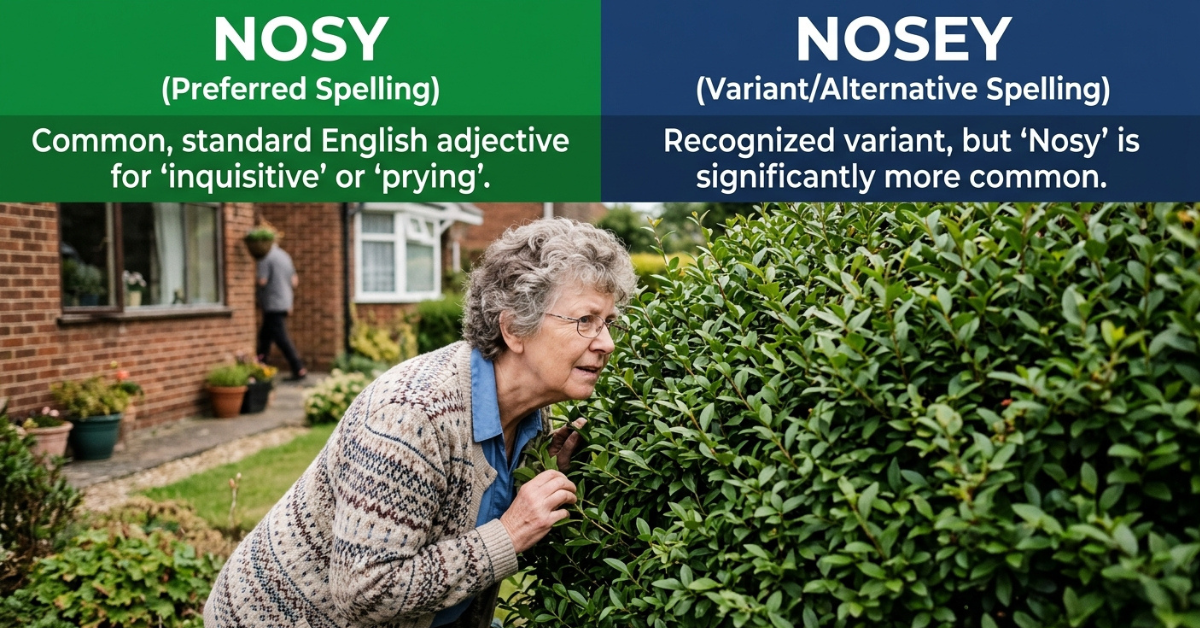
Have you ever caught yourself wondering whether someone is nosey or nosy? You are definitely not alone. Both spellings appear in everyday writing, social media posts, books, and conversations, which makes the question surprisingly confusing.
So, is it nosey or nosy?
The short answer is that both spellings are used, but nosy is generally the more common spelling, especially in modern American English. Nosey is also accepted and is commonly seen in British English and informal writing.
In this guide, we will explain the nosey or nosy meaning, the difference between the two spellings, UK and US usage, and plenty of examples to help you remember which one to use.
Nosey or Nosy Meaning
The words nosey and nosy have the same meaning. They describe someone who is too interested in other people’s private affairs.
A nosy person may:
- Ask overly personal questions.
- Listen to conversations that do not involve them.
- Want to know everyone’s secrets.
- Interfere in other people’s business.
- Constantly look for information about what others are doing.
For example:
My nosy neighbor always wants to know who is visiting my house.
You could also write:
My nosey neighbor always wants to know who is visiting my house.
The meaning remains exactly the same.
Is It Nosey or Nosy?
If you are asking, “Which is correct, nosey or nosy?”, the answer is:
Both are correct.
However, nosy is generally considered the more common and widely preferred spelling in modern English.
The simple rule:
- Nosy → More common, especially in American English.
- Nosey → Also correct and often seen in British English.
- Both mean the same thing.
So, if you are writing for a broad international audience and want the safest option, nosy is usually your best choice.
Nosey or Nosy Spelling: Why Are There Two Versions?
The confusion exists because the adjective comes from the word nose.
Historically, the idea behind the word is quite visual: a person who is overly curious is imagined as someone who is constantly poking their nose into other people’s business.
That connection led to the spelling nosey.
Over time, however, nosy became a more commonly used spelling. Today, both versions are recognized, although usage can vary depending on region, dictionary preferences, and writing style.
How Do You Spell Nosey or Nosy?
If someone asks, “How do you spell nosey or nosy?”, you can spell the two accepted versions as follows:
- Nosy: N-O-S-Y
- Nosey: N-O-S-E-Y
Both are pronounced the same way:
NOH-zee
The pronunciation does not change depending on which spelling you choose.
Which Is Correct: Nosey or Nosy?
The question “Which is correct, nosey or nosy?” does not have just one answer because both forms are legitimate.
That said, nosy is generally the preferred spelling in many modern dictionaries and publications.
Example:
More commonly written:
She is very nosy and always asks personal questions.
Also acceptable:
She is very nosey and always asks personal questions.
Neither sentence changes in meaning.
Nosey or Nosy in American English
In American English, nosy is usually the preferred spelling.
You are more likely to see:
- Nosy neighbor
- Nosy person
- Nosy questions
- Don’t be so nosy
- A nosy coworker
For example:
I don’t mean to be nosy, but where are you moving?
This is the spelling most readers in the United States will expect.
Nosey or Nosy UK: Which Spelling Is More Common?
When it comes to nosey or nosy UK usage, things are a little more flexible.
Both spellings are used in British English. However, nosey has traditionally been quite common in the UK, partly because its spelling clearly connects to the word nose.
For example, a British writer might say:
She’s a bit nosey, isn’t she?
Meanwhile, another writer may use:
She’s a bit nosy, isn’t she?
Both would be understood perfectly.
A useful tip for UK writers
If you are writing for a British publication, check its preferred style guide. Consistency matters more than switching between nosey and nosy throughout the same article.
Nosey or Nosy English: Is There a Difference in Meaning?
No. There is no difference in meaning between nosey and nosy.
Both describe someone who is excessively curious about matters that do not concern them.
Nosey or nosy definition:
Nosy/nosey is an adjective meaning:
Too interested in other people’s private lives or personal affairs.
Depending on the situation, the word can sound:
- Playful
- Mildly critical
- Annoyed
- Humorous
For example:
You’re so nosy!
This could be said jokingly between friends.
But it could also be a genuine complaint:
My coworker is too nosy and keeps asking about my personal life.
The tone and context determine how negative the word sounds.
Being Nosey or Nosy: What Does It Mean?
Being nosey or nosy means showing too much curiosity about something that is not really your business.
For example, someone may be considered nosy if they:
- Read someone else’s messages without permission.
- Ask intrusive questions about money or relationships.
- Listen in on private conversations.
- Search for gossip about other people.
- Constantly want to know everyone’s personal information.
However, there is a difference between being curious and being nosy.
Curious vs. Nosy
Curious usually means wanting to learn or understand something.
I’m curious about how the project works.
Nosy usually suggests unwanted interest in someone else’s private matters.
She’s nosy about everyone’s relationships.
In simple terms, curiosity is not always negative, but being nosy often involves crossing personal boundaries.
Nosey or Nosy Neighbor: Which One Should You Use?
The phrase nosy neighbor is much more commonly seen in modern writing, particularly in American English.
For example:
The nosy neighbor watched everything happening on the street.
You can also say:
The nosey neighbor watched everything happening on the street.
Again, both are correct.
However, if you are choosing one spelling for SEO writing, professional content, or a general audience, nosy neighbor may look more familiar to most readers.
Examples of Nosey and Nosy in Sentences
Here are some examples to make the difference even clearer.
Using “nosy”
- Don’t be so nosy; it’s a private conversation.
- My nosy coworker asks too many personal questions.
- I wasn’t trying to be nosy—I was just curious.
- She has a reputation for being nosy.
- The nosy neighbor knew everything happening on the block.
Using “nosey”
- He’s a little nosey when it comes to other people’s relationships.
- Stop being so nosey and give them some privacy.
- My nosey aunt always asks when I’m getting married.
- She gave me a nosey look at my phone screen.
Both spellings work, but it is best to choose one style and stay consistent.
“I’m Nosey” or “I’m Nosy”?
If you are wondering whether to write “I’m nosey” or “I’m nosy,” both are grammatically acceptable.
For example:
I’m nosy, so I always want to know what happened.
Or:
I’m nosey—I can’t help asking questions!
The first version, I’m nosy, is generally more common in modern American English.
Is It Spelled Nosey or Nosy in Formal Writing?
For formal or professional writing, nosy is generally the safer choice because it is the more widely recognized modern spelling.
That said, nosey is not automatically wrong.
If you are writing:
- A blog post
- A school assignment
- A professional article
- Website content
- Social media content
You can use either spelling, depending on your target audience.
Best practice:
Choose one spelling and use it consistently.
For example, avoid writing:
My nosy neighbor is always asking questions. She’s the nosey person on our street.
Instead, stick to one version:
My nosy neighbor is always asking questions. She’s the nosy person on our street.
Consistency makes your writing look cleaner and more professional.
Why Does “Nosy” Describe Someone Who Is Curious?
The word is connected to the expression:
“Stick your nose into someone else’s business.”
This phrase means becoming involved in matters that do not concern you.
Similar expressions include:
- Keep your nose out of it.
- Poke your nose into someone’s business.
- Have your nose in everyone’s affairs.
These expressions all use nose figuratively to describe unwanted curiosity or interference.
That is why a person who constantly investigates other people’s private lives can be called nosy or nosey.
Common Phrases Using Nosy
The word appears in several everyday expressions.
Don’t be nosy
This means:
Stop asking about something private.
Example:
Don’t be nosy—I’ll tell you when I’m ready.
A nosy person
Someone who takes too much interest in other people’s affairs.
He’s a nice person, but he can be a little nosy.
Nosy questions
Questions that are too personal or intrusive.
She kept asking nosy questions about my salary.
Nosy neighbor
A neighbor who pays excessive attention to other people’s lives.
Every neighborhood seems to have at least one nosy neighbor.
Nosey or Nosy Reddit Discussions: Why Do People Debate It?
Searches for “nosey or nosy Reddit” show how often English speakers debate spelling differences in online discussions.
The reason is simple: many people grew up seeing nosey, while others were taught that nosy is the standard spelling.
This creates the impression that one must be completely wrong.
In reality, the debate usually comes down to regional preference and familiarity, not a difference in meaning.
If you see someone write nosey, they are not necessarily making a spelling mistake. Likewise, nosy is also fully accepted.
How to Remember the Difference Between Nosey and Nosy
If you struggle to remember how to spell nosey or nosy, use this simple guide.
Choose “nosy” if:
- You are writing for an American audience.
- You want the more common modern spelling.
- You are unsure which version to choose.
- You want a simple four-letter spelling.
Choose “nosey” if:
- You prefer the spelling connected directly to nose.
- You are writing in a context where British usage is preferred.
- Your publication or style guide uses this version.
Easy memory trick
Think:
Nosy is the shorter and more common modern spelling.
If you are ever unsure, nosy is generally the safest option for most international audiences.
Nosey vs. Nosy: Quick Comparison
| Feature | Nosy | Nosey |
| Meaning | Too interested in others’ affairs | Too interested in others’ affairs |
| Pronunciation | NOH-zee | NOH-zee |
| Common in US English | Very common | Less common |
| Used in UK English | Yes | Yes |
| Generally accepted | Yes | Yes |
| Safest modern choice | Yes | Also correct |
The most important thing to remember is that the meaning does not change.
Common Mistakes When Using Nosey or Nosy
Although both spellings are accepted, writers sometimes make mistakes with grammar and context.
1. Using “nosey” or “nosy” as a noun
The words are primarily adjectives.
Correct:
She is nosy.
Less natural:
She is a nosy.
Instead, say:
She is a nosy person.
2. Confusing nosy with curious
Not every curious person is nosy.
Someone can be curious about science, history, or nature without interfering in anyone’s private life.
3. Assuming one spelling is always wrong
This is perhaps the biggest mistake in the nosey or nosy spelling debate.
Both forms are used and understood.
4. Switching spellings repeatedly
Pick one spelling for your article, story, or document and use it consistently.
Is Being Nosy Always a Bad Thing?
Usually, calling someone nosy has a negative meaning because it suggests they are invading someone else’s privacy.
However, it can sometimes be playful.
For example:
I’m a little nosy—I love hearing the latest gossip!
Among friends, this may simply mean someone enjoys knowing what is happening.
The difference depends on whether the person’s curiosity is harmless or whether they are genuinely invading someone’s privacy.
Synonyms for Nosey or Nosy
Depending on the situation, you could use several related words instead of nosy.
Some common synonyms include:
- Inquisitive
- Prying
- Meddlesome
- Intrusive
- Snoopy
- Overcurious
- Interfering
However, these words do not all have exactly the same tone.
For example:
Inquisitive can sound neutral or even positive.
Prying and intrusive are usually more negative.
Meddlesome suggests interfering in other people’s affairs.
Snoopy is informal and often playful.
Antonyms of Nosy
Words with the opposite meaning may include:
- Private
- Reserved
- Discreet
- Uninvolved
- Respectful of privacy
A discreet person is generally careful not to interfere in other people’s personal matters.
FAQs About Nosey or Nosy
Is it nosey or nosy?
Both nosey and nosy are correct. However, nosy is generally the more common spelling in modern English, especially in the United States.
Which is correct, nosey or nosy?
Both are correct and have the same meaning. Nosy is usually the preferred spelling for a broad or international audience.
How do you spell nosey or nosy?
You can spell it either nosy (N-O-S-Y) or nosey (N-O-S-E-Y).
What is the meaning of nosey or nosy?
Nosey or nosy means being overly interested in other people’s private affairs or personal business.
Is nosey correct in English?
Yes. Nosey is a correct spelling and is particularly familiar in British English and informal usage.
Is nosy American or British?
Nosy is widely used in both American and British English, although it is especially common in American English. Nosey is also commonly recognized in British English.
How do you spell “I’m nosy”?
The most common modern spelling is:
I’m nosy.
However, I’m nosey is also acceptable.
What does a nosy neighbor mean?
A nosy neighbor is someone who pays too much attention to their neighbors’ private lives and personal activities.
Is being nosy the same as being curious?
Not exactly. Curious can be neutral or positive, while nosy usually suggests unwanted interest in someone else’s private business.
Conclusion: Nosey or Nosy—Which Should You Use?
So, when it comes to nosey or nosy, there is no need to panic over the spelling. Both words are correct, both are pronounced the same way, and both mean someone who takes too much interest in other people’s private affairs.
If you want the most common modern spelling, especially for American English or a general online audience, choose nosy. If you prefer nosey, particularly in British-style writing, that spelling is also accepted.
The key takeaway is simple: nosy is more common, but nosey is not wrong.
Now that you know the difference, you can confidently use the correct spelling in your writing—and maybe even recognize when someone is being a little too nosy about your business.





