
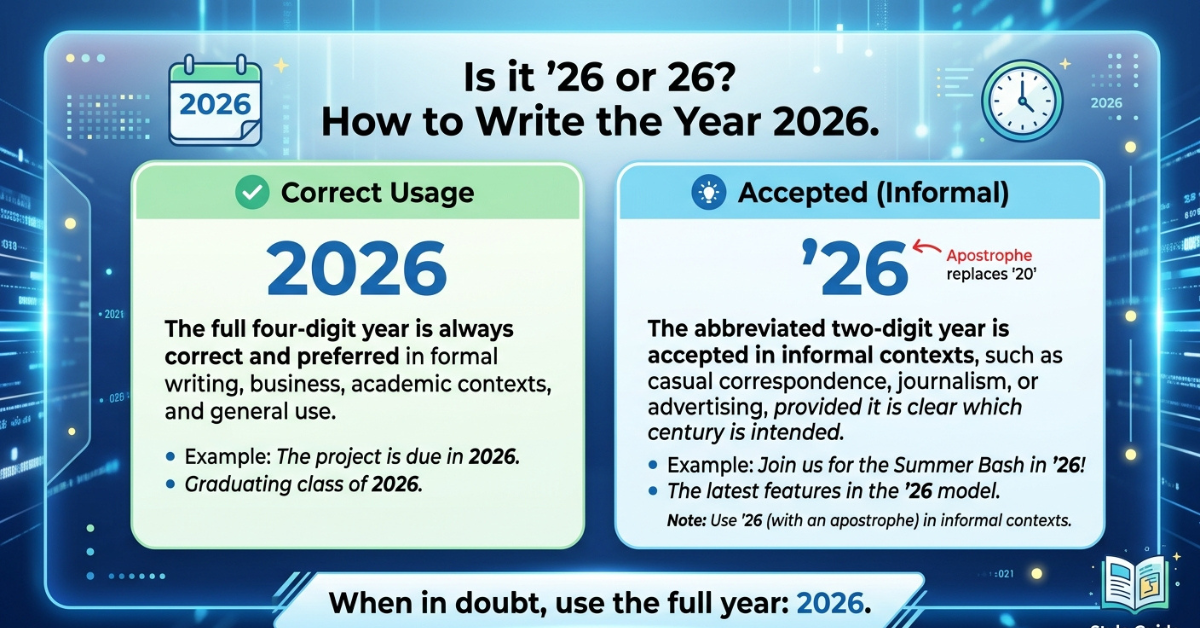
Have you ever shortened 2026 and wondered which punctuation belongs before the final two digits? The choice may look minor, but it changes how readers understand the number.
When you abbreviate a four-digit year, the standard form is ’26. The apostrophe shows that 20 has been omitted. By comparison, 26 normally represents the number twenty-six.
Knowing the difference helps you write dates clearly in everything from graduation announcements to professional documents.
What Is the Correct Abbreviation for 2026?
The conventional shortened form of the year is ’26.
The apostrophe appears before the remaining digits because it marks the numbers removed from the original form:
- 2026 → complete year
- ’26 → abbreviated year
- 26 → number twenty-six
For example:
The Class of ’26 will graduate next spring.
The punctuation tells readers that the final two digits represent a shortened year rather than an ordinary number.
Why Does a Shortened Year Need an Apostrophe?
An apostrophe can indicate that characters have been left out. The same principle applies when shortening a four-digit date.
Look at the change:
2026 → ’26
The first two digits, 20, disappear. The apostrophe signals that those digits once appeared there.
You can see a similar use in everyday contractions:
- do not → don’t
- I am → I’m
- 2026 → ’26
In each case, the punctuation tells the reader that part of the original form is missing.
’26 vs. 2026: Which Form Is Better?
The choice depends largely on context.
2026 is the clearest option when you need a formal or precise style. ’26 works well when you want something shorter, more casual, or visually compact.
For example:
The conference will take place in 2026.
A promotional message might instead say:
Get ready for Summer ’26!
Both communicate the intended year, but they create different tones.
When Should You Write the Full Year?
The four-digit version usually works better in:
- Academic papers
- Business reports
- Legal documents
- Contracts
- Official records
- Research papers
- Government documents
- Formal correspondence
Using all four digits removes doubt and gives the writing a more professional appearance.
Where Does the Apostrophe Go?
Place the apostrophe before the final two digits:
Correct: ’26
Incorrect: 26’
The first version indicates that numbers were removed from the beginning. The second places the punctuation in the wrong position and does not function as a year abbreviation.
You’ll often see the correct form in phrases such as:
- Class of ’26
- Summer ’26
- The ’26 season
- Welcome, ’26!
- Graduates of ’26
These expressions appear frequently in school announcements, event materials, social media posts, and promotional content.
When Is 26 Correct?
There is nothing wrong with 26 when you’re talking about the number twenty-six.
For example:
She is 26 years old.
Or:
The book contains 26 chapters.
Neither sentence refers to a date, so an apostrophe would be unnecessary.
The distinction becomes clearer when you compare these examples:
She is 26 years old.
She belongs to the Class of ’26.
The first sentence uses a number. The second uses a shortened year.
How Do You Shorten Other Years?
The same punctuation rule applies to other four-digit years.
For example:
- 2023 → ’23
- 2024 → ’24
- 2025 → ’25
- 2026 → ’26
- 2027 → ’27
The apostrophe marks the digits omitted from the beginning.
This convention appears frequently in class names, event titles, sports seasons, and other informal references to dates.
Should You Use the Abbreviated Form in Formal Writing?
In most formal situations, writing the complete year is the safer choice.
Compare:
The project was completed in 2026.
with:
The project was completed in ’26.
The first version provides the reader with the complete date immediately. Although the shortened form can be correct, it has a more informal and stylistic feel.
Academic and professional writing generally benefits from consistency and precision. Unless a particular style guide recommends otherwise, spelling out the full year avoids unnecessary ambiguity.
Common Uses of the Shortened Form
A two-digit year can work especially well when space or visual style matters.
Graduation and Class Names
One of the most familiar examples is:
Class of ’26
Schools and universities often use this wording on invitations, merchandise, announcements, and social media graphics.
Events and Campaigns
Promotional materials may use a shortened date to create a compact title:
Summer ’26
Road to ’26
The shorter format can make a headline feel cleaner while retaining its meaning.
Sports Seasons
Sports teams and organizations may shorten a year when referring to a season:
The ’26 season begins in September.
Individual organizations may follow their own editorial style, so consistency matters.
Straight Apostrophe vs. Curly Apostrophe
When typing a shortened year, you may encounter two forms:
- ’26 — straight apostrophe
- ’26 — curly or typographic apostrophe
The curly version generally looks more polished in professionally designed material.
For example:
Class of ’26
has a more refined appearance than:
Class of ’26
Many word processors automatically convert a straight apostrophe into a curly one. Both forms are recognizable, but professional typography often favors the curly mark.
Common Mistakes to Avoid
A few errors frequently appear when people shorten dates.
1. Leaving Out the Apostrophe
You may see:
Class of 26
Readers can often understand the intended meaning from context, but the conventional form is:
Class of ’26
The apostrophe makes the omission explicit.
2. Putting the Mark After the Digits
Avoid:
26’
The punctuation belongs before the shortened year.
3. Adding an Apostrophe to the Complete Date
The full form requires no apostrophe:
2026
Since no digits have been removed, there is nothing for the apostrophe to represent.
4. Using a Shortened Date When Precision Matters
A two-digit reference can become unclear when the surrounding text doesn’t establish the intended year. In those cases, writing all four digits is the better option.
26, 2026, or ’26?
A simple comparison makes the distinction easier:
| Form | Meaning | Example |
| 26 | The number twenty-six | She is 26 years old. |
| 2026 | The complete year | The event is scheduled for 2026. |
| ’26 | A shortened form of 2026 | Class of ’26 |
Think about what you’re trying to communicate before choosing the format.
Use 26 for the number, 2026 for the complete date, and ’26 when you intentionally shorten the year.
Is It ’26 or 26 for 2026?
If you’re shortening 2026, use ’26. The apostrophe makes it clear that the first two digits have been omitted.
For example:
We’re looking forward to ’26.
In a formal document, however, you may want to retain the complete form:
We’re looking forward to 2026.
Simply writing 26 can create uncertainty because readers may interpret it as the number twenty-six.
Is It ’26 or 26 for the Year?
When a four-digit date becomes a two-digit abbreviation, the apostrophe indicates the missing beginning.
For 2026, the shortened version is therefore:
’26
You don’t need to abbreviate every reference, though. Professional, academic, and official writing will often look clearer with the complete year.
Frequently Asked Questions
What is the correct abbreviation for 2026?
The conventional shortened form is ’26. The apostrophe shows that the first two digits have been omitted.
Can 26 represent the year 2026?
Readers may understand it from context, particularly in informal designs or headlines. However, ’26 provides a clearer indication that you’re referring to an abbreviated year.
Where should the apostrophe go?
Place it before the remaining digits. For example, write ’26, not 26’.
Should I write 2026 or ’26 in an essay?
For most academic essays, 2026 is preferable because the complete form provides greater clarity and maintains a formal tone.
Is “Class of ’26” correct?
Yes. Class of ’26 is a common way to identify a graduating class associated with that year.
Is ’26 grammatically correct?
Yes. The apostrophe indicates that the beginning of the original year has been omitted.
What is the difference between 26 and ’26?
26 is the number twenty-six. ’26 indicates an abbreviated year, with the apostrophe showing that digits have been removed from the beginning.
Conclusion
When abbreviating 2026, the conventional form is ’26. The apostrophe tells readers that the first two digits have been omitted.
Use 26 when you mean the number twenty-six, while 2026 remains the clearest choice when you need the complete year. Formal documents, academic writing, and official communication generally benefit from using all four digits.
For casual expressions such as Class of ’26 or Summer ’26, the shortened version works naturally. Once you understand what the apostrophe represents, choosing the appropriate format becomes straightforward.





