
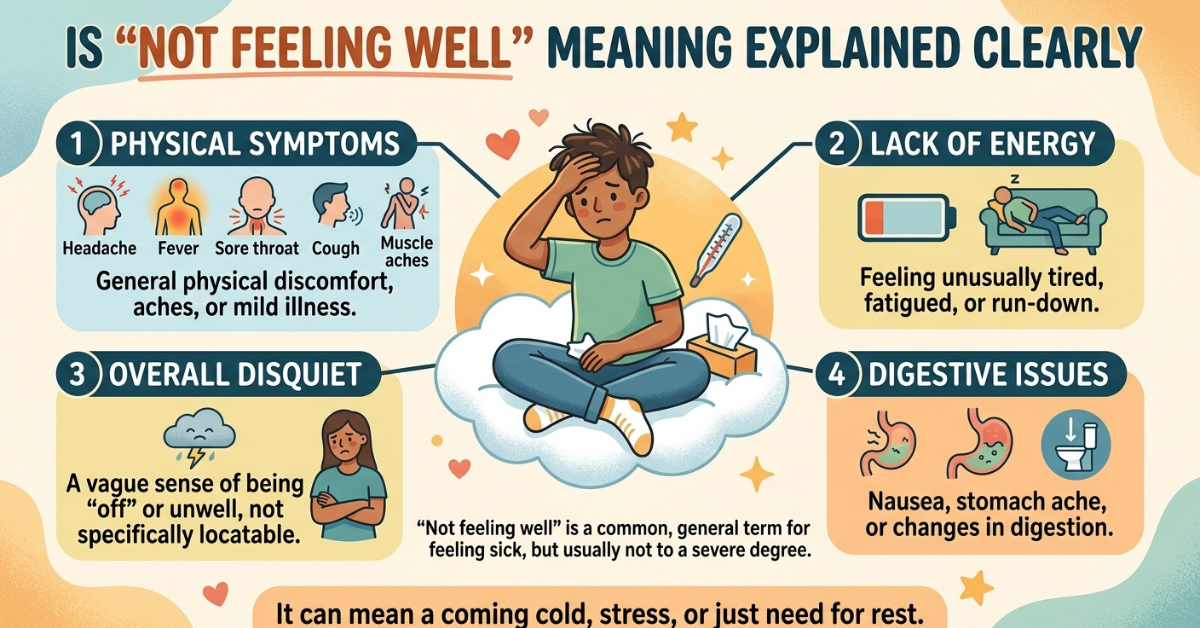
Sometimes, a person says, “I’m not feeling well,” and the meaning seems obvious. But depending on the situation, the phrase can refer to physical illness, emotional discomfort, tiredness, or simply feeling different from normal.
So, what does “is not feeling well” mean exactly? In everyday English, it usually means that someone does not feel physically or emotionally okay. The phrase is intentionally broad, which makes it useful when a person does not want to explain every detail.
What Does “Is Not Feeling Well” Mean?
The phrase “is not feeling well” means that someone is experiencing some kind of discomfort, illness, weakness, or emotional uneasiness.
For example:
- “She is not feeling well today.”
- “He is not feeling well, so he stayed home.”
- “My friend is not feeling well after the long trip.”
In these sentences, the speaker does not necessarily tell us what is wrong. The person could have a headache, stomachache, fever, fatigue, stress, or another issue.
The phrase is therefore a polite and general way to say that someone does not feel okay.
Is “Not Feeling Well” the Same as Being Sick?
Not always.
“Sick” usually suggests an illness or a noticeable physical health problem. “Not feeling well” is softer and more general.
Compare these examples:
“I am sick.”
This directly suggests that the speaker has an illness.
“I am not feeling well.”
This could mean the person is sick, tired, dizzy, stressed, uncomfortable, or simply under the weather.
That is why people often choose “not feeling well” when they do not want to give specific medical details.
What Does “I’m Not Feeling Well” Mean?
When someone says “I’m not feeling well,” they are usually communicating that they do not feel physically or emotionally normal at that moment.
The exact meaning depends on the context.
It could mean:
- They have physical symptoms.
- They feel unusually tired or weak.
- They are experiencing stress or emotional discomfort.
- They may be becoming ill.
- They simply need some rest.
For example, if someone cancels plans and says, “I’m not feeling well,” it is generally understood as a polite explanation that they are unable or unwilling to go out.
Physical Meaning of “Not Feeling Well”
In many situations, “not feeling well” refers to physical health.
Someone might use the phrase when experiencing symptoms such as:
- Headache
- Nausea
- Fatigue
- Dizziness
- Stomach discomfort
- A sore throat
- Fever
- Body aches
- General weakness
However, the phrase itself does not identify a specific illness. It simply communicates that the person is feeling unwell.
Example in a Conversation
Friend: “Are you coming to dinner tonight?”
You: “I’m not feeling well, so I think I’ll stay home.”
Here, the speaker does not need to explain the exact symptoms. The listener can understand that the person is not well enough to attend.
Can “Not Feeling Well” Describe Emotions?
Yes. Although the phrase commonly refers to physical health, context can give it an emotional meaning.
Someone might say:
“I haven’t been feeling well emotionally lately.”
This clearly refers to their mental or emotional state.
Even without the word “emotionally,” the meaning can sometimes be understood from the conversation. For example, a person discussing stress, sadness, anxiety, or personal problems may use “not feeling well” to describe how they are doing emotionally.
However, if clarity matters, phrases such as “I’m feeling emotionally drained” or “I’m not doing well emotionally” are more specific.
“Not Feeling Well” vs. “Feeling Unwell”
The expressions “not feeling well” and “feeling unwell” have very similar meanings.
The main difference is style.
- Not feeling well sounds natural and conversational.
- Feeling unwell can sound slightly more formal.
- Feeling sick is more direct and often suggests physical illness.
- Feeling ill is also associated with physical sickness and is more common in some varieties of English.
For everyday conversations, “I’m not feeling well” is extremely common.
Is “Not Feeling Well” Grammatically Correct?
Yes, “not feeling well” is grammatically correct.
The expression uses the verb feel followed by the adverb well. It is commonly used with forms of the verb “be” or “have” depending on the sentence.
Examples include:
- “I am not feeling well.”
- “She is not feeling well.”
- “He was not feeling well yesterday.”
- “They have not been feeling well lately.”
The wording can change depending on the subject and tense, but the basic meaning remains the same.
“I Don’t Feel Well” vs. “I’m Not Feeling Well”
Both expressions are correct, but they can have slightly different nuances.
I Don’t Feel Well
“I don’t feel well” is a straightforward statement about how someone feels right now.
Example:
“I don’t feel well, so I’m going to rest.”
I’m Not Feeling Well
“I’m not feeling well” can sound a little softer and may emphasize the person’s current condition.
Example:
“I’m not feeling well today. Can we meet tomorrow instead?”
In everyday English, both are natural and widely understood.
How to Say “I’m Not Feeling Well” Politely
If you need to tell someone that you are unwell, there are several natural ways to say it.
Casual
- “I’m not feeling well today.”
- “I don’t feel too good.”
- “I’m feeling a little off.”
- “I’m under the weather.”
Professional
- “I’m not feeling well today and may need to rest.”
- “I’m feeling unwell and won’t be able to attend today.”
- “I’m not feeling well, so I’d like to take the day off.”
More Specific
If you are comfortable sharing details, you can say:
- “I have a headache and I’m not feeling well.”
- “My stomach is upset, so I’m not feeling well.”
- “I’ve been feeling very tired and unwell today.”
You do not have to provide a detailed explanation if you do not want to.
What Does “Not Feeling Well” Imply in a Text?
When someone texts “I’m not feeling well,” the meaning is usually simple: they are currently unwell or uncomfortable.
The phrase may also be used when someone wants to:
- Cancel plans
- Explain why they are not responding quickly
- Ask for some rest
- Take time away from work or school
- Let someone know they need support
For example:
“Sorry I didn’t reply earlier. I’m not feeling well today.”
This generally means the person has been feeling unwell and may not have had the energy or ability to respond.
Common Synonyms for “Not Feeling Well”
Depending on the context, you can replace the phrase with several alternatives:
- Feeling unwell
- Feeling sick
- Feeling ill
- Feeling poorly
- Feeling under the weather
- Not feeling okay
- Feeling off
- Feeling weak
- Feeling unwell physically
These expressions are not always perfect substitutes. For example, “feeling off” can describe a vague physical or emotional feeling, while “feeling sick” more strongly suggests physical illness.
When Should You Use “Not Feeling Well”?
Use the phrase when you want to communicate that someone is not feeling normal without giving a specific diagnosis or explanation.
It works especially well in:
- Casual conversations: “I’m not feeling well today.”
- Work communication: “I’m not feeling well and need to take the day off.”
- School: “She is not feeling well and will stay home today.”
- Social situations: “I’m not feeling well, so I’ll skip the party.”
- General conversations: “He hasn’t been feeling well lately.”
Its flexibility is one reason the phrase is so common in everyday English.
Common Mistakes to Avoid
One common mistake is assuming that “not feeling well” always means someone has a serious illness. It does not. The phrase can describe anything from mild tiredness to a more significant health problem.
Another mistake is treating it as a specific diagnosis. Saying someone is “not feeling well” does not tell you what condition they have.
The context matters.
FAQs About “Is Not Feeling Well” Meaning
What is the simple meaning of “not feeling well”?
“Not feeling well” means that a person does not feel physically or emotionally okay. It is a general expression that does not identify a specific problem.
Does “not feeling well” mean sick?
It can mean sick, but not necessarily. Someone may say they are not feeling well because they are tired, dizzy, stressed, uncomfortable, or experiencing another temporary problem.
Is “I’m not feeling well” grammatically correct?
Yes. “I’m not feeling well” is a grammatically correct and very common expression in English.
What is another way to say “not feeling well”?
You can say “feeling unwell,” “feeling sick,” “feeling ill,” “feeling under the weather,” or “not feeling okay,” depending on the context.
Is “I don’t feel well” or “I’m not feeling well” better?
Both are correct. “I don’t feel well” is direct, while “I’m not feeling well” often sounds natural when describing a current or temporary condition.
Can “not feeling well” refer to mental health?
Yes. Context can make the phrase refer to emotional or mental well-being, although more specific wording such as “I’m struggling emotionally” may communicate that meaning more clearly.
Conclusion
The “is not feeling well” meaning is simple but broad: it tells us that someone does not feel okay without explaining exactly why. Most often, it refers to physical discomfort or illness, but it can also describe tiredness, stress, or emotional uneasiness.
Its flexibility makes “not feeling well” a useful expression in everyday conversations, texts, school, and professional settings. If you want to communicate that you are unwell without sharing personal details, it is a natural and polite choice.





