
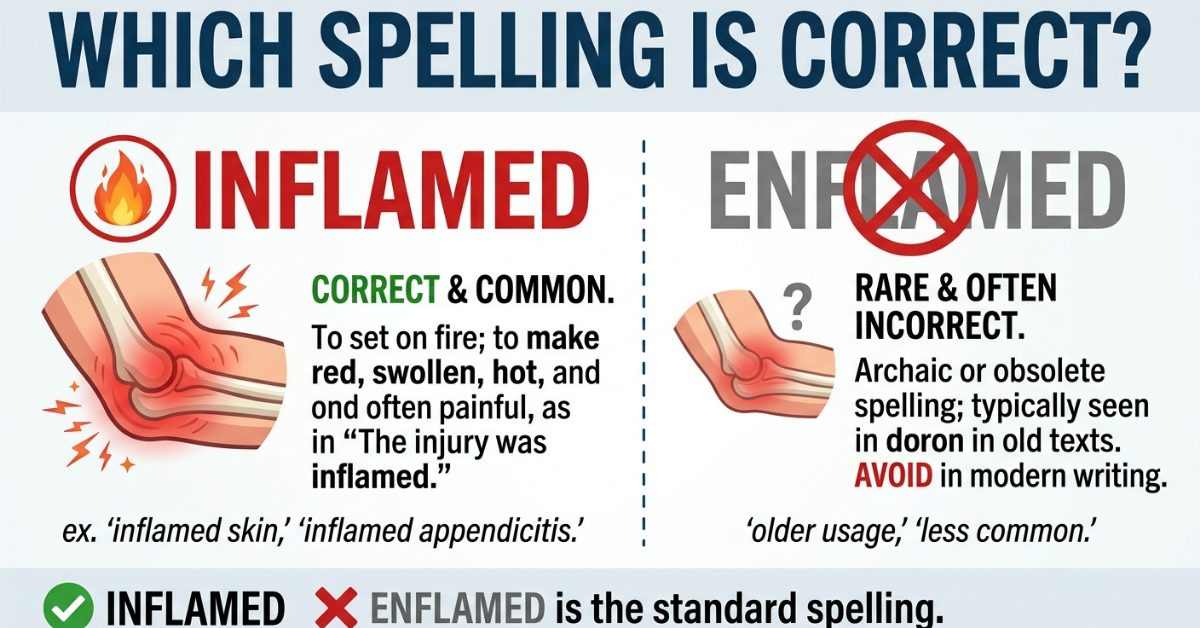
Have you ever written a sentence like “the skin around the wound looks ___” and suddenly wondered whether the right word is inflamed or enflamed? It’s an easy mix-up because the two words look and sound remarkably similar.
When comparing inflamed vs enflamed, however, there is an important distinction. Inflamed is the standard and overwhelmingly preferred word when you mean affected by inflammation. Enflamed is a real word, but it is much less common and usually has a different meaning related to setting something on fire or causing intense emotion.
So, if you’re talking about swollen, red, irritated tissue, inflamed is almost certainly the word you want.
Inflamed vs Enflamed: The Quick Answer
The easiest way to remember the difference is this:
- Inflamed = affected by inflammation; irritated, swollen, or reddened.
- Enflamed = set on fire or, in some contexts, intensely excited or emotionally stirred.
- Inflamed is the normal choice in medical, health, and everyday contexts.
- Enflamed is uncommon in modern everyday English.
For example:
“The skin around the cut is inflamed.”
This means the area is showing signs of inflammation.
On the other hand:
“The speech enflamed public anger.”
Here, enflamed means the speech intensified or stirred up strong feelings.
What Does Inflamed Mean?
Inflamed is the past participle and adjective form of the verb inflame. In medical and everyday language, it most commonly refers to a body part or tissue experiencing inflammation.
Inflammation is part of the body’s immune response to injury, infection, irritation, or other triggers. Depending on the situation, an inflamed area may become:
- Red
- Swollen
- Warm
- Painful or tender
- More sensitive than usual
For example:
- “My gums are inflamed.”
- “The doctor noticed an inflamed joint.”
- “The skin around the bite became inflamed.”
- “His throat looks inflamed.”
Inflamed as a Figurative Word
Inflamed can also describe emotions, arguments, or situations that have become more intense.
For example:
- “The controversial comment inflamed tensions.”
- “The article inflamed public opinion.”
- “His remarks inflamed an already heated debate.”
In these examples, inflamed means something caused anger, excitement, or tension to become stronger.
What Does Enflamed Mean?
Enflamed is a legitimate English word, but it is considerably less common than inflamed.
It can be used to mean set on fire or made to burn, and it can also have a figurative sense involving intense emotions or passions.
For example:
- “The dry material was quickly enflamed.”
- “His words enflamed their resentment.”
That said, modern writers generally use inflamed much more often, particularly when discussing inflammation or emotional tension.
Because enflamed is relatively uncommon, it can sometimes look like a misspelling of inflamed. In many everyday sentences, replacing enflamed with inflamed will sound more natural.
Inflamed vs Enflamed Meaning
The two words overlap somewhat, especially when used figuratively, but their typical uses are different.
| Word | Main meaning | Common usage |
| Inflamed | Affected by inflammation; made more intense | Medical, physical, emotional |
| Enflamed | Set on fire or intensely stirred | Literary, figurative, less common |
The key point is that inflamed has a strong connection with physical inflammation, while enflamed tends to emphasize fire or something being set alight.
Why Is “Inflamed” Usually the Better Choice?
If you’re writing about the human body, inflamed is the clear choice.
You would normally write:
- Inflamed skin
- Inflamed gums
- Inflamed tonsils
- Inflamed joints
- Inflamed tissue
- Inflamed muscles
- Inflamed eyes
You would not normally write enflamed skin or enflamed joints when you mean that these body parts are experiencing inflammation.
For health-related writing, inflamed is also the term readers are much more likely to recognize and understand immediately.
Inflamed vs Enflamed in Example Sentences
Seeing the words in context makes the difference easier to remember.
Examples With “Inflamed”
- “The doctor said the tissue was inflamed.”
- “Her ankle became inflamed after the injury.”
- “The cream may help soothe inflamed skin.”
- “His gums looked red and inflamed.”
- “The infection caused the area to become inflamed.”
- “The politician’s comments inflamed public anger.”
In the first five examples, inflamed describes physical inflammation. In the final example, it is being used figuratively.
Examples With “Enflamed”
- “The flames enflamed the dry grass.”
- “The speech enflamed the crowd’s anger.”
- “The discovery enflamed his desire to investigate further.”
These uses are less common in contemporary everyday writing.
Is Inflamed the Correct Spelling?
Yes. Inflamed is the standard spelling when you mean affected by inflammation.
For example:
“The area around the wound is inflamed.”
This is the natural and standard construction.
If you’re writing an article, email, school assignment, medical explanation, or everyday message, inflamed is generally the safest choice when referring to inflammation.
Is Enflamed a Misspelling of Inflamed?
Not necessarily.
Enflamed is an actual English word, so it isn’t simply an incorrect spelling of inflamed. The issue is that it is much less frequently used and has somewhat different traditional meanings.
This is why the distinction can be confusing. Both words are related historically to the idea of setting something on fire or intensifying something, but inflamed has developed into the standard term for bodily inflammation.
So, rather than thinking:
Enflamed = wrong
it’s more accurate to think:
Inflamed = standard and common in most modern contexts involving inflammation.
Enflamed = legitimate but uncommon, with meanings associated more closely with fire or intense feeling.
Inflamed vs Enflamed: How to Remember the Difference
Here’s a simple memory trick.
Think of inflamed as being connected to inflammation.
Inflamed → inflammation
If you’re describing redness, swelling, irritation, heat, or another inflammatory response, use inflamed.
For example:
“My knee is inflamed.”
If you’re talking about something being set on fire or a feeling being intensely stirred, enflamed may be possible, although inflamed can also work in many figurative contexts.
A Simple Rule
Body + inflammation = inflamed.
That one rule will solve most spelling questions involving these two words.
Inflamed vs Inflaming: What’s the Difference?
Another common point of confusion is inflamed versus inflaming.
Both come from the verb inflame, but they perform different grammatical jobs.
- Inflamed describes something that has already become affected or intensified.
- Inflaming describes the action of causing something to become inflamed or more intense.
Examples:
“The wound is inflamed.”
The wound is experiencing inflammation.
“The chemical is inflaming the skin.”
The chemical is causing or contributing to the inflammation.
The same distinction works in figurative contexts:
“The debate became inflamed.”
“His comments were inflaming the argument.”
Common Phrases With “Inflamed”
Because inflamed is the preferred modern term for inflammation, you’ll encounter it in many common expressions.
Some examples include:
- Inflamed skin
- Inflamed gums
- Inflamed joints
- Inflamed tissue
- Inflamed tonsils
- Inflamed eyes
- Inflamed muscles
- Inflamed nerves
- Inflamed throat
- Inflamed areas
These phrases are especially common in health, medical, dermatology, and general wellness writing.
Common Mistakes With Inflamed vs Enflamed
Mistake 1: Assuming Enflamed Is Always Wrong
Although inflamed is usually the correct choice for physical inflammation, enflamed is not simply a nonexistent word.
It has legitimate uses, especially in literary or figurative writing.
Mistake 2: Using Enflamed for Medical Inflammation
If you mean that a body part is swollen, red, irritated, or experiencing an inflammatory response, use inflamed.
Incorrect or unusual:
“Her ankle is enflamed.”
Better:
“Her ankle is inflamed.”
Mistake 3: Thinking the Words Are Completely Interchangeable
They can overlap in some figurative contexts, but their usual meanings aren’t identical.
Choosing the more precise word makes your writing clearer.
Which One Should You Use?
When you’re unsure, ask yourself what you’re describing.
Use “inflamed” when:
- Talking about inflammation in the body
- Describing irritated or swollen tissue
- Discussing a medical or health condition
- Describing an argument or emotion that has become more intense
- Writing for a general audience
Consider “enflamed” when:
- Referring to something being set on fire
- Writing in a literary or deliberately dramatic style
- Describing something intensely stirred or aroused
- The context specifically calls for the less common word
In most everyday writing, inflamed will be the more natural choice.
Frequently Asked Questions
Is “inflamed” or “enflamed” correct?
Both are recognized English words, but inflamed is the standard and much more common choice when referring to inflammation. Enflamed is less common and is more closely associated with fire or intense emotional stimulation.
Is “enflamed” a real word?
Yes. Enflamed is a real word, although it is uncommon in modern everyday English. It can mean set on fire or, figuratively, intensely stirred or excited.
Should I say “inflamed skin” or “enflamed skin”?
Say inflamed skin when you mean skin affected by inflammation. This is the standard and natural expression.
What is the difference between inflammation and being inflamed?
Inflammation is the biological process or response, while inflamed describes something experiencing that process.
For example:
“Inflammation is causing the skin to become inflamed.”
Can inflamed describe emotions?
Yes. Inflamed can be used figuratively to describe anger, tension, controversy, or other strong emotions becoming more intense.
For example:
“The announcement inflamed public anger.”
Is “inflamed” a medical term?
It is commonly used in medical and health contexts, but it is also an ordinary English adjective. It describes tissue or an area of the body showing signs of inflammation.
What is the opposite of inflamed?
The exact opposite depends on the context. In a physical context, words such as calm, soothed, or non-inflamed may be appropriate. There isn’t one universal opposite of inflamed.
Is “enflamed” more correct when talking about fire?
Enflamed can be used in the sense of being set on fire, although other expressions such as ignited, burning, or on fire are often more natural in modern English.
Final Verdict: Inflamed vs Enflamed
When comparing inflamed vs enflamed, the best choice depends on what you mean. If you’re talking about inflammation, irritated tissue, swelling, redness, or an inflammatory response, choose inflamed.
Enflamed is a legitimate but uncommon word that can refer to something being set on fire or to strong emotions being stirred. In modern everyday writing, however, inflamed is overwhelmingly the more familiar and useful choice.
So if you’re writing “inflamed skin,” “inflamed gums,” or “an inflamed joint,” you’re on the right track. When in doubt, remember the simple connection: inflamed → inflammation.