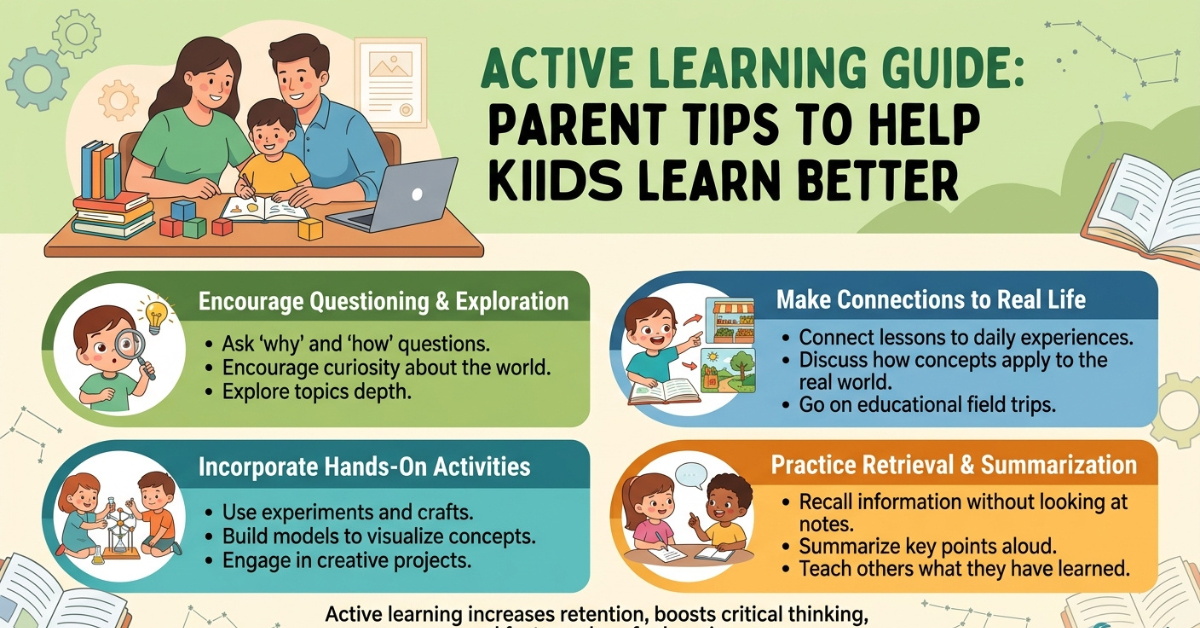
Reading a textbook from beginning to end can certainly feel productive. However, looking at information for hours does not always mean that you are truly learning it. This is where the active learning guide fparentips approach can make a difference.
Active learning focuses on participation rather than simply receiving information. Instead of only reading, listening, or memorizing, learners ask questions, solve problems, explain concepts, discuss ideas, and apply what they know.
Whether you’re a student, parent, teacher, or lifelong learner, these techniques can make study sessions more purposeful. Best of all, you don’t need expensive software or complicated equipment to begin.
What Is Active Learning?
Active learning is an educational approach in which students participate directly in the learning process. Rather than simply absorbing information, they interact with it and use it in different ways.
For example, imagine that you’re studying photosynthesis. You could read the definition several times, but an active approach would take the lesson further. You might:
- Explain photosynthesis in your own words
- Draw a diagram showing the process
- Answer questions without checking your notes
- Teach the concept to another person
- Connect the topic with real plants and everyday life
As a result, the learner is doing more than reading. They are processing information, making connections, and checking whether they actually understand the concept.
Why Does Active Learning Matter?
One major advantage of active learning is that it encourages deeper thinking. Instead of simply recognizing information on a page, students have to retrieve knowledge, make connections, analyze ideas, and explain their reasoning.
Furthermore, learning research has highlighted the value of techniques such as retrieval practice, feedback, problem-solving, and elaboration. When these methods are used appropriately, they can support understanding and long-term retention.
Another useful feature is that active learning can reveal knowledge gaps. Once students discover what they cannot explain or remember, they can return to that specific area instead of repeatedly reviewing material they already know.
Key Benefits of Active Learning
Active learning can support several important aspects of studying, including:
- Better retention: Recalling information gives your memory an opportunity to retrieve it.
- Deeper understanding: Learners work with concepts instead of relying only on memorization.
- Improved problem-solving: Practical exercises require students to apply their knowledge.
- Greater engagement: Interactive tasks make lessons less passive.
- Useful feedback: Questions and exercises can reveal areas that need more attention.
- Greater independence: Over time, students can develop learning strategies that suit them.
Active Learning Strategies for Students
You don’t have to completely redesign your study routine. Instead, begin with one or two techniques and gradually introduce additional strategies as you become comfortable with them.
1. Use Active Recall
Active recall involves trying to retrieve information from memory before looking at the answer.
After studying a section, close your book and ask yourself:
- What were the main ideas?
- Can I explain this topic without looking at my notes?
- Which examples can I remember?
- What part of the lesson remains unclear?
For instance, flashcards and practice questions can turn an ordinary review session into an active recall exercise. Similarly, answering questions from memory gives you a clearer picture of what you actually know.
2. Explain the Topic in Your Own Words
Another simple strategy is to explain a concept as though you’re teaching it to someone else.
Rather than repeating textbook sentences word for word, use everyday language and familiar examples. If the explanation becomes difficult, that can be a useful signal that you need to review the subject more carefully.
This technique also works well for complicated subjects because it forces you to organize information logically.
3. Turn Notes Into Questions
Traditional notes often record information without requiring much interaction. Therefore, turning statements into questions can make those notes more useful during revision.
For example, instead of writing:
The water cycle includes evaporation, condensation, precipitation, and collection.
Create questions such as:
- What are the main stages of the water cycle?
- What happens during evaporation?
- Why does condensation occur?
- What is precipitation?
Later, you can hide the answers and test yourself. Consequently, your notes become a revision tool rather than something you simply read repeatedly.
4. Practice With Real Problems
Whenever possible, connect new knowledge with practical situations.
For mathematics, for example, solve problems instead of only reading formulas. In science, think about where a concept appears in everyday life. Meanwhile, history students can compare events and examine their causes and consequences.
Applying information in different situations can make abstract ideas easier to understand and remember.
5. Try the Teach-Back Method
Choose a topic and pretend you’re explaining it to a beginner.
Begin with the basic idea, introduce a simple example, and then move toward the more complicated details. If you suddenly realize that you cannot explain one part clearly, you’ve found an area worth revisiting.
In this way, teaching someone else becomes a practical test of your own understanding.
Active Learning Activities for the Classroom
Active learning isn’t limited to individual study sessions. Teachers can also introduce interactive activities without turning every lesson into a large project.
Several simple classroom techniques can encourage students to participate more actively.
Think-Pair-Share
First, students think about a question individually. Next, they discuss their ideas with a partner. Finally, they share their responses with the class.
This structure gives students time to organize their thoughts before speaking. As a result, participation does not depend entirely on the students who are most comfortable answering immediately.
Group Problem-Solving
Teachers can present a problem that requires more than remembering a definition. Students then work in small groups to discuss possible solutions and explain why they chose a particular approach.
Besides encouraging collaboration, this activity allows students to hear different ways of approaching the same problem.
Classroom Polls
Quick polls can provide immediate feedback about how well students understand a topic.
For example, a teacher can ask a multiple-choice question before explaining a difficult concept. Afterwards, students can discuss their reasoning and reconsider their answers.
One-Minute Papers
At the end of a lesson, students can spend one minute responding to a few simple prompts:
- What was the most important thing you learned?
- Which question do you still have?
- What concept was most difficult?
- What would you like to review?
This short reflection gives students a chance to organize their thoughts. At the same time, teachers can use the responses to identify areas that may need further explanation.
Active Learning at Home
Parents can encourage active learning at home without turning every study session into another classroom lesson.
Instead of asking only, “Did you finish your homework?”, try asking questions such as:
- “What did you learn today?”
- “Can you explain that to me?”
- “Which part was most difficult?”
- “How would you solve that problem differently?”
- “Can you give me an example?”
These questions encourage children to retrieve information and explain their thinking. More importantly, they shift the conversation from simply completing work to understanding it.
Make Learning Part of Everyday Life
Everyday activities can also provide natural learning opportunities.
For example, cooking can introduce measurements and fractions. Shopping can involve budgeting, comparison, and percentages. Likewise, a museum visit can lead to conversations about history, science, or art.
The goal isn’t to turn every family activity into a formal lesson. Instead, parents can help children notice how knowledge connects with the world around them.
Active Learning vs. Passive Learning
Active and passive learning can both have a place in education. The main difference is the level of participation required from the learner.
| Active Learning | Passive Learning |
|---|---|
| Answering questions | Reading without interaction |
| Solving problems | Watching a lesson without taking part |
| Explaining concepts | Copying definitions |
| Discussing ideas | Listening without reflection |
| Practicing skills | Repeatedly reviewing information |
| Teaching someone else | Highlighting large sections |
For instance, reading a chapter can provide valuable background information. However, answering questions about that chapter afterward requires you to retrieve and process what you have read.
Therefore, passive activities aren’t automatically useless. Instead, they become more effective when combined with activities that require genuine thinking and application.
How to Build an Active Learning Routine
A useful learning routine doesn’t need to be complicated. In fact, a simple five-step process can provide a practical starting point.
- Preview the topic: Identify the main ideas before you begin.
- Study the material: Read, watch, or listen to the initial explanation.
- Recall the information: Put your notes away and test yourself.
- Apply what you learned: Complete questions, solve problems, or use the concept.
- Review mistakes: Identify gaps and return to difficult areas.
This approach creates a learning cycle instead of a routine based entirely on consuming information. Over time, you can also adjust the process according to the subject and your personal learning needs.
Common Active Learning Mistakes to Avoid
Active learning works best when an activity genuinely requires you to think. However, some study habits may appear productive while providing limited opportunities for retrieval or application.
Highlighting Everything
Highlighting can be useful for identifying important information. Nevertheless, highlighting an entire page doesn’t require much retrieval or analysis.
Instead, highlight only key points and then turn those points into questions. This small change can make your revision more interactive.
Memorizing Without Understanding
Memorization has an important role in learning. Students may need to remember formulas, vocabulary, dates, terminology, or other essential facts.
At the same time, knowing a fact isn’t always enough. Whenever possible, make sure you also understand how, when, and why that information should be used.
Making Study Sessions Too Complicated
It is easy to assume that an effective study routine requires numerous apps, notebooks, and color-coded systems.
In reality, you can practice active learning with something as simple as a textbook and a sheet of paper. What matters most is the quality of the thinking involved.
Avoiding Mistakes
Getting an answer wrong does not automatically mean that a study method has failed.
Instead, use mistakes as feedback. Review the error, determine why it happened, and then attempt a similar question again. This process can help turn a weak area into an opportunity for improvement.
How Technology Can Support Active Learning
Digital tools can make active learning more convenient, especially for students who study independently.
For example, learners can use:
- Digital flashcards
- Online quizzes
- Interactive simulations
- Collaborative documents
- Educational videos followed by questions
- Digital mind maps
- Practice-test platforms
However, technology should support active learning rather than replace it. A complicated app isn’t necessarily more effective than a simple method that requires you to retrieve, explain, or apply information.
A Simple 30-Minute Active Learning Plan
If you’re unsure how to begin, try a short 30-minute study session.
First 5 minutes: Review the topic and identify the key concepts.
Next 10 minutes: Study the material and create a few questions.
Next 10 minutes: Put your notes away and answer those questions from memory.
Final 5 minutes: Check your answers and write down anything that needs another review.
You can adjust these time periods according to your age, subject, and attention span. More importantly, keep the basic sequence intact: learn, recall, apply, and review.
Frequently Asked Questions
What is active learning in simple terms?
Active learning means participating in the learning process instead of simply receiving information. For example, answering questions, solving problems, explaining concepts, and practicing skills all involve active participation.
Is active learning better than traditional studying?
Active learning provides opportunities to retrieve, apply, and explain information, which can support learning and retention. However, traditional activities such as reading and listening can still be useful when they are combined with active practice.
What is the easiest active learning technique?
Active recall is a straightforward technique for beginners. After studying a small section, close your notes and try to explain the main ideas or answer questions without checking the material.
Can children use active learning?
Yes. Active learning can be adapted to different ages through games, questions, discussions, experiments, storytelling, drawing, and practical activities.
How can parents encourage active learning?
Parents can ask children to explain what they learned, connect school subjects with everyday experiences, encourage questions, and provide opportunities to practice. As a result, children can focus more on understanding rather than simply completing assignments.
Does active learning require technology?
No. Many active learning strategies require no technology at all. A textbook, notebook, practice questions, or even a conversation can provide everything needed for an effective activity.
Conclusion
The active learning guide fparentips approach is built around a simple principle: learning becomes more meaningful when you actively participate in the process.
Instead of spending every study session rereading the same information, try asking questions, recalling concepts, explaining ideas, solving problems, and reviewing mistakes. These small changes can make your study time more purposeful while helping you identify what you understand and what still needs attention.
Most importantly, you don’t need to change your entire routine at once. Start with one technique, such as active recall or the teach-back method, and gradually add other strategies that suit your learning style.
The goal isn’t simply to spend more hours studying. The goal is to make the time you already spend learning more interactive, focused, and useful.