
Have you ever typed a sentence and suddenly stopped to wonder, “Is it inflamed or enflamed?” You’re not alone. These two words look almost identical, sound similar, and are both found in English dictionaries, which makes the choice surprisingly confusing.
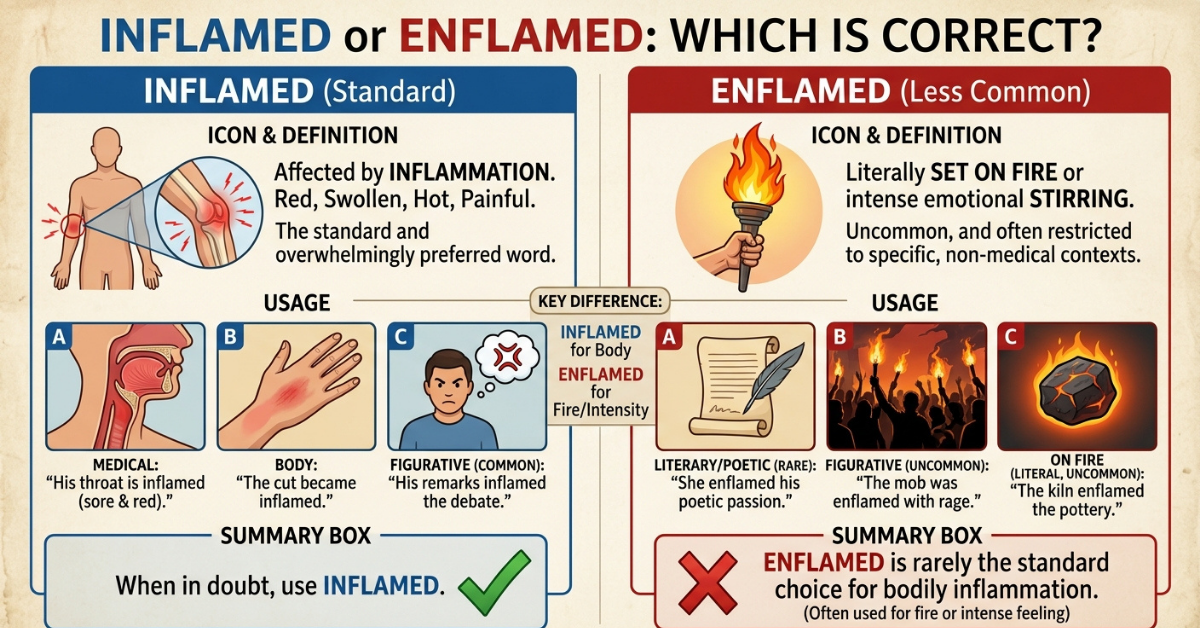
The good news is that there is a simple answer: inflamed is the standard and more commonly used form, while enflamed is an accepted but less common variant. Both can refer to something that has become affected by inflammation, but inflamed is generally the safer choice in modern writing.
Let’s break down the difference so you can confidently choose the right word in your writing.
Is It Inflamed or Enflamed?
If you’re wondering “is it inflamed or enflamed?”, the answer is inflamed for most situations.
Inflamed is the usual past-tense and past-participle form of the verb inflame. It can describe bodily tissue affected by inflammation, but it can also describe something that has become heated, intensified, or emotionally charged.
For example:
- Correct and most common: My throat is inflamed.
- Also possible, but less common: My throat is enflamed.
- More natural: The doctor said the tissue was inflamed.
- Less common: The doctor said the tissue was enflamed.
Merriam-Webster lists enflame as a less common spelling of inflame, while its main entry gives inflame as the standard form.
Inflamed vs. Enflamed at a Glance
| Word | Is it correct? | Commonness | Best choice? |
| Inflamed | Yes | Very common | Yes |
| Enflamed | Yes | Less common | Usually no |
So, if you’re writing an email, article, academic paper, medical description, or everyday sentence, inflamed is generally the better choice.
What Does Inflamed Mean?
Inflamed is the past participle of inflame. In a medical context, it means that bodily tissue has become affected by inflammation.
Inflammation is part of the body’s response to injury, infection, irritation, or other triggers. Depending on the situation, an inflamed area may become red, swollen, warm, or painful.
For example:
The skin around the wound looks inflamed.
Here, inflamed describes a physical condition.
However, inflamed isn’t limited to medical situations. The verb inflame can also mean to make something more intense or emotionally charged. Merriam-Webster includes meanings involving anger, excitement, increased intensity, heat, and inflammation.
Examples include:
- The comment inflamed public anger.
- The debate became increasingly inflamed.
- The patient’s ankle was inflamed after the injury.
What Does Enflamed Mean?
Enflamed is also a legitimate English word. It is the past-tense or past-participle form of enflame, which Merriam-Webster identifies as a less common spelling of inflame.
In other words, enflamed is not simply a spelling mistake.
It can carry the same meanings as inflamed, including:
- affected by inflammation
- made hot or red
- emotionally excited or angered
- intensified
- set on fire or kindled
For example:
The argument enflamed tensions between the two groups.
That sentence is grammatically possible, but most modern readers would probably find inflamed tensions more familiar and natural.
Why Is Inflamed More Common Than Enflamed?
The preference for inflamed has a long history.
The English verb inflame dates back to the Middle English period and ultimately traces to Latin inflammare, meaning “to set on fire” or “kindle.” The word entered English through forms related to Old French enflamer. Historically, enflame existed as a spelling, but the spelling with in- became predominant from around the 16th century onward.
That history helps explain why both forms exist today.
English contains many words that have developed different spellings over centuries. Sometimes one spelling becomes dominant while another survives as a less common variant. That is essentially what happened with inflame and enflame.
Inflamed or Enflamed: Which Should You Use?
For most writing, choose inflamed.
It’s especially appropriate when you’re writing:
- Medical or health-related content
- “The patient’s tonsils were inflamed.”
- Academic writing
- “The study examined inflammation in inflamed tissue.”
- Professional communication
- “The skin around the area appears inflamed.”
- SEO content
- “What causes inflamed gums?”
- Everyday conversation
- “My knee is inflamed after exercising.”
Although enflamed is correct, it can sound unusual to many readers because it is considerably less common.
When Can You Use Enflamed?
You can use enflamed when you deliberately want the variant spelling or when it appears in a quotation, historical text, or particular style.
For ordinary modern English, though, there is usually little reason to choose it over inflamed.
Think of it this way:
Inflamed = standard, familiar, and preferred
Enflamed = valid, but uncommon
Examples of Inflamed in a Sentence
Here are some natural examples:
Medical Examples
- The doctor noticed that the patient’s gums were inflamed.
- Her ankle became inflamed after the injury.
- The skin around the cut looked red and inflamed.
- The MRI showed signs of inflamed tissue.
Emotional or Figurative Examples
- His remarks inflamed an already tense situation.
- The announcement inflamed public concern.
- The argument became increasingly inflamed.
- Her comments inflamed tensions between the two sides.
These uses reflect the different meanings associated with inflame.
Examples of Enflamed in a Sentence
Because enflamed is a valid variant, it can appear in sentences such as:
- The wound became enflamed.
- The heated discussion enflamed tensions.
- The flames left the surrounding area enflamed.
These aren’t necessarily grammatically wrong. The main issue is usage and familiarity, not whether the word exists.
Merriam-Webster explicitly lists enflame as a less common spelling of inflame and gives enflamed as an accepted variant.
Common Mistake: Thinking Enflamed Is Always Wrong
One of the biggest misconceptions surrounding this pair is that enflamed is an incorrect spelling.
That’s not quite right.
Dictionaries recognize enflame and enflamed. The issue is that inflame/inflamed is the dominant form in contemporary English.
So if someone writes “enflamed,” it doesn’t automatically mean they made a spelling error.
However, if your goal is to write naturally and use the form most readers expect, inflamed is the better choice.
Inflamed or Enflamed in Medical Writing
If you’re specifically describing inflammation in the body, inflamed is overwhelmingly the more natural choice.
For example:
- inflamed gums
- inflamed skin
- inflamed joints
- inflamed tonsils
- inflamed tissue
- inflamed muscles
You would normally write:
The patient has inflamed gums.
rather than:
The patient has enflamed gums.
The first version sounds more natural and familiar to modern English readers.
It’s also important to remember that inflamed describes a condition; it doesn’t by itself explain why the inflammation occurred. Causes can vary widely, so a medical concern should be evaluated based on symptoms and context rather than the word used to describe it.
Inflamed or Enflamed in SEO Content
If you’re creating website content around this spelling question, inflamed should be your primary keyword and wording choice.
You can naturally incorporate related search phrases such as:
- inflamed or enflamed
- is it inflamed or enflamed
- inflamed meaning
- enflamed meaning
- inflamed definition
- enflamed definition
- difference between inflamed and enflamed
- correct spelling of inflamed
- is enflamed a word
- inflamed vs enflamed
- how to spell inflamed
Avoid repeating the exact keyword in every paragraph. Search engines increasingly understand context, meaning, synonyms, and related concepts, so useful information is more valuable than obvious keyword repetition.
Quick Trick to Remember the Correct Spelling
If you frequently forget which form to use, here’s an easy rule:
When in doubt, use “inflamed.”
You can remember it alongside related words such as:
- inflammation
- inflammatory
- inflame
- inflamed
The spelling family makes inflamed easier to recognize.
Inflamed vs. Enflamed: Final Verdict
So, is it inflamed or enflamed?
Both forms are recognized, but inflamed is the standard and more common choice. Enflamed is a valid but less common variant of inflamed.
If you’re writing something for a general audience, professional setting, medical context, school assignment, website, or SEO article, inflamed is almost always the safest option.
Quick Answer
Use “inflamed” in most situations.
Use “enflamed” only when you have a specific reason to prefer the less common variant.
Frequently Asked Questions
Is “enflamed” a correct word?
Yes. Enflamed is a legitimate word and is the past-tense or past-participle form of enflame. However, it is less common than inflamed.
Is inflamed or enflamed more common?
Inflamed is much more common. Modern dictionaries identify enflame as a less common spelling of inflame.
Is “inflamed” the correct spelling?
Yes. Inflamed is the standard spelling and is the form you will generally want to use in modern English.
Can I say “enflamed skin”?
You can, because enflamed is an accepted variant. However, “inflamed skin” sounds more natural and is the preferred wording for most readers.
What is the difference between inflamed and enflamed?
There is little difference in meaning. Enflamed is essentially a less common variant of inflamed. The main difference is usage and frequency rather than definition.
Is “inflamed” only used for medical conditions?
No. Inflamed can describe physical inflammation, but it can also describe something emotionally or figuratively intensified. For example, someone can have an inflamed injury, while a controversial statement can inflame public anger.
Should I use inflamed or enflamed in formal writing?
Use inflamed. While enflamed is not incorrect, inflamed is more familiar and is the standard choice for most formal and professional writing.
Conclusion
The next time you pause and ask, “Is it inflamed or enflamed?”, you can confidently choose inflamed.
Both spellings are recognized in English, but inflamed is the standard, familiar form, while enflamed is a less common variant. This is especially important in medical, academic, professional, and SEO writing, where clarity and natural usage matter.
So the simple rule is:
Inflamed = preferred
Enflamed = correct, but less common
When you’re unsure, stick with inflamed. It’s the spelling most readers will expect and the one most likely to sound natural in modern English.





