
Have you ever agreed with someone so strongly that a simple “yes” just didn’t feel enough? That’s exactly where the phrase “absolutely true” comes in.
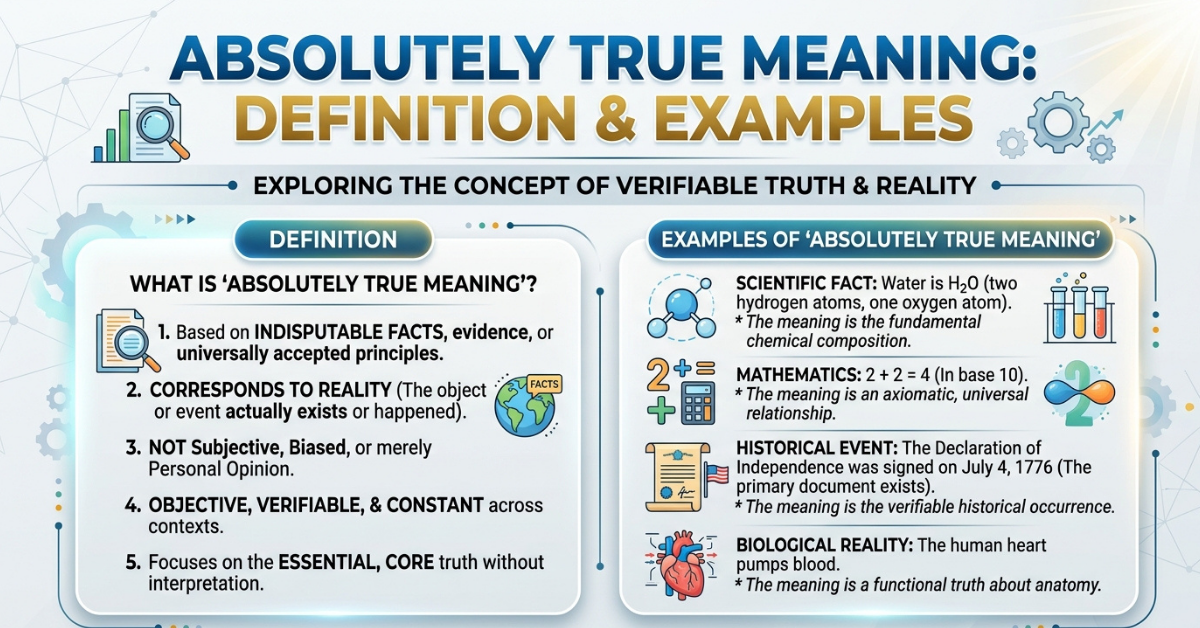
The absolutely true meaning is completely true, entirely correct, or true without any doubt. When someone says, “That is absolutely true,” they are not merely agreeing; they are emphasizing that they strongly believe the statement is correct.
For example:
“Hard work can improve your chances of success.”
“That is absolutely true.”
In this conversation, the second speaker is expressing complete agreement with the first statement.
Absolutely True Meaning in English
The absolutely true meaning in English is completely true or unquestionably correct.
Here, “true” means correct, factual, or in accordance with reality. Meanwhile, “absolutely” works as an intensifier, making the meaning of “true” much stronger.
Simple definition
Absolutely true = completely true + without any doubt
The phrase is commonly used when someone wants to:
- Show strong agreement
- Confirm that something is correct
- Express certainty
- Emphasize the truth of a statement
- Support another person’s opinion
For instance, if someone says, “Practice is important if you want to improve,” replying “Absolutely true” shows that you completely agree.
Examples of “Absolutely True”
Here are a few examples that show how the phrase works naturally in conversation:
Example 1:
“Exercise can be an important part of a healthy lifestyle.”
“Absolutely true.”
Example 2:
“Learning a new skill requires time and practice.”
“That is absolutely true.”
Example 3:
“Good communication can prevent many misunderstandings.”
“It is absolutely true.”
As you can see, the expression often works as a stronger version of “I agree.”
It Is Absolutely True Meaning
The phrase “it is absolutely true” means “it is completely true” or “there is no doubt that it is true.”
Unlike the shorter response “absolutely true,” this version is a complete sentence. It can be used when you want to make a clear statement about the truth of something.
For example:
“It is absolutely true that preparation can make difficult tasks easier.”
In this sentence, the speaker is confidently confirming the statement.
“Absolutely True” vs. “It Is Absolutely True”
Although both expressions communicate certainty, they are used slightly differently.
“Absolutely true” is often used as a short response:
“You need patience to become good at something.”
“Absolutely true!”
On the other hand, “It is absolutely true” forms a complete statement:
“It is absolutely true that patience is important.”
Therefore, both phrases express strong agreement, but the first is more conversational while the second fits naturally into a complete sentence.
Absolutely True Meaning in Hindi
The absolutely true meaning in Hindi can be expressed in several natural ways, depending on the context.
Common translations include:
- बिल्कुल सच — Bilkul sach
- पूरी तरह सच — Puri tarah sach
- बिल्कुल सही — Bilkul sahi
For example:
“That is absolutely true.”
→ “यह बिल्कुल सच है।”
(Yah bilkul sach hai.)
Another natural option is:
“यह बिल्कुल सही है।”
(Yah bilkul sahi hai.)
In everyday Hindi, “बिल्कुल सच” is particularly close to the meaning of “absolutely true.” However, “बिल्कुल सही” may sound more natural when you are confirming that someone’s statement or answer is correct.
Hindi Example
Person A: “मेहनत सफलता के लिए जरूरी है।”
Person B: “यह बिल्कुल सच है।”
In English:
Person A: “Hard work is important for success.”
Person B: “That is absolutely true.”
Absolutely True Meaning in Urdu
The absolutely true meaning in Urdu can be expressed as:
- بالکل سچ — Bilkul sach
- بالکل درست — Bilkul durust
- مکمل طور پر درست — Mukammal taur par durust
For example:
“That is absolutely true.”
→ “یہ بالکل سچ ہے۔”
You can also say:
“یہ بالکل درست ہے۔”
Both expressions communicate strong agreement or confirmation. However, the most suitable translation can change depending on whether you are talking about a fact, opinion, answer, or personal statement.
Urdu Example
Person A: “محنت کامیابی کے لیے ضروری ہے۔”
Person B: “یہ بالکل سچ ہے۔”
In English:
Person A: “Hard work is necessary for success.”
Person B: “That is absolutely true.”
Absolutely True Meaning in Bengali
The absolutely true meaning in Bengali can be translated in different ways according to the situation.
Some common expressions are:
- একেবারে সত্য — Ekebare satya
- সম্পূর্ণ সত্য — Sampurno satya
- একদম সত্যি — Ekdum satyi
For example:
“That is absolutely true.”
→ “এটা একেবারে সত্য।”
In informal conversation, “একদম সত্যি” can also naturally express the same idea.
Consequently, the exact Bengali wording may vary depending on whether the conversation is formal, informal, written, or spoken.
When Do People Say “Absolutely True”?
People generally use “absolutely true” when they want to strongly agree with another person’s statement.
Consider this short conversation:
A: “Nobody becomes an expert without making mistakes.”
B: “Absolutely true.”
Person B isn’t simply saying “yes.” Instead, they are emphasizing that they completely agree with what Person A has said.
The expression can therefore communicate several ideas at once:
- Strong agreement — “I completely agree.”
- Certainty — “I have no doubt about this.”
- Confirmation — “Yes, that statement is correct.”
- Emphasis — “This is definitely true.”
- Confidence — “I strongly believe this is correct.”
Because of this, the phrase is especially common in everyday discussions, interviews, social conversations, and online communication.
Synonyms for “Absolutely True”
There are many expressions that can convey a similar meaning. However, the best choice depends on the context and the level of certainty you want to express.
Common alternatives
- Completely true
- Entirely true
- Definitely true
- Certainly true
- Totally true
- Completely correct
- Exactly right
- Unquestionably true
- Undeniably true
- Without a doubt
- No doubt about it
- That’s exactly right
For example, instead of saying:
“That is absolutely true.”
you could say:
“That’s exactly right.”
Similarly, “without a doubt” puts more emphasis on certainty, whereas “exactly right” is often used to confirm that someone’s answer or statement is correct.
“Absolutely True” vs. “Definitely True”
At first glance, “absolutely true” and “definitely true” may appear to mean exactly the same thing. In everyday English, they are often interchangeable, but there is a slight difference in emphasis.
Absolutely true tends to emphasize complete agreement or certainty:
“Your explanation is absolutely true.”
Meanwhile, definitely true places more emphasis on confidence:
“It is definitely true that preparation is important.”
As a result, both expressions work well in casual English. The choice usually depends on the speaker’s style rather than a major difference in meaning.
“Absolutely True” in Everyday Conversation
One reason this phrase is so popular is that it is short, natural, and easy to understand.
Here are some examples of how it can appear in ordinary conversations.
Friend 1: “Sometimes taking a short break helps you work better.”
Friend 2: “Absolutely true.”
Friend 1: “You can learn a lot from your mistakes.”
Friend 2: “That is absolutely true.”
Friend 1: “Good communication is important in relationships.”
Friend 2: “Absolutely!”
Interestingly, “Absolutely!” can sometimes be used by itself. In the right context, it can mean “I completely agree” or “Definitely.”
Is “Absolutely True” Grammatically Correct?
Yes, “absolutely true” is grammatically correct.
From a grammar perspective, “true” is an adjective, while “absolutely” is an adverb that modifies the adjective.
The basic structure is:
Absolutely + adjective
For example:
- Absolutely correct
- Absolutely necessary
- Absolutely certain
- Absolutely amazing
- Absolutely true
The adverb strengthens the adjective that follows it. Therefore, “absolutely true” is a perfectly natural English expression.
Common Mistakes With “Absolutely True”
Although the phrase is easy to understand, there are a few mistakes English learners should avoid.
1. Using unnecessary repetition
A sentence such as:
“It is absolutely completely true.”
sounds unnatural because “absolutely” and “completely” both intensify “true.”
A better version is:
“It is absolutely true.”
2. Confusing “absolutely” with “probably”
These two words communicate very different levels of certainty.
“It is absolutely true.”
This suggests complete confidence.
By contrast:
“It is probably true.”
suggests that something is likely to be true, but there is still some uncertainty.
Therefore, you should choose the word that accurately reflects how certain you are.
3. Using it when you disagree
“Absolutely true” normally communicates strong agreement. If you actually disagree with someone’s statement, using the phrase may confuse the listener.
Instead, you could say:
“I don’t think that’s true.”
or:
“I’m not completely sure about that.”
Quick Translation Guide
| Language | Common Meaning |
| English | Completely true / unquestionably correct |
| Hindi | बिल्कुल सच / पूरी तरह सच |
| Urdu | بالکل سچ / بالکل درست |
| Bengali | একেবারে সত্য / একদম সত্যি |
Keep in mind that translations are not always word-for-word. The most natural expression can change according to the sentence, situation, and style of conversation.
Why Does “Absolutely” Make “True” Stronger?
To understand the phrase more clearly, it helps to look at the two words separately.
True means something is correct, factual, or consistent with reality.
Absolutely is used to add strong emphasis. It can suggest that there is no meaningful doubt about what is being said.
Therefore:
True → correct
Absolutely true → completely correct or true without doubt
For example:
“The statement is true.”
This confirms the statement.
However:
“The statement is absolutely true.”
This gives the confirmation much more emphasis.
Frequently Asked Questions
What is the absolutely true meaning?
“Absolutely true” means completely true, entirely correct, or true without any doubt. It is commonly used to show strong agreement or confirmation.
What is absolutely true meaning in Hindi?
The absolutely true meaning in Hindi is commonly expressed as “बिल्कुल सच” (Bilkul sach) or “पूरी तरह सच” (Puri tarah sach). Depending on the context, “बिल्कुल सही” can also be appropriate.
What is absolutely true meaning in Urdu?
The absolutely true meaning in Urdu can be expressed as “بالکل سچ” or “بالکل درست.” Both phrases can be used to show strong agreement or confirm that something is correct.
What is absolutely true meaning in Bengali?
In Bengali, “absolutely true” can be expressed as “একেবারে সত্য” or “একদম সত্যি.” The more natural choice depends on the context and level of formality.
What does “it is absolutely true” mean?
“It is absolutely true” means “it is completely true” or “there is no doubt that it is true.” It is generally used to express strong certainty.
Is “absolutely true” a positive phrase?
Generally, yes. The expression is usually used positively because it communicates agreement, confirmation, or certainty about a statement.
Can I say “absolutely true” by itself?
Yes. In casual conversation, “Absolutely true!” can be used as a short response when you strongly agree with something someone has said.
Is “absolutely true” the same as “I agree”?
They are similar, but not identical. “I agree” directly expresses agreement, while “absolutely true” confirms that the statement itself is completely correct.
What is another word for “absolutely true”?
Depending on the context, alternatives include completely true, definitely true, certainly true, unquestionably true, exactly right, and undeniably true.
Conclusion
The absolutely true meaning is straightforward: it describes something that is completely true, entirely correct, or beyond reasonable doubt. The word “absolutely” adds emphasis to the word “true,” making the speaker’s certainty or agreement stronger.
In English, “absolutely true” is commonly used in everyday conversations to confirm a statement. In Hindi, it can be expressed as बिल्कुल सच, while common Urdu equivalents include بالکل سچ and بالکل درست. In Bengali, natural options include একেবারে সত্য and একদম সত্যি.
Ultimately, understanding this phrase is useful because it appears frequently in spoken English, online conversations, discussions, and informal writing. So, when you completely agree with something someone says, “Absolutely true!” is a simple, natural way to let them know that you agree without any hesitation.





