
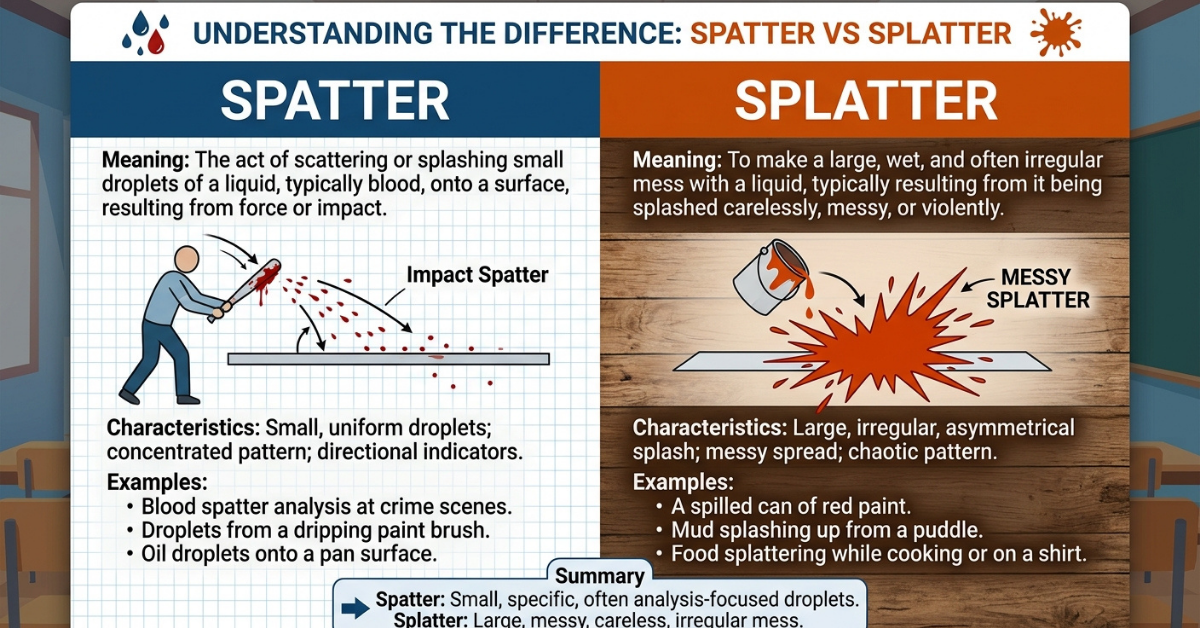
At first glance, spatter vs splatter seems like a case of two words that mean exactly the same thing. Both describe small drops or scattered material, and in everyday conversation, people often use them interchangeably. But look a little closer and the distinction becomes more interesting.
The difference usually comes down to how the material is scattered and the context in which the word is being used. “Spatter” is often preferred when referring to droplets scattered by an impact, spray, or similar force, while “splatter” tends to suggest material scattered messily or forcefully in several directions.
This distinction becomes especially useful in fields such as forensics, welding, painting, cooking, and manufacturing. So, let’s break down spatter vs splatter meaning, examine their definitions, and see when each word makes the most sense.
Spatter vs Splatter Meaning
The simplest way to understand the difference is to think about droplets versus messy scattering.
What does “spatter” mean?
Spatter generally refers to small drops or particles of a liquid or semi-liquid substance that are scattered onto a surface or into the surrounding area.
For example:
- Water can spatter when a stone hits a puddle.
- Paint may spatter during spraying.
- Grease can spatter while cooking.
- Molten metal can produce spatter during welding.
As a verb, spatter means to scatter small drops or particles.
Example:
“Rainwater spattered across the window.”
As a noun, spatter can refer to the drops or marks themselves.
What does “splatter” mean?
Splatter also means to scatter liquid or semi-liquid material, but it often carries a stronger sense of messy, irregular, or forceful scattering.
For example:
- Mud may splatter onto someone’s clothes.
- Sauce can splatter around a kitchen while cooking.
- Paint can splatter across a wall.
- A puddle can splatter when a car drives through it.
The word splatter often creates a more vivid mental picture of something spreading messily in multiple directions.
Spatter vs Splatter Definition: Is There a Technical Difference?
There isn’t always a strict dictionary boundary between the two words. In many contexts, spatter and splatter overlap significantly, and native speakers may choose one simply because it sounds more natural in a particular situation.
A useful general distinction is:
| Term | Common sense | Typical impression |
| Spatter | Small drops scattered by an external force | More precise or technical |
| Splatter | Liquid or material scattered messily | More vivid or informal |
| Splash | A larger amount of liquid displaced or thrown | Usually larger movement of liquid |
However, context matters more than the spelling. You shouldn’t assume that every use of “spatter” is technical or that every use of “splatter” describes a large mess.
Blood Spatter vs Splatter
One of the most searched distinctions is blood spatter vs splatter, particularly because of the terminology used in forensic science.
In forensic contexts, bloodstain pattern analysis is the more formal field-specific terminology. The word spatter has traditionally been used to describe blood droplets distributed through the air and deposited on surfaces.
“Blood splatter” is common in everyday speech, movies, television, and popular media, but blood spatter is generally the more established forensic expression.
Why do forensics use “blood spatter”?
Forensic investigators may examine the size, shape, distribution, and location of bloodstains as part of a broader bloodstain pattern analysis.
Depending on the circumstances, analysts may consider factors such as:
- The shape of individual stains
- The distribution of stains
- The direction of travel
- The location of stains
- The surface receiving the blood
- The mechanism that produced the pattern
Importantly, bloodstain patterns should not be interpreted from one characteristic alone. A stain’s appearance can be influenced by many variables, including the surface, fluid properties, angle of impact, and environmental conditions.
Blood spatter vs splatter in everyday language
If you’re simply describing blood scattered over a surface, “blood splatter” isn’t inherently incomprehensible or wrong in ordinary English. It is widely understood.
But if you’re writing about forensic science, academic research, or professional terminology, “blood spatter” or “bloodstain pattern” is generally the safer choice, depending on what you’re describing.
Spatter vs Splatter Forensics
When comparing spatter vs splatter forensics, context is particularly important.
Forensic science uses specialized terminology because investigators need to communicate observations accurately. The broader discipline is commonly referred to as bloodstain pattern analysis, rather than simply “blood splatter analysis.”
A forensic report might distinguish between:
- Individual bloodstains.
- Groups or patterns of bloodstains.
- The mechanisms that may have produced those patterns.
- Other physical evidence surrounding the stains.
The important point is that the words spatter and splatter aren’t interchangeable in every technical situation. Professional terminology should be based on the discipline’s established vocabulary rather than assumptions about what sounds more descriptive.
Weld Spatter vs Splatter
The distinction appears outside forensics too. A good example is weld spatter vs splatter.
In welding, weld spatter is the standard technical expression. It refers to small droplets of molten metal that are expelled from the welding arc or weld pool and land outside the intended weld area.
Weld spatter can result in unwanted deposits on:
- The workpiece
- Nearby equipment
- Welding fixtures
- Protective surfaces
- The surrounding work area
Factors such as welding parameters, electrode or wire type, shielding gas, material, and technique can influence spatter.
Why “weld spatter” is preferred
Although someone might casually say “weld splatter,” weld spatter is the established technical term in welding.
This is a good example of why the difference between words isn’t always about a strict dictionary definition. Industry terminology matters.
Spatter vs Splatter vs Splash
Another useful comparison is spatter vs splatter vs splash.
These three words can overlap, but they create slightly different images.
Spatter
Usually suggests small drops or particles scattered over an area.
Example:
“Oil spattered onto the stovetop.”
Splatter
Often suggests messy or irregular scattering, sometimes with more force.
Example:
“Mud splattered across the car.”
Splash
Usually suggests a larger movement or displacement of liquid.
Example:
“The child jumped into the pool and made a huge splash.”
A simple way to remember the difference is:
Spatter = small scattered drops
Splatter = messy scattered material
Splash = larger movement of liquid
These aren’t absolute rules, but they are useful when choosing the most natural word.
Why Do Spatter and Splatter Sound So Similar?
There is a reason these words are easy to confuse: they belong to a group of English words associated with sounds, movement, and scattered material.
Words such as splash, splatter, spatter, and spray can describe actions that involve liquids or small particles moving through space.
The extra “l” in splatter doesn’t create a completely different concept. Instead, the words developed with overlapping meanings, which explains why dictionaries and everyday usage sometimes treat them as close synonyms.
Spatter vs Splatter Examples
Here are some everyday examples to make the distinction easier.
Example 1: Cooking
Spatter:
“Hot oil spattered my hand.”
Splatter:
“The tomato sauce splattered all over the stove.”
Both work, but splatter emphasizes the messy result.
Example 2: Painting
Spatter:
“The artist used a brush to spatter paint onto the canvas.”
Splatter:
“Paint splattered across the floor.”
Again, both words can describe scattered paint, but the emphasis changes slightly.
Example 3: Water
Spatter:
“Water spattered against the windshield.”
Splash:
“The car drove through the puddle with a loud splash.”
The first describes scattered droplets; the second describes a larger displacement of water.
Example 4: Welding
Spatter:
“The welder reduced weld spatter by adjusting the welding parameters.”
Splatter:
This may be understood, but it is not the preferred technical term in welding.
When Should You Use Spatter Instead of Splatter?
Choose spatter when:
- You’re discussing a technical process.
- You’re describing small droplets.
- You’re writing about welding.
- You’re discussing forensic bloodstain terminology.
- You want to emphasize scattered droplets rather than a general mess.
Choose splatter when:
- You’re writing conversationally.
- You’re emphasizing a messy result.
- You’re describing food, mud, paint, or similar substances.
- You want the description to sound more vivid.
Neither choice is universally correct. The surrounding context determines the best word.
Is “Spatter” More Formal Than “Splatter”?
Not necessarily, but spatter is often more common in technical terminology.
For example, professionals commonly use phrases such as:
- Blood spatter
- Weld spatter
- Spray spatter
- Spatter marks
Meanwhile, splatter is especially common in informal descriptions and popular culture.
That doesn’t mean splatter is an incorrect word. It simply tends to have a stronger association with messy, uncontrolled scattering.
Common Mistakes When Using Spatter and Splatter
Here are a few mistakes worth avoiding.
1. Assuming they are always completely different
They aren’t. Their meanings overlap considerably.
2. Assuming “splatter” is always incorrect
It’s perfectly legitimate English. The issue is whether it is the most appropriate term for your context.
3. Using casual language in technical writing
If you’re writing a forensic or welding report, use the terminology normally recognized in that field.
4. Treating “splash” as exactly the same
A splash generally involves a larger displacement of liquid, while spatter usually emphasizes smaller droplets.
How to Remember Spatter vs Splatter
If you keep mixing them up, use this quick memory trick:
Spatter → small droplets
Splatter → scattered mess
Splash → bigger movement of liquid
Think of a few drops of oil hitting your stovetop: that’s spatter.
Think of sauce covering the surrounding counter: that’s splatter.
Think of someone jumping into a swimming pool: that’s a splash.
It’s not a strict scientific rule, but it makes the everyday distinction much easier to remember.
Frequently Asked Questions
Is spatter and splatter the same thing?
Not exactly, but their meanings overlap. Both can describe liquid or semi-liquid material being scattered. Spatter often emphasizes small droplets, while splatter commonly emphasizes messy or irregular scattering.
Which is correct: blood spatter or blood splatter?
Both phrases are understandable in ordinary English, but blood spatter is the more established term in forensic contexts. The broader professional field is commonly called bloodstain pattern analysis.
What is the difference between spatter and splatter in forensics?
In forensic contexts, spatter is the more established term for scattered blood droplets, while splatter is more common in informal or popular descriptions. For professional writing, terminology should follow accepted forensic usage.
Is it weld spatter or weld splatter?
Weld spatter is the standard technical term used in welding. It refers to molten metal droplets expelled during welding and deposited outside the intended weld area.
What is the difference between spatter, splatter, and splash?
Spatter generally refers to small scattered drops, splatter often suggests messy or irregular scattering, and splash usually refers to a larger displacement or movement of liquid.
Is “splatter” a real word?
Yes. Splatter is a standard English word. It can function as both a noun and a verb and is commonly used for liquids or other substances scattered in an irregular way.
Is “spatter” more formal than “splatter”?
Not automatically. However, spatter appears frequently in specialized terminology, including blood spatter and weld spatter, which can make it seem more technical.
Conclusion
So, what’s the real difference in spatter vs splatter? The answer isn’t simply that one is correct and the other is wrong.
Spatter generally works well when you’re talking about small droplets or established technical terminology, while splatter often paints a picture of something being scattered messily or irregularly. Splash, meanwhile, usually describes a larger displacement of liquid.
The most important takeaway is to consider context. Say blood spatter or weld spatter when following established technical terminology, while splatter is perfectly natural when describing a messy everyday situation.
Once you understand the subtle difference, choosing between these easily confused words becomes much simpler. If you’re interested in other commonly confused English words, exploring related language and usage guides can be a great next step.





