
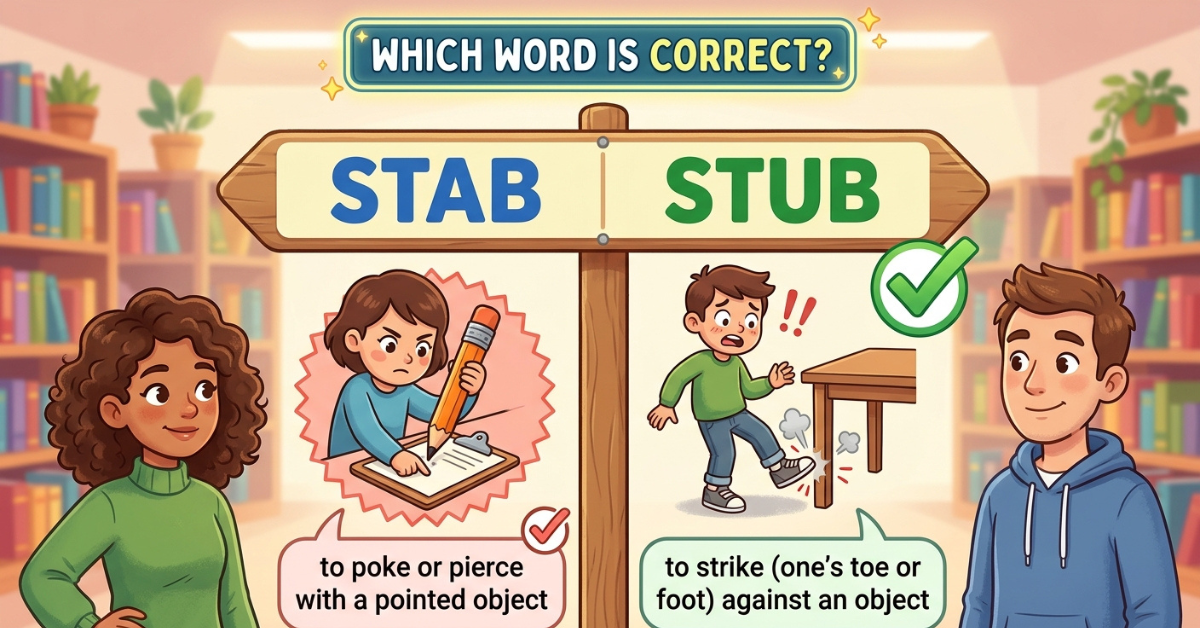
Have you ever stopped while writing and wondered whether you should use stab or stub? These two words may sound somewhat similar in certain accents, but they have completely different meanings.
Knowing when to use stab and when to use stub can help you avoid common spelling and vocabulary mistakes. This is especially useful when people search for phrases such as stab or stub paper, food stab or stub, or meal stab or stub.
In simple terms, stab usually refers to piercing something with a pointed object, while stub has several meanings, including hitting your toe, putting out a cigarette, or referring to a short remaining piece of something.
Let’s break down the difference in an easy way.
What Does “Stab” Mean?
The word stab is generally used when someone or something is pierced with a sharp or pointed object.
For example:
- He accidentally stabbed himself with a fork.
- She used a knife to stab the cardboard.
- The character was stabbed in the movie.
- He felt a sharp stabbing pain in his side.
The word can be used as both a verb and a noun.
Stab as a Verb
As a verb, stab means to push a sharp object into something.
Example:
She stabbed the potato with a fork.
Stab as a Noun
As a noun, it refers to the act of stabbing or an attempt to do something.
Examples:
- He made a quick stab at solving the problem.
- The detective investigated the stabbing.
The phrase “take a stab at something” also has a figurative meaning. It means to make an attempt.
Example:
I don’t know the answer, but I’ll take a stab at it.
What Does “Stub” Mean?
The word stub has several different meanings depending on the situation. Unlike stab, it does not normally mean piercing something with a sharp object.
Here are some of the most common meanings.
1. To Stub Your Toe
One of the most common uses is stub your toe.
This happens when you accidentally hit your toe against something hard.
Example:
I stubbed my toe on the edge of the table.
You would not say you “stabbed your toe” unless something sharp actually pierced it.
2. A Stub as a Short Remaining Piece
A stub can also refer to a small piece that remains after most of something has been used or removed.
Examples include:
- A cigarette stub
- A pencil stub
- A ticket stub
Example:
Keep your ticket stub until the event is over.
3. To Stub Out a Cigarette
The phrase stub out means to extinguish a cigarette by pressing the burning end against a surface.
Example:
He stubbed out his cigarette in the ashtray.
Again, stab would be incorrect in this context.
Stab or Stub Paper: Which One Is Correct?
The phrase stab or stub paper can be confusing because the correct word depends on what you are trying to describe.
If you are talking about piercing paper with a sharp object, use stab.
Correct examples:
- Don’t stab the paper with the scissors.
- He stabbed a hole in the paper using a sharp tool.
However, if you are talking about a small remaining piece of paper, a receipt, or part of a document, stub may be the correct word.
Examples:
- Keep the ticket stub.
- The receipt stub contains the transaction details.
Quick Rule for Paper
- Stab paper = pierce paper with something sharp.
- Stub paper = usually refers to a remaining portion or attached part of a document.
So, when deciding between stab or stub paper, think about whether something is being pierced or whether you are describing a remaining piece.
Food Stab or Stub: Which Word Should You Use?
When discussing food, the correct word is usually stab, particularly when you are using a fork or another pointed utensil.
For example:
- Stab the piece of meat with your fork.
- He stabbed the potato to check whether it was cooked.
- Use a fork to stab the food before lifting it.
The word stub generally does not make sense when describing the action of picking up or piercing food.
Example:
Incorrect: He stubbed the chicken with a fork.
Correct: He stabbed the chicken with a fork.
However, native speakers may more naturally say “pierce the food with a fork” rather than “stab the food,” depending on the situation.
Meal Stab or Stub: Understanding the Correct Context
The phrase meal stab or stub is not a common standard English expression. If you encounter this phrase, the intended meaning usually depends on context.
For example, if someone is talking about using a fork during a meal, stab would make more sense.
Example:
She stabbed the vegetables with her fork.
On the other hand, stub does not normally relate to eating or preparing a meal.
If the phrase appears in a menu, app, document, or informal conversation, it may be:
- A spelling mistake
- A typo
- A brand-specific term
- An incorrectly written phrase
This is why context is important when choosing between stab or stub.
Stab vs. Stub: The Main Differences
Here is a simple comparison to remember the difference:
| Word | Main Meaning | Example |
| Stab | Pierce with a sharp object | She stabbed the food with a fork. |
| Stub | Hit something bluntly or leave a short piece | I stubbed my toe. |
| Stub | A small remaining piece | Keep the ticket stub. |
| Stub out | Extinguish a cigarette | He stubbed out the cigarette. |
The easiest way to remember it is:
Sharp and piercing = Stab
Short piece or accidental blunt hit = Stub
Common Mistakes People Make With Stab and Stub
Because these words can be confused in writing, here are some common mistakes to avoid.
Mistake 1: Saying “Stub the Food”
If you mean piercing food with a fork, stab is the better word.
Incorrect: Stub the food with your fork.
Correct: Stab the food with your fork.
Mistake 2: Saying “Stab Your Toe”
When you accidentally hit your toe against furniture, use stub.
Incorrect: I stabbed my toe on the chair.
Correct: I stubbed my toe on the chair.
Mistake 3: Confusing Ticket Stub With Stab
A small portion of a ticket is called a ticket stub, not a ticket stab.
Incorrect: Keep your ticket stab.
Correct: Keep your ticket stub.
Easy Trick to Remember Stab or Stub
A simple memory trick can make this much easier.
Think of the Letter “A” in Stab
You can associate stab with:
- A sharp object
- A knife
- A fork
- A pointed tool
These things are used to pierce something.
Think of “Stub” as Something Short
A stub is often a short piece left behind, such as:
- A ticket stub
- A pencil stub
- A cigarette stub
You can also remember the common phrase “stub your toe.”
When Should You Use “Pierce” Instead?
Sometimes, neither stab nor stub is the best choice.
The word pierce can sound more neutral and less dramatic.
For example:
- Pierce the potato with a fork.
- Pierce the paper carefully.
- Pierce the dough with a fork before baking.
In cooking instructions, pierce is often more natural than stab.
For example:
More natural: Pierce the potato several times with a fork.
Less natural but understandable: Stab the potato several times with a fork.
So, while stab can technically describe piercing food, the best word depends on the tone and context.
Why Context Matters When Choosing Stab or Stub
English contains many words that look or sound similar but have completely different meanings. Stab and stub are a good example.
Before choosing one, ask yourself:
- Is something being pierced with a sharp object?
- Is someone accidentally hitting their toe?
- Am I describing a short remaining piece?
- Is the object related to a ticket, receipt, or cigarette?
- Would the word pierce sound more natural?
Answering these questions usually makes the correct choice obvious.
FAQs About Stab or Stub
Is it stab or stub?
It depends on the meaning. Use stab when something is pierced with a sharp object. Use stub when referring to hitting your toe, a short remaining piece, or extinguishing a cigarette.
Is it correct to say “stab the food”?
Yes, if you mean piercing food with a fork or another pointed object. However, pierce the food may sound more natural in cooking instructions.
What does “stub your toe” mean?
It means accidentally hitting your toe against something hard, such as furniture, a wall, or the edge of a bed.
Is it stab or stub paper?
Use stab when talking about piercing paper with something sharp. Use stub when referring to a small remaining section, such as a ticket or receipt stub.
What is a paper stub?
A paper stub is usually a small portion of a document that remains after another part has been removed. Common examples include ticket stubs and receipt stubs.
What does food stab or stub mean?
When talking about piercing food with a fork, stab is the correct word. Stub is generally not used for this action.
What does meal stab or stub mean?
Meal stab or stub is not a standard English phrase. If the context involves piercing food during a meal, stab is likely the intended word.
Final Thoughts: Stab or Stub?
Understanding stab or stub is easier once you know the basic difference between the two words.
Use stab when talking about piercing something with a sharp object, such as a knife or fork. Use stub when referring to accidentally hitting your toe, a short remaining piece, or putting out a cigarette.
When dealing with phrases like stab or stub paper, food stab or stub, or meal stab or stub, always look at the context. In many cases, the intended meaning will immediately tell you which word is correct.
The next time you are unsure, remember this simple rule: sharp and piercing usually means stab, while a short remaining piece or a bumped toe means stub. For more helpful English word comparisons, explore related grammar and vocabulary guides to improve your everyday writing and communication.





