
Have you ever typed “shakey” and paused because something about it looked wrong? You’re not alone. The confusion over shaky or shakey is surprisingly common, especially because English words ending in the long “-ee” sound are not always spelled the way they sound.
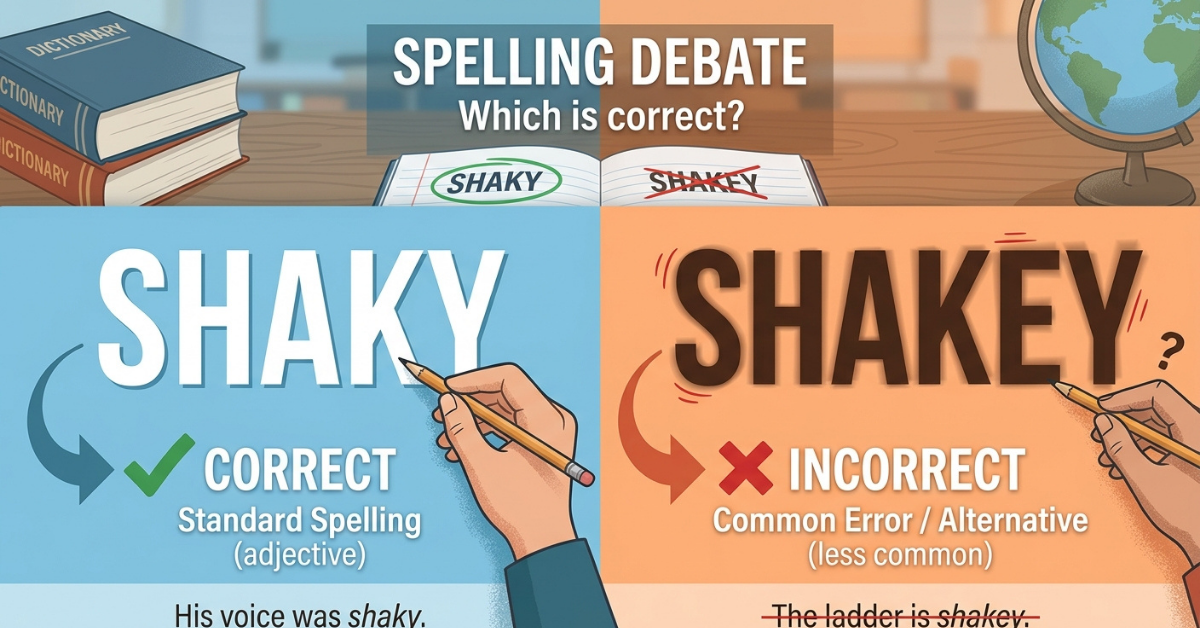
So, is it shaky or shakey? The correct spelling is shaky. “Shakey” is generally considered a misspelling when you mean the adjective describing something that shakes, trembles, or is unsteady.
In this guide, we’ll look at the correct shaky or shakey spelling, its meaning, examples, UK usage, and a few simple ways to remember it.
Shaky or Shakey: Which Is Correct?
The correct spelling is shaky.
- Shaky — correct
- Shakey — incorrect in standard English when used to mean trembling or unsteady
For example:
“My hands were shaky after the long workout.”
Here, shaky describes hands that are trembling or unsteady.
The word shakey may occasionally appear as a name, nickname, informal spelling, or typo, but it isn’t the standard spelling of the adjective.
Is It Shaky or Shakey?
If you’re wondering “is it shaky or shakey?”, choose shaky.
The word is formed from shake + -y, giving us shaky. Although “shake” ends with an “e,” that final e is dropped before adding the -y suffix.
Compare:
- shake → shaky
- mistake → mistakey
- smoke → smoky
- ice → icy
- noise → noisy
This pattern helps explain why shakey isn’t the standard spelling.
How Do You Spell Shaky or Shakey?
If you’re asking “how do you spell shaky or shakey?”, spell it:
S-H-A-K-Y
The correct word is shaky, with no e between the k and y.
Is It Spelled Shaky or Shakey?
Yes, the standard spelling is shaky.
Shakey is usually a spelling error caused by writing the word as it sounds. Because “shaky” is pronounced roughly like “shay-kee,” it can be tempting to add an extra e.
A useful trick is to remember:
shake → shaky
The e disappears when -y is added.
Shaky or Shakey Meaning
The word shaky has several related meanings depending on context.
1. Trembling or Unsteady
The most common meaning is something that physically shakes or trembles.
For example:
- “She had shaky hands.”
- “His voice sounded shaky.”
- “The old chair felt shaky.”
2. Not Firm or Stable
Shaky can also describe something that isn’t physically stable or secure.
For example:
“The table has a shaky leg.”
This means the table isn’t completely steady.
3. Uncertain or Unreliable
The word can also be used figuratively when something isn’t dependable or convincing.
For example:
“The company is in a shaky financial position.”
Here, shaky doesn’t mean physically trembling. It means unstable or uncertain.
4. Weak or Unconvincing
You can also describe an argument, explanation, or piece of knowledge as shaky.
For example:
“His explanation was a little shaky.”
In this case, the explanation isn’t particularly convincing or well-supported.
Shaky or Shakey UK: Is the Spelling Different?
If you’re searching for “shaky or shakey UK,” the answer is the same: shaky is the standard spelling in British English.
There is no standard British spelling “shakey” for the adjective.
For example, a British English speaker would write:
“The bridge looked shaky.”
Not:
“The bridge looked shakey.”
The spelling shaky is used in both British and American English.
Why Do People Spell It “Shakey”?
The confusion mostly comes from pronunciation.
When spoken aloud, shaky sounds like it could be written “shakey.” English has many words where pronunciation doesn’t provide an obvious guide to spelling.
People may also associate the spelling with other words ending in -ey, such as:
- grey
- money
- honey
- journey
However, shaky follows the spelling pattern of shake + y, rather than using -ey.
Another reason you may encounter “Shakey” is that it can be used as a proper name or nickname. That doesn’t make it the standard spelling of the adjective.
Shaky in a Sentence: Examples
Seeing the word in context makes the spelling easier to remember.
Here are some examples:
- My hands felt shaky after carrying the heavy boxes.
- The ladder looked shaky, so I decided not to climb it.
- She gave a shaky explanation for what happened.
- His voice was shaky when he started speaking.
- The team’s position in the competition is looking shaky.
- I felt shaky after standing up too quickly.
Notice that shaky can describe physical movement, stability, confidence, or certainty.
Shaky vs. Similar Words
Understanding related words can also make the meaning clearer.
| Word | Meaning |
| Shaky | Trembling, unstable, uncertain, or unreliable |
| Unsteady | Not firmly balanced or stable |
| Trembling | Shaking slightly, often from fear, cold, or emotion |
| Wobbly | Moving from side to side or lacking stability |
| Uncertain | Not definite, confident, or reliable |
| Weak | Lacking strength or effectiveness |
For example, a person’s hands might be shaky, while a chair might be wobbly. The words overlap, but they’re not always interchangeable.
A Simple Way to Remember the Shaky Spelling
Still wondering “is it shaky or shakey?” Try this simple rule:
Think of the base word: SHAKE
Start with:
SHAKE
Add -Y:
SHAK + Y = SHAKY
The final e is removed.
You can use the same idea with other words:
- smoke → smoky
- ice → icy
- noise → noisy
- taste → tasty
So when you’re unsure how to spell shaky, remember:
SHAKE → SHAKY
Not:
SHAKE → SHAKEY
Common Mistakes With Shaky
Here are a few mistakes worth avoiding:
Shakey
This is the most common spelling error.
Shakey hands
Write:
Correct: Shaky hands
Incorrect: A shakey voice
Write:
Correct: A shaky voice
Incorrect: The building looks shakey
Write:
The building looks shaky
If you’re writing for school, work, a website, or professional communication, shaky is the spelling to use.
Is “Shakey” Ever Correct?
There are situations where Shakey may appear intentionally, particularly as a name, nickname, or stylized term.
For example, someone might have a nickname spelled “Shakey.” In that specific case, the spelling is part of the name.
However, if you’re describing something as trembling, unstable, or uncertain, the standard English adjective is shaky.
Frequently Asked Questions
Is it shaky or shakey?
Shaky is the correct standard spelling. Shakey is generally a misspelling when referring to something that is trembling, unstable, or uncertain.
How do you spell shaky or shakey?
The correct spelling is shaky: S-H-A-K-Y.
Is it spelled shaky or shakey?
It is spelled shaky when you’re using the standard English adjective.
What does shaky mean?
Shaky can mean trembling or unsteady. It can also mean unstable, uncertain, unreliable, or unconvincing depending on the context.
Is “shakey” a word?
“Shakey” can appear as a name, nickname, or intentional spelling, but it isn’t the standard spelling of the adjective shaky.
Is the spelling shaky or shakey in the UK?
In British English, the standard spelling is shaky. The same spelling is used in American English.
Why is shaky spelled without an e?
Shaky comes from shake + -y. When the suffix -y is added, the final e in “shake” is dropped, producing shaky.
Can shaky describe a person?
Yes. It can describe someone’s physical movements, hands, voice, or condition. It can also describe someone’s confidence or an uncertain situation.
For example:
“His voice was shaky during the presentation.”
Final Answer: Shaky or Shakey?
So, is it shaky or shakey? The answer is straightforward: shaky is the correct standard spelling.
Remember the simple connection:
SHAKE → SHAKY
Whether you’re describing shaky hands, a shaky voice, a shaky table, or a shaky argument, use shaky without the extra “e.”
If you’re interested in improving your English spelling, exploring other commonly confused words can be a great next step. Small spelling differences can make a big difference in clear, professional writing.





