
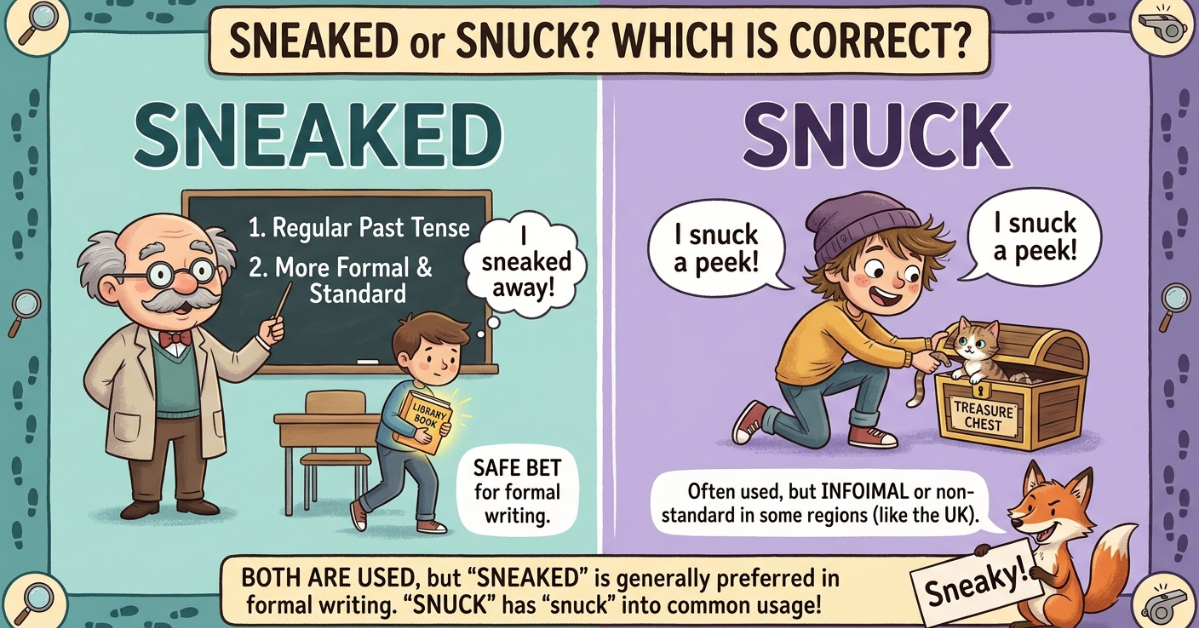
If you have ever written a sentence like “I ___ out of the room,” you may have paused over sneaked or snuck. Both forms sound familiar, but which one is actually correct?
The short answer is: both “sneaked” and “snuck” are accepted past-tense forms of “sneak.” However, they are not used in exactly the same way everywhere. Sneaked is the traditional regular form, while snuck is especially common in North American English and is now recognized as standard by major dictionaries.
So, if you have wondered “is it sneaked or snuck?”, the answer depends partly on your audience, region, and level of formality.
Sneaked or Snuck: Which Is Correct?
Both sneaked and snuck can be grammatically correct.
The verb sneak means to move, go, or do something secretly or quietly, usually to avoid being noticed. For example:
- I sneaked out of the house.
- I snuck out of the house.
Neither sentence is grammatically wrong.
According to Merriam-Webster, sneaked is the original past-tense form, while snuck developed later in American English and is now considered a standard form.
Oxford takes a slightly more conservative approach: it lists sneaked as the usual past form while noting that snuck is very common in informal North American English.
Quick answer
In other words, sneaked or snuck—which is correct? Both.
What Is the Past Tense of Sneak
| Form | Correct? | Common usage |
| sneaked | Yes | Traditional, formal, and general English |
| snuck | Yes | Especially common in US/Canadian English |
| sneaking | Yes | Present participle/gerund |
| sneak | Yes | Present/base form |
: Sneaked or Snuck?
The past tense of sneak can be sneaked or snuck.
This is somewhat unusual because sneak originally behaved like a regular verb:
sneak → sneaked
Over time, snuck developed as an alternative past-tense form. Merriam-Webster notes that snuck began appearing in American English in the late 1800s and has since become very common.
So you can say:
- She sneaked into the kitchen.
- She snuck into the kitchen.
- They sneaked out after midnight.
- They snuck out after midnight.
The meaning remains essentially the same.
Is “Sneaked” Grammatically Correct?
Yes. Sneaked is completely grammatically correct.
In fact, it is the original and traditional past-tense form of sneak. Oxford lists sneaked as the usual past form in its general learner’s dictionary.
For example:
- He sneaked into the room.
- We sneaked a quick look at the answers.
- She sneaked out through the back door.
- I sneaked downstairs so nobody would hear me.
There is no grammatical error in any of these sentences.
If you prefer a more traditional or conservative style, sneaked is a safe choice.
Is “Snuck” Grammatically Correct?
Yes, snuck is also grammatically correct.
Although some speakers still consider snuck informal or less traditional, major dictionaries recognize it as a legitimate past-tense and past-participle form of sneak. Merriam-Webster describes it as a standard form, while Oxford notes its widespread use in informal North American English.
For example:
- He snuck out before anyone noticed.
- I snuck into the kitchen for a snack.
- She snuck a quick look at her phone.
- They snuck away before the meeting ended.
So, if someone tells you that snuck is always wrong, that claim is too strong.
Sneaked or Snuck in American English
In American English, snuck is extremely common.
Merriam-Webster explains that the form emerged in American English in the late 19th century and has become a standard form.
You will commonly hear sentences such as:
- I snuck out of the house.
- He snuck behind the curtain.
- She snuck into the party.
- We snuck a few cookies before dinner.
That does not mean Americans never use sneaked. They do. Both forms are understood and accepted.
Sneaked or snuck USA usage
If your question is specifically “sneaked or snuck USA?”, snuck is generally the more characteristic choice in American English, particularly in everyday conversation.
However, sneaked is not incorrect in American English. The choice can come down to personal preference and style.
Sneaked or Snuck in British English
British English has traditionally been more comfortable with sneaked.
Oxford notes that snuck is now very common in informal North American English and that some British English speakers use it as well. However, some speakers still regard it as informal or nonstandard in formal writing.
Therefore, if you are writing for a British audience and want the most conservative option, sneaked is usually the better choice.
For example:
She sneaked out of the office before anyone noticed.
That sounds perfectly natural in formal British English.
Sneaked or Snuck in a Sentence
Seeing both forms in context makes the difference easier to understand.
Examples with “sneaked”
- I sneaked out of the room quietly.
- She sneaked into the house through the back door.
- He sneaked a cookie from the kitchen.
- We sneaked away before the guests arrived.
- They sneaked a look at the answer sheet.
Examples with “snuck”
- I snuck out of the room quietly.
- She snuck into the house through the back door.
- He snuck a cookie from the kitchen.
- We snuck away before the guests arrived.
- They snuck a look at the answer sheet.
Notice something important: the meaning does not change. The difference is primarily one of usage, variety of English, and style.
“He Sneaked or Snuck”: Which One Should You Use?
Both are possible:
- He sneaked out before dinner.
- He snuck out before dinner.
If you are writing casual American English, he snuck out will sound very natural.
If you are writing formal English, especially for an audience that prefers traditional usage, he sneaked out may be the safer choice.
The same principle applies to other subjects:
- I sneaked/snuck out.
- You sneaked/snuck out.
- She sneaked/snuck out.
- We sneaked/snuck out.
- They sneaked/snuck out.
Is It Correct to Say “Sneaked or Snuck Out”?
Yes. Both sneaked out and snuck out are correct.
The expression sneak out means to leave quietly or secretly without being noticed.
For example:
I sneaked out of the house after everyone went to sleep.
Or:
I snuck out of the house after everyone went to sleep.
Oxford itself gives examples using sneaked out, while Merriam-Webster’s dictionary records snuck out as a normal usage.
Other common forms
You may also encounter:
- sneak into — enter secretly
- sneak away — leave quietly
- sneak up on — approach someone without being noticed
- sneak around — move or act secretly
- sneak something in — bring something somewhere secretly
For example:
The children snuck into the kitchen.
She sneaked away before anyone noticed.
“I Sneaked or Snuck”: Which Is Better?
Both are correct:
I sneaked into the room.
I snuck into the room.
If you’re speaking American English, I snuck may sound more natural in everyday conversation.
If you’re writing formal content or want to avoid objections from readers who prefer traditional English, I sneaked is a good option.
The choice does not affect the basic meaning.
Sneaked or Snuck: What Does Oxford Say?
The Oxford Advanced Learner’s Dictionary gives a particularly useful answer to the sneaked or snuck Oxford question.
Oxford lists sneaked as the usual past form but also recognizes snuck, describing it as very common in informal North American English. Its American dictionary also lists snuck as the past tense and past participle of sneak.
This is a good example of how dictionaries can distinguish between what is traditionally preferred and what people actually use.
Language changes through usage, and snuck has become established enough to receive dictionary recognition.
Sneaked or Snuck: What About Formal Writing?
If you are writing something formal, consider your audience.
Use “sneaked” when:
- You want a traditional form.
- You are writing formal British English.
- Your audience may dislike snuck.
- You want to avoid a potentially controversial usage choice.
Use “snuck” when:
- You are writing conversational American English.
- You are reproducing natural dialogue.
- Your audience commonly uses North American English.
- You want the sentence to sound casual and contemporary.
Neither form automatically makes a piece of writing good or bad. Context matters more than a simple “right versus wrong” rule.
Sneaked or Snuck: AP Style
People also search for “sneaked or snuck AP style” when deciding which form to use in professional writing.
The safest approach is to consider your publication’s house style and audience. If you are writing for a news organization or professional publication that has a specific style guide, follow that guide consistently.
More generally, sneaked is a conservative choice when you want to avoid controversy, while snuck is well established in American English.
The important point is not to assume that snuck is automatically grammatically wrong. Major dictionaries now recognize it as a standard form.
Why Does “Snuck” Exist?
This is one of the more interesting things about English grammar.
Normally, a verb ending in a consonant does not simply change its vowel to create an irregular past tense. For example, English has forms such as:
- sing → sang
- drink → drank
- swim → swam
But sneak originally followed the regular pattern:
sneak → sneaked
Then snuck appeared centuries later.
Merriam-Webster notes that the form began appearing in the United States in the late 1800s. Unlike many older irregular verbs, snuck is a relatively modern development.
Its exact origin is not entirely clear, which is part of what makes the history interesting.
Sneaked or Snuck: Common Mistakes to Avoid
Although both forms are correct, there are a few mistakes worth avoiding.
1. Don’t write “sneakded”
The correct forms are:
- sneaked
- snuck
Not sneakded.
2. Don’t use “snucked”
The irregular form is snuck, not snucked.
Incorrect:
She snucked out.
Correct:
She snuck out.
3. Don’t confuse “snuck” with “slunk”
The words snuck and slunk may sound similar, but they come from different verbs.
- sneak → sneaked/snuck
- slink → slunk
For example:
He snuck out of the room.
He slunk away after the argument.
4. Keep the verb tense consistent
If your sentence is in the past tense, use sneaked or snuck appropriately.
Yesterday, she snuck into the office.
Not:
Yesterday, she sneak into the office.
Sneaked vs. Snuck: Simple Rule to Remember
If you want an easy rule, use this:
Sneaked = traditional and universally safe.
Snuck = standard and especially common in North American English.
So when someone asks, “Do you say sneaked or snuck?”, the answer is: either one, depending on your preferred variety and context.
If you are unsure which one to choose in formal writing, sneaked is the more conservative option.
Sneaked or Snuck: Quick Comparison
| Question | Answer |
| Is “sneaked” correct? | Yes |
| Is “snuck” correct? | Yes |
| Is “snuck” grammatically correct? | Yes |
| Which is traditional? | Sneaked |
| Which is especially common in US English? | Snuck |
| Which is safer for formal writing? | Sneaked |
| Is “sneaked out” correct? | Yes |
| Is “snuck out” correct? | Yes |
| Can both be past tense forms? | Yes |
| Does the meaning change? | Generally, no |
FAQs About Sneaked or Snuck
Is it sneaked or snuck?
Both are correct. Sneaked is the traditional regular past tense, while snuck is an established alternative that is particularly common in North American English.
Sneaked or snuck, which is correct in proper English?
Both can be considered proper English. However, sneaked is the more traditional choice, while snuck is now recognized as standard, particularly in American English.
Is “snuck” a real word?
Yes. Snuck is a real word and is listed in major dictionaries as the past tense and past participle of sneak.
Is “sneaked” grammatically correct?
Yes. Sneaked is grammatically correct and is the traditional past-tense form of sneak.
Is “snuck” informal?
It can sound informal in some varieties of English, particularly to speakers who prefer the traditional sneaked. Oxford specifically notes its widespread use in informal North American English.
Is “sneaked” or “snuck” better in American English?
Both are used in American English. Snuck is especially common in everyday American usage, but sneaked remains correct.
Which is correct: “I sneaked” or “I snuck”?
Both are correct:
I sneaked out early.
I snuck out early.
The second is especially natural in American conversational English.
Is “he sneaked out” correct?
Yes. He sneaked out is grammatically correct. You can also say he snuck out.
Is “sneaked out” correct?
Yes. Sneaked out is a standard construction meaning to leave secretly or without being noticed.
Is “snuck out” correct?
Yes. Snuck out is also correct and very common in North American English.
What does Oxford say about sneaked and snuck?
Oxford lists sneaked as the usual past form and recognizes snuck as very common in informal North American English. Its American dictionary lists snuck as a past-tense and past-participle form of sneak.
Conclusion: Sneaked or Snuck?
So, sneaked or snuck—which is correct? The good news is that you don’t have to choose between a correct word and an incorrect one. Both sneaked and snuck are accepted past-tense forms of sneak.
The main difference is usage and style. Sneaked is the older, traditional form and remains a particularly safe choice for formal writing. Snuck is a standard form that is especially widespread in American and Canadian English.
When in doubt, remember:
sneak → sneaked / snuck → sneaking
If you’re writing for a broad or formal audience, sneaked is the conservative choice. If you’re writing natural American English, snuck will usually sound perfectly normal.
Either way, you can confidently say that someone sneaked out or snuck out—English allows both.





