
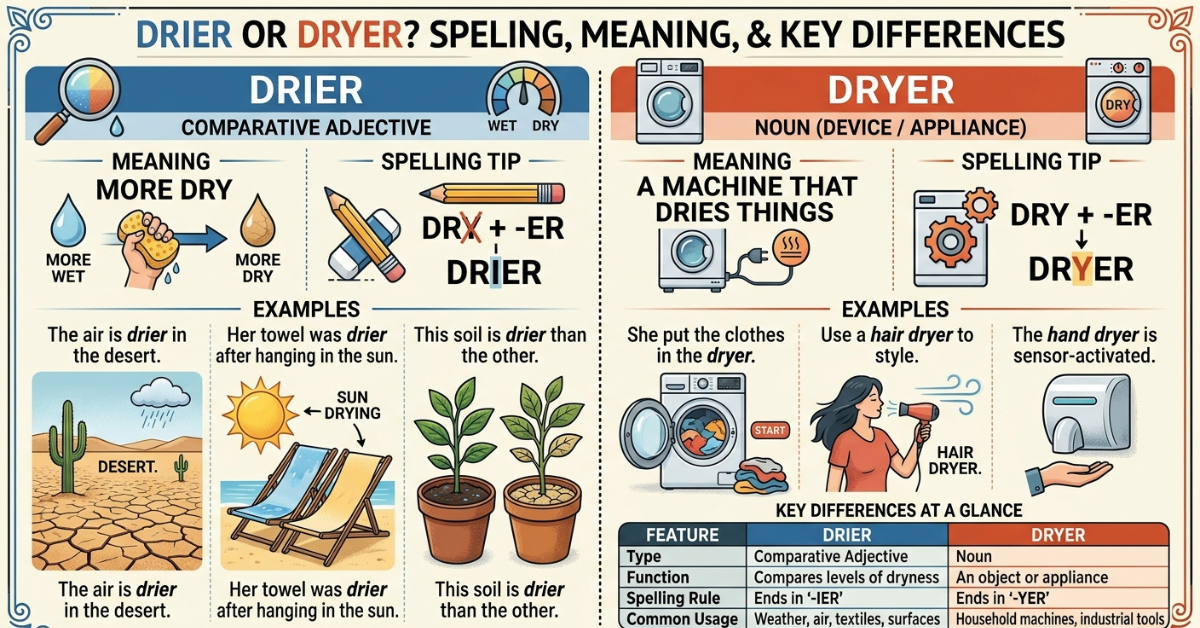
Have you ever paused while writing and wondered, “Is it drier or dryer?” You are definitely not alone. These two words look almost identical, sound very similar, and are both correct—but they have different meanings and uses.
The basic difference is quite simple: drier is generally the comparative form of dry, meaning “more dry,” while dryer is usually a noun for a machine, device, or object that dries something. Once you understand this distinction, choosing the right spelling becomes much easier.
This guide explains when to use each word, with practical examples involving clothes, hair, weather, skin, hand-drying machines, and everyday situations.
Drier or Dryer: The Quick Answer
Here’s the easiest way to remember the difference:
- Drier = more dry
- Dryer = something that dries
For example:
- The desert is drier than the forest.
- Put the clothes in the dryer.
So, when deciding which spelling to use, look at what you are trying to describe. If you’re comparing dryness, drier is usually the right choice. If you’re referring to an appliance or device, choose dryer.
What Does “Drier” Mean?
Drier is normally the comparative form of the adjective dry. It is used when one thing has less moisture than another or has become more dry.
Examples
- This towel is drier than the other one.
- The weather becomes drier during the summer.
- My skin feels drier in winter.
- This region is much drier than the coastal area.
In each example, the word describes a change or comparison in moisture.
Drier Definition
The simplest definition is “more dry” or “less moist.”
For example:
- A drier climate contains less moisture.
- Drier skin has less moisture than before.
- Drier clothes contain less water.
What Does “Dryer” Mean?
Dryer is usually a noun. It describes something designed to remove moisture or make another object dry.
Common examples include:
- Hair dryer
- Clothes dryer
- Hand dryer
- Tumble dryer
- Food dryer
For example:
- I bought a new hair dryer.
- The clothes are in the dryer.
- Use the hand dryer after washing your hands.
In these examples, the word names an object or appliance rather than describing something as “more dry.”
The Difference Explained Simply
The easiest way to understand the distinction is to look at their grammatical roles.
| Word | Common Use | Meaning | Example |
| Drier | Adjective | More dry | The weather is drier today. |
| Dryer | Noun | Something that dries | The hair dryer is broken. |
A simple memory trick
Drier = comparison
Dryer = device
This rule covers most everyday situations and makes the spelling much easier to remember.
Which Spelling Is Used for Clothes?
When talking about a machine used to dry laundry, the standard spelling is dryer.
Correct examples:
- Clothes dryer
- Laundry dryer
- Tumble dryer
For example:
I put my clothes in the dryer.
However, when you’re describing the condition of the clothes, use the comparative adjective:
These clothes are drier than they were before.
So the distinction is:
- Clothes dryer = the appliance
- Drier clothes = clothes containing less moisture
What About a Dryer Machine?
If you mean an appliance that removes moisture, dryer is the usual word. People sometimes say dryer machine, but in natural English, simply saying dryer is usually better.
You might encounter:
- Clothes dryer
- Tumble dryer
- Hair dryer
- Industrial dryer
For example:
I put my clothes in the dryer.
Rather than:
I put my clothes in the drier machine.
The first version sounds much more natural.
Hair Drier or Dryer?
When referring to the appliance used to dry hair, hair dryer is the standard spelling.
Correct:
I need a new hair dryer.
You may occasionally encounter hair drier, but hair dryer is by far the more common form for the appliance.
The same pattern appears with other drying devices:
- Blow dryer
- Hand dryer
- Clothes dryer
Whenever you are naming an appliance designed to perform the drying, dryer is generally the safest choice.
Hand Drier or Dryer?
The usual spelling is hand dryer.
A hand dryer is the electric device commonly found in public bathrooms that blows air onto your hands after washing them.
Example:
The hand dryer wasn’t working in the restroom.
Because the word refers to a device, dryer is appropriate here.
Tumble Drier or Dryer: UK and US English
Regional English can make this topic slightly confusing.
In British English, tumble dryer is a standard term for the appliance used to dry clothes. In American English, clothes dryer or simply dryer is especially common.
Common expressions include:
- Tumble dryer – widely used in British English
- Clothes dryer – especially common in American English
- Dryer – common general term
The important point is that the appliance is normally spelled with -yer in this context.
Which Word Should You Use for Weather?
When describing weather or climate, use drier.
Examples:
- This summer has been drier than last year.
- The northern region is wetter, while the southern region is drier.
- We usually experience drier weather during this season.
Here, the word describes a lower level of moisture, so it functions as a comparative adjective.
Correct:
- Drier weather
- A drier climate
Usually incorrect in this meaning:
- Dryer weather
Remember that dryer in this context would normally suggest an object or appliance rather than a comparison of moisture.
What About Skin?
When talking about skin becoming more dry, drier is generally the appropriate spelling.
Examples:
- My skin feels drier during winter.
- This soap can make your skin drier.
- Her hands are becoming drier because of the cold weather.
For example:
Winter makes my skin drier.
The word describes an increase in dryness, so it functions as a comparative adjective.
Dry, Drier, and Dryer Compared
Looking at all three forms together makes the distinction easier.
Dry
Dry describes something that contains little or no moisture.
The clothes are dry.
Drier
Drier means more dry than something else.
The clothes are drier than before.
Dryer
Dryer generally refers to something that performs the drying.
Put the clothes in the dryer.
Word Meaning Dry Without much moisture Drier More dry Dryer A device or object that dries
Why Do These Words Cause Confusion?
The confusion comes partly from the way English uses the ending -er.
It can create a comparative adjective:
- Tall → taller
- Fast → faster
- Dry → drier
But -er can also form a noun describing someone or something that performs an action:
- Drive → driver
- Bake → baker
- Dry → dryer
Because the two words are pronounced similarly, it is easy to mix them up when writing.
The key is to focus on the meaning and grammatical function rather than pronunciation alone.
How to Choose the Correct Form
Try this simple three-step method.
1. Are you comparing dryness?
If yes, use drier.
This climate is drier than the previous one.
2. Are you naming a machine or device?
If yes, use dryer.
The dryer needs to be repaired.
3. Are you describing something that has less moisture?
In most comparisons, use drier.
My hair is drier after swimming.
This quick test will solve most spelling questions.
Everyday Examples
Here are some practical examples showing how context changes the word.
Weather
The weather is getting drier.
Clothes
Put the clothes in the dryer.
These clothes are drier now.
Hair
I use a hair dryer every morning.
My hair feels drier after swimming.
Skin
My skin becomes drier during winter.
Hands
Use the hand dryer to dry your hands.
Climate
This country has a drier climate.
Dryer and Washing Machine: What’s the Difference?
A washing machine and a dryer perform different jobs.
Washing machine
A washing machine uses water and detergent to clean clothes.
Dryer
A dryer removes moisture from clothes after washing.
Some modern appliances combine both functions and are called:
- Washer-dryer
- Washer-dryer combo
- Washer dryer machine
For example:
We bought a washer-dryer because we don’t have space for two separate appliances.
When you are specifically referring to the drying appliance, dryer is the standard spelling.
What Does “Book a Hotel” Have to Do With It?
You may have encountered searches combining these spelling terms with phrases such as “book a hotel.” This is usually a search-intent issue rather than a special grammar rule.
The correct word still depends on what you’re describing.
For example:
- The hotel room has a hair dryer.
- The hotel provides a clothes dryer.
- The area has drier weather during summer.
The surrounding topic does not change the spelling. Meaning and grammar determine which form is appropriate.
Common Spelling Mistakes
Let’s look at a few errors people frequently make.
Mistake 1: Using “dryer” for weather
Incorrect: The weather is dryer today.
Correct: The weather is drier today.
Mistake 2: Using “drier” for an appliance
Incorrect: Put the clothes in the drier.
Correct: Put the clothes in the dryer.
Mistake 3: Confusing a condition with an object
Incorrect: My clothes are dryer than yesterday.
Correct: My clothes are drier than yesterday.
The second sentence uses the comparative form because the clothes are being compared according to their moisture level.
Drier or Dryer Spelling: The Easy Rule
If you only remember one rule, remember this:
Use “drier” when you mean “more dry,” and use “dryer” when you mean a machine or device that dries something.
Think about these examples:
Drier
- Drier weather
- Drier skin
- Drier hair
- Drier climate
- Drier clothes
Dryer
- Hair dryer
- Clothes dryer
- Hand dryer
- Tumble dryer
- Food dryer
This distinction works in the vast majority of everyday writing.
Can “Drier” Also Be a Noun?
Yes, although this use is much less common in everyday conversation.
In some technical or industrial contexts, drier can refer to a substance or material that helps something dry. The term may appear in areas such as paints, coatings, and manufacturing.
However, when you are talking about a household appliance, dryer is the normal modern spelling.
This is another reason why context matters.
Frequently Asked Questions
Is drier or dryer correct?
Both spellings are correct, but they have different uses. Drier generally means “more dry,” while dryer commonly refers to a device or machine that dries something.
Which spelling is correct for clothes?
Use dryer when referring to the appliance:
Put the clothes in the dryer.
Use drier when describing clothes that have become more dry:
The clothes are drier now.
Is it hair drier or hair dryer?
Hair dryer is the standard spelling for the appliance.
Is it hand drier or hand dryer?
Hand dryer is the standard spelling for the bathroom appliance used to dry hands.
Should I write drier or dryer for weather?
Use drier when describing weather or climate.
The weather is drier this year.
Is “drier skin” correct?
Yes. Drier skin is appropriate when you mean skin that has become more dry or has less moisture.
Is tumble drier or tumble dryer correct?
Tumble dryer is the standard modern spelling for the clothes-drying appliance, particularly in British English.
Why do people confuse these spellings?
Both words are pronounced similarly, and the ending -er has different grammatical functions in English. One form describes a comparison, while the other commonly names a device.
Which one should I use in formal writing?
Focus on the meaning. Use drier for a comparison involving dryness and dryer when referring to a drying device or appliance.
Final Thoughts
The distinction between these two spellings is much easier once you connect each word with its function. Drier generally means “more dry,” while dryer usually identifies something that performs the drying.
So keep these examples in mind:
- Drier weather
- Drier skin
- Drier clothes
- Hair dryer
- Hand dryer
- Clothes dryer
- Tumble dryer
The next time you’re unsure which spelling to choose, ask yourself: Am I describing something as more dry, or am I naming something that dries? That simple question will usually give you the answer.





