
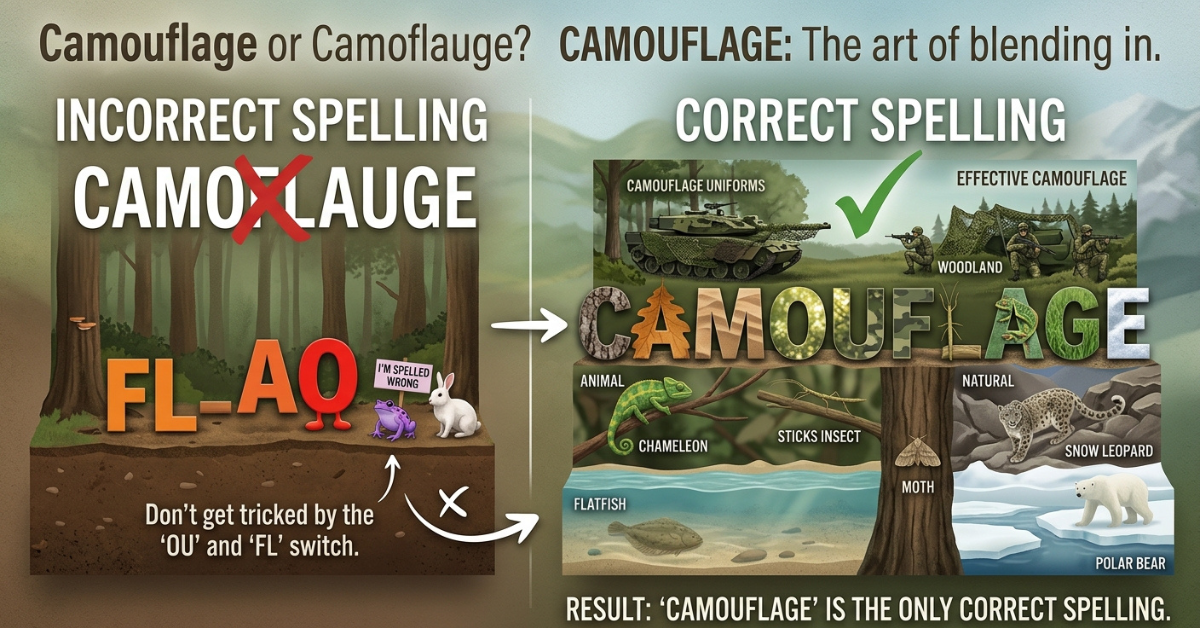
Have you ever stopped while typing and wondered, “Is it camouflage or camoflauge?” You are definitely not alone. This word is commonly misspelled because its pronunciation can make the spelling feel confusing.
The correct spelling is camouflage. Camoflauge is a common misspelling and is not considered correct in standard English dictionaries. In this article, we will explain the meaning of camouflage, why people often spell it incorrectly, how to remember the correct spelling, and how to use it properly in everyday sentences.
Is It Camouflage or Camoflauge?
The correct spelling is:
Camouflage
The incorrect spelling is:
Camoflauge
So, if you are writing an essay, social media post, product description, or professional document, camouflage is always the correct word to use.
Why Do People Spell Camouflage as Camoflauge?
The confusion usually happens because of pronunciation. When people hear the word spoken aloud, they may mentally arrange the letters differently and write camoflauge instead.
English spelling can be tricky because words are not always written exactly the way they sound. In this case, remembering the correct letter order can help:
C-A-M-O-U-F-L-A-G-E
A simple way to remember it is:
Camo + u + flage = camouflage
The word contains “flage” at the end, not “flauge.”
What Does Camouflage Mean?
Camouflage refers to something designed to blend into its surroundings so that it becomes difficult to see or recognize.
It can be used as:
- A noun
- A verb
- A general term for a pattern or disguise
For example, military uniforms may use camouflage patterns to help soldiers blend into forests, deserts, or other environments.
Animals also use natural camouflage to protect themselves from predators or to make hunting easier.
Example:
The chameleon uses camouflage to blend into its surroundings.
In this sentence, camouflage refers to the ability to become less visible by matching the environment.
Camouflage Meaning in Simple Words
In simple terms, camouflage means hiding something by helping it blend in.
Imagine a green insect sitting on a green leaf. Because its color matches the leaf, it may be difficult to notice. That is a form of natural camouflage.
Camouflage can involve:
- Colors
- Patterns
- Shapes
- Textures
- Clothing
- Makeup
- Environmental adaptation
The main purpose is usually to make a person, animal, or object harder to detect.
Common Uses of Camouflage
The word camouflage is used in many different situations. While most people immediately think about military clothing, camouflage exists throughout nature and modern life.
1. Military Camouflage
Military camouflage is one of the most familiar uses of the word.
Soldiers may wear clothing with patterns designed for environments such as:
- Forests
- Deserts
- Snowy areas
- Grasslands
- Urban environments
Different environments require different colors and patterns. A desert camouflage pattern, for example, would not be very effective in a green forest.
2. Animal Camouflage
Nature provides some of the best examples of camouflage.
Many animals have evolved colors and patterns that help them blend into their environments. This can help them avoid predators or approach prey without being noticed.
Examples include:
- Chameleons
- Stick insects
- Arctic animals with white fur
- Leaf insects
- Certain fish and reptiles
Some animals use camouflage mainly for protection, while others use it to become better hunters.
3. Camouflage Fashion
Camouflage is also popular in fashion.
Camouflage-print clothing, often called camo, appears in:
- Jackets
- Pants
- T-shirts
- Shoes
- Bags
- Accessories
In fashion, camouflage is usually worn for its visual style rather than its original purpose of hiding from view.
The term camo is simply an informal shortened version of camouflage.
4. Camouflage in Everyday Language
Camouflage can also be used figuratively.
For example:
She used makeup to camouflage the dark circles under her eyes.
Here, camouflage does not mean literally blending into a forest or natural environment. Instead, it means concealing or making something less noticeable.
Another example:
The company tried to camouflage its problems with attractive advertising.
In this context, camouflage means hiding something behind another appearance.
How Do You Pronounce Camouflage?
Camouflage is commonly pronounced approximately as:
KAM-uh-flahzh
The pronunciation may vary slightly depending on accent and region.
The unusual pronunciation is one reason people sometimes write camoflauge instead of the correct spelling, camouflage.
When in doubt, remember that the written word follows this order:
cam-ou-flage
Not:
camo-flauge
The Origin of the Word Camouflage
The word camouflage came into English from French. It became widely associated with military concealment, especially during the early twentieth century.
Its meaning developed around the idea of disguising or concealing something so that it becomes difficult to notice.
Today, the word is used much more broadly. It can describe military techniques, animal survival strategies, fashion patterns, and even attempts to hide something metaphorically.
Camouflage vs. Camo: What Is the Difference?
Both words are commonly used, but they are slightly different.
Camouflage
Camouflage is the complete and formal word.
Example:
The animal’s camouflage helped it survive.
Camo
Camo is an informal shortened version of camouflage.
Example:
He bought a new camo jacket.
In casual conversations, fashion, and product descriptions, camo is very common. However, for formal writing, academic content, or professional documents, camouflage is usually the better choice.
Camouflage vs. Camoflauge: A Quick Comparison
| Word | Correct? | Meaning |
| Camouflage | Yes | A way of concealing or blending into surroundings |
| Camoflauge | No | Common misspelling of camouflage |
The easiest answer to the question “is it camouflage or camoflauge?” is simple:
Camouflage is correct. Camoflauge is incorrect.
How to Remember the Correct Spelling of Camouflage
If you frequently forget how to spell camouflage, try these simple tips.
1. Remember the Ending: “Flage”
The word ends with:
F-L-A-G-E
Not:
F-L-A-U-G-E
That is one of the most common spelling mistakes.
2. Break the Word Into Parts
You can mentally divide the word like this:
Cam-ou-flage
Breaking longer words into smaller sections can make them easier to remember.
3. Think of the Word “Camo”
Since camo is the shortened version of camouflage, start with:
CAMO
Then remember that the complete word is:
CAMOUFLAGE
4. Use It in a Sentence
Practice often helps spelling stick in your memory.
For example:
The soldier wore camouflage clothing.
The butterfly’s camouflage protected it from predators.
The designer used a camouflage pattern in the new collection.
The more you see and use the correct spelling, the easier it becomes to remember.
Examples of Camouflage in Sentences
Here are some examples showing how to use the word correctly.
- The snake’s camouflage made it difficult to see among the leaves.
- Soldiers wear camouflage uniforms in certain environments.
- The insect uses natural camouflage to avoid predators.
- She wore a camouflage jacket with black jeans.
- The company tried to camouflage the issue instead of solving it.
- The artist used colors that created a camouflage effect.
- The fish blended into the ocean floor using camouflage.
These examples show that the word can be used literally or figuratively.
Different Types of Camouflage
Camouflage is not limited to simply matching colors. There are several ways living things and objects can become harder to notice.
Background Matching
This happens when an animal or object matches the colors of its environment.
For example, a green insect on a green plant may be difficult to see.
Disruptive Coloration
This type of camouflage uses patterns to break up the outline of an animal or object.
Stripes, spots, and irregular shapes can make it harder to recognize the body’s true shape.
Concealing Coloration
Some animals have colors that help them disappear into their surroundings.
A white animal in a snowy environment is a common example.
Mimicry
Although mimicry is not exactly the same as camouflage, the concepts can overlap.
Mimicry occurs when one organism resembles another object, animal, or feature of the environment for protection or advantage.
Why Is Camouflage Important in Nature?
Camouflage plays an important role in survival.
For prey animals, blending into the environment can reduce the chances of being seen by predators. For predators, camouflage can help them approach prey more successfully.
Camouflage can provide advantages such as:
- Better protection from predators
- Improved hunting ability
- Increased chances of survival
- Greater opportunities to reproduce
Over time, natural selection can favor traits that help organisms remain less visible in their environments.
Common Misspellings of Camouflage
Because the word has an unusual spelling, several mistakes are common.
These include:
- Camoflauge
- Camoflage
- Camouflagee
- Camouflag
- Camaflage
The correct spelling remains:
Camouflage
If you are unsure, using a spell checker can also help catch mistakes before publishing or submitting your writing.
Is “Camoflauge” Ever Correct?
No. In standard English, camoflauge is considered a misspelling.
You may occasionally see it online because many people make the same mistake, especially when typing quickly or spelling the word based on how it sounds.
However, popularity does not make the spelling correct.
For formal writing, school assignments, professional communication, SEO content, and published articles, always use camouflage.
FAQs About Camouflage or Camoflauge
Is it camouflage or camoflauge?
The correct spelling is camouflage. Camoflauge is a common misspelling.
How do you spell camouflage correctly?
It is spelled:
C-A-M-O-U-F-L-A-G-E
What does camouflage mean?
Camouflage means blending into the surroundings to become less visible or harder to recognize.
Why do people spell camouflage incorrectly?
The pronunciation of the word can make people confuse the order of letters, leading to misspellings such as camoflauge.
Is camo short for camouflage?
Yes. Camo is an informal shortened version of the word camouflage.
Can camouflage be used outside military situations?
Absolutely. Camouflage can describe animal behavior, fashion patterns, makeup techniques, design, and even figurative attempts to hide something.
What is the plural of camouflage?
The word camouflage can often be used as an uncountable noun. In some contexts, camouflages may be used when referring to different types or examples.
Is camouflage a noun or a verb?
It can be both. As a noun, it refers to a method or pattern of concealment. As a verb, it means to hide or disguise something by blending it into its surroundings.
Conclusion
So, is it camouflage or camoflauge? The answer is clear: camouflage is the correct spelling, while camoflauge is incorrect.
Camouflage is much more than a military pattern. It is an important survival strategy in nature, a popular fashion style, and a useful word for describing the act of hiding or disguising something. Whether you are talking about animals, clothing, military uniforms, or everyday situations, using the correct spelling helps your writing look polished and professional.
The next time you find yourself wondering how to spell the word, remember this simple rule: it is always camouflage, never camoflauge.





