
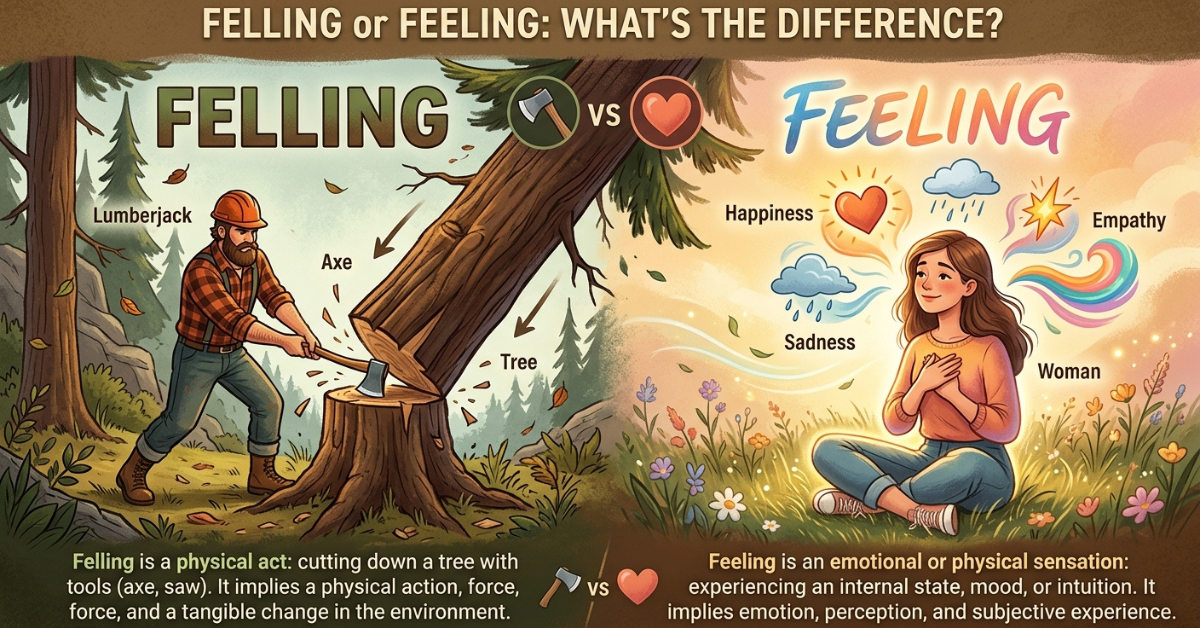
Have you ever typed a sentence and paused because you were unsure whether to use felling or feeling? You are not alone. These two words look very similar, yet their meanings are completely different.
Although only one letter separates them, choosing the wrong word can change the meaning of your sentence entirely. Feeling is connected to emotions and physical sensations, whereas felling usually refers to cutting down trees or causing something to fall.
In this guide, you’ll learn the difference between felling or feeling, discover when to use each word, and see plenty of simple examples. By the end, choosing the correct spelling should feel much easier.
What Does “Feeling” Mean?
The word feeling is related to emotions, physical sensations, thoughts, and impressions. It comes from the verb feel and is one of the most commonly used words in everyday English.
For example, someone might say:
- I am feeling happy today.
- She is feeling sick.
- He has a strange feeling about the situation.
- The fabric gives a soft feeling.
Therefore, when you are describing an emotion, physical condition, or sensation, feeling is usually the correct choice.
Feeling as a Verb
As a verb, feeling describes the experience of an emotion or physical sensation.
For instance:
- I am feeling much better today.
- Are you feeling nervous about the interview?
- She has been feeling cold all morning.
- They are feeling excited about their trip.
In each example, the word describes how someone is experiencing something physically or emotionally.
Feeling as a Noun
Besides being part of a verb phrase, feeling can also work as a noun. In that case, it refers to an emotion, impression, or sensation.
Here are a few examples:
- Love is a powerful feeling.
- I had a feeling that something was wrong.
- There was a strong feeling of excitement in the room.
As a result, the meaning of feeling depends slightly on the sentence, but it always remains connected to emotions, sensations, or impressions.
What Does “Felling” Mean?
Unlike feeling, felling has nothing to do with emotions. Instead, it comes from the verb fell, which means to cut down something, especially a tree.
Consider these examples:
- The workers are felling trees in the forest.
- Tree felling requires proper equipment and safety measures.
- The company stopped felling trees in the protected area.
So, whenever the context involves cutting down trees, felling is the correct word.
Felling and Cutting Down Trees
The term felling is commonly used in forestry, logging, landscaping, and environmental discussions. For that reason, you may often see it in phrases related to tree removal.
Common examples include:
- Tree felling
- Controlled tree felling
- Illegal felling
- Felling large trees
For example:
The workers were felling old trees to clear the land.
Here, felling clearly means physically cutting down the trees.
Felling or Feeling: The Main Difference
The easiest way to understand felling or feeling is to focus on what the sentence is describing.
| Word | Meaning | Example |
| Feeling | Experiencing an emotion or physical sensation | I am feeling tired. |
| Felling | Cutting down a tree or causing something to fall | They are felling trees. |
In short, feeling relates to emotions and sensations. Felling, on the other hand, relates to cutting down trees or causing something to fall.
That one extra letter may seem small; however, it creates a completely different meaning.
When Should You Use “Feeling”?
Use feeling when you are talking about emotions, physical sensations, health, intuition, or personal impressions.
For example, the word may describe:
- Happiness or sadness
- Physical sensations
- Health conditions
- Nervousness or excitement
- Intuition
- Personal impressions
Examples of Feeling in Sentences
The following examples show how feeling works in everyday English:
- I am feeling tired after work.
- She is feeling nervous about the exam.
- We are feeling excited about the weekend.
- He had a bad feeling about the decision.
- How are you feeling today?
- After resting, I am feeling much healthier.
Clearly, feeling is connected to experiences that happen in the mind or body.
When Should You Use “Felling”?
Choose felling when the sentence refers to cutting down trees or causing something to fall.
This word is especially common in forestry and environmental contexts.
Examples of Felling in Sentences
Here are several correct examples:
- The company is felling trees for construction.
- Tree felling can affect local wildlife.
- Workers completed the felling of several damaged trees.
- Illegal felling is a serious environmental problem.
Consequently, you would never use felling to describe being happy, tired, nervous, or sick.
Common Mistakes Between Felling and Feeling
One of the most common mistakes is using felling when the sentence is actually describing a physical condition.
Incorrect: I am felling sick today.
Correct: I am feeling sick today.
The reason is simple: being sick describes a physical condition. Therefore, feeling is the correct word.
Another frequent mistake happens when people confuse tree cutting with emotions.
Incorrect: The workers are feeling trees.
Correct: The workers are felling trees.
Since the workers are cutting down trees, felling is the appropriate spelling.
An Easy Trick to Remember Felling vs. Feeling
Fortunately, there is a simple way to remember the difference.
Feeling = Feelings and Emotions
Think about your emotions, thoughts, and physical sensations.
Examples include:
- Feeling happy
- Feeling sad
- Feeling tired
- Feeling nervous
Felling = Trees Falling
Now think about a tree being cut down and falling to the ground.
That connection makes the difference easier to remember:
- Feeling → emotions and sensations
- Felling → cutting down trees
Once you remember this association, choosing between the two words becomes much simpler.
Is “Felling” Related to Falling?
Yes, felling can be related to causing something to fall. However, felling and falling are still different words.
The verb fell can mean to cause something to fall or to cut something down.
For example:
- The strong wind felled the tree.
- Workers felled several trees.
Meanwhile, falling describes something moving downward on its own.
For instance:
- The leaves are falling from the tree.
Therefore, the difference is important:
- Falling means moving downward.
- Felling means causing something to fall or cutting something down.
Feeling, Felling, and Falling: Understanding the Difference
Because these words are similar in spelling, comparing them side by side can be helpful.
Feeling
This word relates to emotions or physical sensations.
Example: I am feeling happy.
Felling
This word refers to cutting something down or causing it to fall.
Example: They are felling trees.
Falling
This word describes something moving downward.
Example: The leaves are falling from the tree.
Understanding these differences can improve your English writing and help you avoid common spelling mistakes.
Why Are Felling and Feeling Commonly Confused?
The main reason is their similar spelling and pronunciation. When people type quickly, a single missing or extra letter can easily create a mistake.
Additionally, autocorrect can sometimes make the confusion worse, particularly when typing on a phone.
Another reason is that feeling appears much more often in everyday conversations. Felling, by comparison, is mainly used in specific contexts such as forestry, logging, and tree removal.
Examples of Felling or Feeling in Everyday English
Seeing the words in context is one of the best ways to understand the difference.
Talking About Emotions
When discussing emotions, use feeling:
- I am feeling happy.
- She is feeling stressed.
- They are feeling confident.
Talking About Health
Similarly, health conditions require feeling:
- Are you feeling okay?
- After the long day, I am feeling tired.
- He has been feeling unwell.
Talking About Trees
However, when discussing trees being cut down, use felling:
- The workers are felling trees.
- The storm resulted in the felling of several trees.
- Tree felling requires careful planning.
How to Choose Between Felling or Feeling
Before choosing between felling or feeling, take a moment to consider the meaning of your sentence.
Ask yourself:
Am I describing an emotion, sensation, or physical condition?
If the answer is yes, use feeling.
Alternatively, ask:
Am I talking about cutting down a tree or causing something to fall?
If so, use felling.
A Quick Decision Guide
Use this simple checklist:
- Happy, sad, tired, sick, or excited → Feeling
- Emotions and physical sensations → Feeling
- Cutting down trees → Felling
- Forestry and logging → Felling
- Causing something to fall → Felling
As a result, checking the context before writing can prevent most mistakes.
Why Using the Correct Word Matters
Correct spelling may seem like a small detail; nevertheless, it can make your writing clearer and more professional.
For example:
“I am felling nervous about my interview.”
Although readers may understand what you mean, the sentence is incorrect.
The correct version is:
“I am feeling nervous about my interview.”
In professional emails, academic assignments, job applications, blogs, and social media posts, small spelling errors can affect how your writing is understood. Therefore, learning the difference between commonly confused words is always worthwhile.
Frequently Asked Questions
Is it “felling” or “feeling” tired?
The correct phrase is feeling tired because the sentence describes a physical condition or sensation.
Is “I am felling sick” correct?
No. The correct sentence is “I am feeling sick.” Since sickness describes how someone physically feels, feeling is the right word.
What does felling mean?
Felling means cutting down a tree or causing something to fall.
What does feeling mean?
Feeling refers to experiencing an emotion, physical sensation, or impression.
How can I remember the difference between felling and feeling?
A helpful trick is to connect feeling with feelings and emotions. Meanwhile, connect felling with trees being cut down and falling.
Can felling be used for something other than trees?
Yes. Although it is most commonly associated with trees, fell can also mean causing a person or object to fall.
For example:
The strong force felled the statue.
However, tree felling remains the most common use of the word.
Is “felling” always a spelling mistake?
No. Felling is a correct English word when referring to cutting down trees or causing something to fall. It only becomes incorrect when someone means to write feeling instead.
Conclusion: Felling or Feeling?
The difference between felling or feeling becomes easy once you understand the context. Feeling refers to emotions, sensations, health, and personal experiences, while felling refers to cutting down trees or causing something to fall.
So, before choosing a word, consider what your sentence means. If you are describing how someone feels physically or emotionally, use feeling. On the other hand, if you are discussing trees being cut down, felling is the correct choice.
Learning the difference between felling or feeling can make your writing clearer, more accurate, and more professional. Keep practicing with similar grammar topics, and over time, confusing English word pairs will become much easier to understand.





