
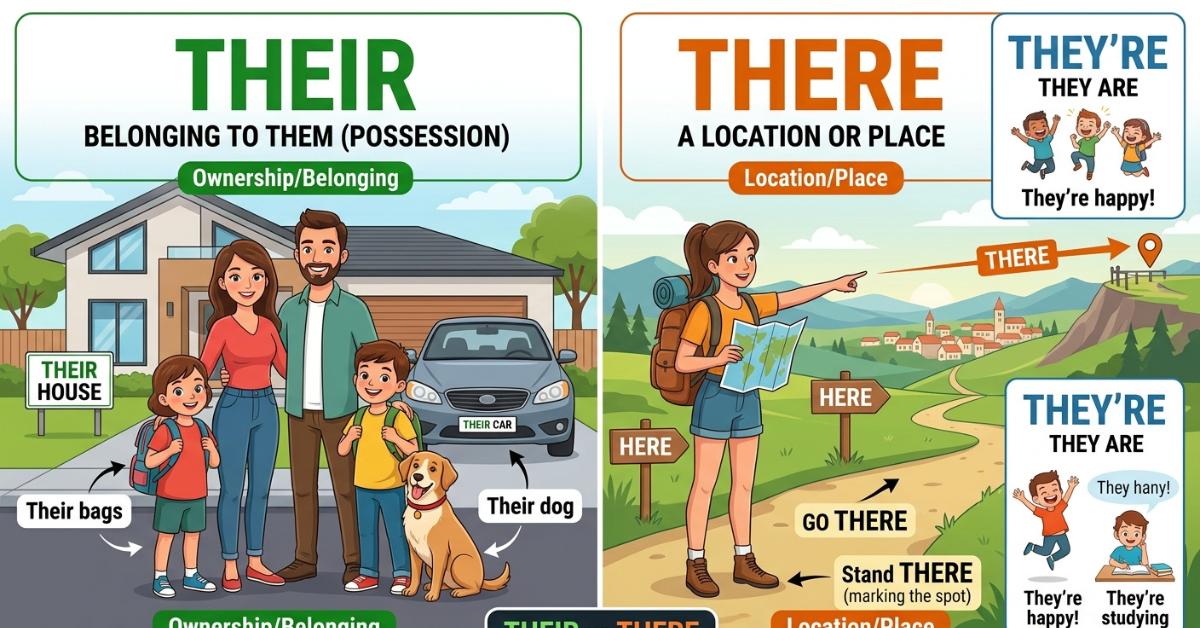
Have you ever written a sentence and suddenly wondered, “Wait… is it their or there?” You are definitely not alone. Their vs there is one of those common English grammar questions that can confuse even people who use English every day.
At first glance, their, there, and they’re look and sound almost identical. However, each word has a different meaning and grammatical function. Once you understand what each one does, choosing the correct spelling becomes much easier.
In this guide, we’ll break down their vs there vs they’re, explain their definitions, provide clear examples, and share simple tricks to help you remember when to use each word.
Their vs There vs They’re: What’s the Difference?
The easiest way to understand these commonly confused words is to focus on what each one means:
- Their = shows possession or ownership.
- There = refers to a place, position, or existence.
- They’re = a shortened form of they are.
Here is a quick comparison:
| Word | Meaning | Example |
| Their | Belonging to them | Their house is beautiful. |
| There | A place or existence | The books are over there. |
| They’re | They are | They’re coming home. |
Although the three words are pronounced similarly, their meanings are not interchangeable. Therefore, the best way to choose the right word is to look at the meaning of the sentence.
Their Meaning and Definition
Their is a possessive determiner. In simple terms, it shows that something belongs to or is associated with a person or group of people.
For example:
The students finished their homework.
Here, their tells us that the homework belongs to the students.
You can see the same idea in these examples:
- The children put away their toys.
- They brought their own lunch.
- The employees returned to their offices.
- The birds built their nest in the tree.
- My friends invited me to their wedding.
How to Remember “Their”
A useful trick is to connect their with ownership.
Ask yourself:
“Does this sentence talk about something that belongs to them?”
If the answer is yes, their is usually the correct choice.
For example:
They forgot ___ keys.
Since the keys belong to them, the correct sentence is:
They forgot their keys.
In short, whenever you see a noun that belongs to “them,” think their.
There Meaning and Definition
There is commonly used to refer to a place or location. It can point to a particular position, especially when the listener already knows what place is being discussed.
For example:
Your shoes are over there.
In this sentence, there points to a particular location.
Here are a few more examples:
- Put the bag over there.
- I left my phone there.
- She is standing there.
- We went there yesterday.
- Look over there!
However, there does not always refer to a physical place. It can also introduce the existence of something.
For instance:
There is a problem with the computer.
Likewise:
There are three students in the classroom.
In these sentences, there does not point to a particular location. Instead, it introduces something that exists.
How to Remember “There”
One popular memory trick is to notice that there contains the word here:
t + here = there
Because here and there can both refer to locations, this trick can make the spelling easier to remember.
So, if you are talking about a place, position, or the existence of something, there may be the word you need.
They’re Meaning and Definition
They’re is a contraction of they are. The apostrophe shows that letters have been removed when the two words are combined.
For example:
They’re happy.
This means:
They are happy.
Similarly:
They’re going to the store.
means:
They are going to the store.
You will often see they’re in everyday conversations, emails, messages, and informal writing.
Some additional examples are:
- They’re waiting outside.
- They’re very talented.
- They’re studying for the exam.
- They’re already here.
- They’re planning a trip.
The Simple “They Are” Test
When you’re unsure whether they’re is correct, replace it with they are.
If the sentence still makes sense, they’re is usually the right choice.
For example:
They’re working today.
Replace the contraction:
They are working today.
The sentence still works, so they’re is correct.
By contrast, consider:
Their working today.
If your intended meaning is that the people themselves are working, they’re is the correct choice:
They’re working today.
This quick substitution test is one of the easiest ways to distinguish they’re from their.
Their vs There vs They’re: Easy Comparison
Once you understand their individual meanings, the difference becomes much easier to spot.
Their
Use their when something belongs to someone.
The players wore their uniforms.
The uniforms belong to the players.
There
Use there for a location or to introduce something that exists.
The players are standing there.
The word refers to a particular place.
They’re
Use they’re when you mean they are.
They’re ready for the game.
You could rewrite the sentence as:
They are ready for the game.
As a result, remembering the function of each word is much more useful than trying to memorize the spellings separately.
Their vs There Examples
Looking at their vs there examples side by side can make the difference clearer.
- Their car is parked outside.
- The car is parked over there.
- The children finished their dinner.
- Please sit there.
- The workers brought their tools.
- I saw them standing there.
- The students opened their books.
- Your keys are right there.
Notice the pattern. Their connects something with ownership, whereas there generally points to a location or introduces something that exists.
Their vs There vs They’re Examples
Now let’s include all three words in the same comparison.
- Their dog is very friendly.
- The dog is sleeping over there.
- They’re taking the dog for a walk.
Here is another example:
- Their house is near the park.
- The park is over there.
- They’re going to the park this afternoon.
One more set makes the difference even clearer:
- The students brought their notebooks.
- Their notebooks are over there.
- They’re ready to begin the lesson.
Although the words sound similar, their roles are completely different. Therefore, identifying the intended meaning should always come before choosing the spelling.
When to Use Their vs There
Wondering when to use their vs there? Start by asking yourself what the sentence is trying to communicate.
Use “their” when you mean ownership
The girls packed their bags.
The bags belong to the girls.
Use “there” when referring to a place
The bags are over there.
Here, there identifies a location.
Use “they’re” when you mean “they are”
They’re packing their bags.
This can be expanded to:
They are packing their bags.
A quick mental check can therefore prevent most mistakes:
Belonging? → Their
Place or existence? → There
They are? → They’re
Their vs There vs They’re Difference in Grammar
The their vs there vs they’re difference becomes especially clear when you look at grammar.
Their works as a possessive determiner and normally appears before a noun:
their house
their car
their idea
their friends
Meanwhile, there can function as an adverb when it refers to a location:
Put it there.
It can also appear in sentences that introduce something:
There is a problem.
Finally, they’re is a contraction made from a subject and verb:
They’re = they are
For example:
They’re excited.
The expanded form is:
They are excited.
Understanding these grammatical functions helps you recognize the correct word even when all three sound alike.
Their vs There vs They Are
Another common search is their vs there vs they are.
The important thing to remember is that they’re and they are have the same meaning. The difference is simply that they’re is the contracted form.
For example:
They are ready.
and:
They’re ready.
Both sentences are grammatically correct.
In contrast, their and there have completely different functions.
Compare these sentences:
- Their friends are here.
- There are several people outside.
- They are waiting outside.
- They’re waiting outside.
Each sentence uses a different form because each word performs a different grammatical role.
Common Mistakes With Their, There, and They’re
Because these words sound alike, spelling mistakes are extremely common. They can appear in school assignments, emails, social media posts, text messages, and even professional writing.
Fortunately, most errors are easy to correct once you understand the basic rule.
Mistake 1: Using “there” for Possession
Incorrect:
The students brought there books.
Correct:
The students brought their books.
The books belong to the students, so their is required.
Mistake 2: Using “their” for a Location
Incorrect:
Put the box over their.
Correct:
Put the box over there.
The sentence refers to a location, so there is the appropriate choice.
Mistake 3: Using “their” Instead of “they’re”
Incorrect:
Their going to the party.
Correct:
They’re going to the party.
Here, the intended meaning is they are going, so the contraction they’re is necessary.
Mistake 4: Forgetting the Apostrophe
Incorrect:
Theyre coming later.
Correct:
They’re coming later.
The apostrophe is required because they’re is a contraction of they are.
A Simple Trick to Never Confuse Them
If you regularly mix up these words, try this three-question method.
Step 1: Is Something Being Possessed?
If something belongs to them, use their.
They lost their tickets.
Step 2: Is the Sentence Referring to a Place or Existence?
If it refers to a location or introduces something that exists, use there.
Their tickets are over there.
Step 3: Can You Replace the Word With “They Are”?
If replacing the word with they are works, use they’re.
They’re looking for their tickets.
This method is simple, but it works in most everyday situations. With enough practice, you will start making the distinction automatically.
Their vs There vs They’re Worksheet Practice
If you are learning English grammar, practice can help turn these rules into a habit.
Fill in each blank with their, there, or they’re.
- The children left ___ backpacks at school.
- Please put the books over ___.
- ___ going to visit us tomorrow.
- The employees finished ___ work.
- Look! ___ is the bus.
- ___ planning a birthday party.
- The dogs are sleeping in ___ beds.
- Your shoes are right ___.
- ___ excited about the trip.
- The players collected ___ equipment.
Answers
- their
- there
- they’re
- their
- there
- they’re
- their
- there
- they’re
- their
Before checking the answers, try completing the exercise yourself. Then, review any mistakes and identify whether the sentence was describing ownership, location/existence, or “they are.”
Their vs There Meaning in Hindi
For Hindi speakers, understanding the basic meaning can make this grammar distinction easier.
- Their = उनका / उनकी / उनके
- There = वहाँ
- They’re = वे हैं / वे लोग हैं
For example:
Their house is big.
= उनका घर बड़ा है।
The house is over there.
= घर वहाँ है।
They’re happy.
= वे खुश हैं।
Of course, the exact Hindi translation can change according to context and sentence structure. Nevertheless, these basic equivalents provide a useful starting point for understanding the meaning of their vs there.
Their vs There: Pronunciation
Another reason their vs there vs they’re causes confusion is pronunciation. In standard English, the three words are generally pronounced alike.
They are therefore examples of homophones: words that have the same or very similar pronunciation but different spellings and meanings.
Because of this, listening alone usually will not tell you which spelling to choose. Instead, you need to consider the meaning and grammatical role of the word.
For example, if you hear:
“They’re going to their house over there.”
The three words sound similar, but each one has a different job:
- They’re = they are
- their = belonging to them
- there = location
That is why understanding sentence structure is more reliable than relying on pronunciation.
Their vs There vs They’re: Quick Memory Guide
If you want a short cheat sheet, remember these three rules:
THEIR → Ownership
Their house
Their books
Their parents
THERE → Place or Existence
Over there
There is a problem
There are two options
THEY’RE → They Are
They’re happy.
They’re coming.
They’re ready.
In other words:
Their = belonging
There = place/existence
They’re = they are
Once these three associations become familiar, the their vs there vs they’re difference becomes much easier to remember.
Why These Words Are Often Confused
There are several reasons these words cause problems.
First, they sound alike in normal conversation. Because listeners cannot easily distinguish their spellings, the confusion often carries over into writing.
Second, all three words are extremely common. We encounter them in conversations, emails, schoolwork, articles, text messages, and social media posts.
Finally, English spelling does not always provide obvious clues about meaning. Consequently, even experienced writers can occasionally type the wrong word when writing quickly.
The solution is straightforward: instead of relying on sound, focus on meaning, sentence structure, and grammatical function.
Frequently Asked Questions About Their vs There
What is the difference between their and there?
Their shows possession or association with people, while there usually refers to a place or introduces something that exists.
For example:
Their car is there.
Here, their shows ownership, whereas there indicates location.
What is the difference between their, there, and they’re?
Their means belonging to them. There refers to a place or existence. They’re means they are.
A quick reminder is:
Their = belonging
There = place
They’re = they are
When do you use their vs there?
Use their when something belongs to someone:
They brought their bags.
On the other hand, use there when referring to a place:
The bags are over there.
Is “they’re” the same as “they are”?
Yes. They’re is the contraction of they are.
For example:
They’re late.
means:
They are late.
Can “their” refer to one person?
Yes. Their can be used as a singular, gender-neutral possessive determiner when referring to one person.
For example:
Someone left their umbrella here.
This use of singular they/their is standard in contemporary English.
Is “there” always about a place?
No. Although there frequently refers to a location, it can also introduce the existence of something.
For example:
There is a mistake in this sentence.
Here, there does not refer to a physical place.
What is the easiest way to remember their vs there vs they’re?
Use this simple formula:
Their = belonging
There = location or existence
They’re = they are
If you are still unsure, try replacing they’re with they are. If that works, you have probably found the correct word.
What does their vs there mean in Hindi?
As a basic guide, their can mean उनका, उनकी, or उनके, depending on context. There commonly means वहाँ, while they’re generally means वे हैं or a similar phrase depending on the sentence.
Final Thoughts on Their vs There
Understanding their vs there does not have to be difficult. Although their, there, and they’re sound alike, each word has a distinct meaning and grammatical purpose.
The easiest way to remember the difference is:
- Their = something belongs to them.
- There = a place or the existence of something.
- They’re = they are.
Whenever you hesitate, stop for a moment and ask yourself one question: Am I talking about ownership, a place, or “they are”? In most cases, that quick check will lead you to the correct answer.
With a little practice, these commonly confused words will become much easier to use correctly. If you want to strengthen your English grammar further, exploring related topics such as your vs you’re, its vs it’s, and other commonly confused words can be a useful next step.





