
Have you ever typed “intail” and wondered whether it was actually supposed to be “entail”? You are not alone. Many English learners and even native speakers get confused about these two spellings.
The short answer is simple: “entail” is the correct English word, while “intail” is generally considered a misspelling. However, understanding why entail is correct and how to use it properly can help you avoid the mistake in the future.
In this guide, we will explain intail or entail, their meaning, correct usage, synonyms, examples, and the common confusion surrounding the phrase “intail or entail vs intail.”
Intail or Entail: Which One Is Correct?
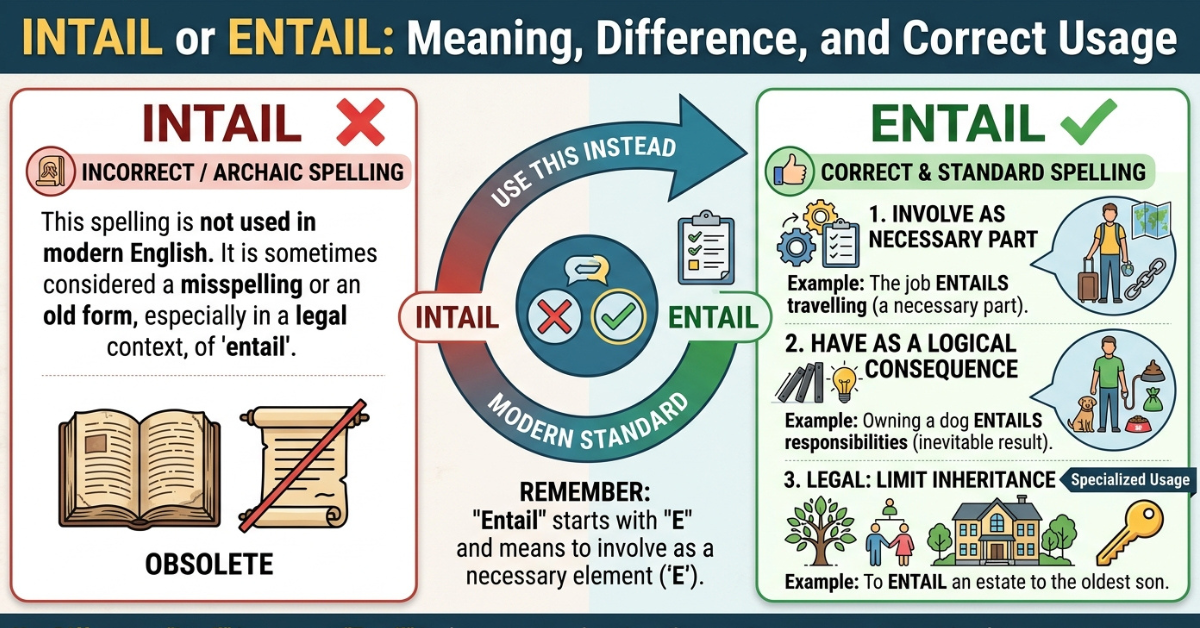
When comparing intail or entail, the correct spelling in standard English is:
Entail (Correct)
Intail (Incorrect)
The word entail is a verb that usually means to involve something as a necessary part, consequence, or result.
For example:
- The job may entail working on weekends.
- Starting a business can entail financial risks.
- The project entails careful planning and research.
In all of these examples, entail means that something involves or requires something else.
Why Do People Write “Intail”?
The confusion often happens because entail and intail can sound somewhat similar when spoken quickly. People may also assume that the word begins with “in,” especially if English is not their first language.
However, “intail” is not the standard spelling of the word meaning to involve or require something.
So, whenever you are asking whether to use intail or entail, choose entail.
What Does Entail Mean?
The word entail means that something involves, requires, or makes something else necessary.
In simple terms:
If one thing entails another, the second thing is an important or unavoidable part of the first.
For example:
“The new position entails more responsibility.”
This means the new position involves or requires more responsibility.
Common Meanings of Entail
The word can be used in several closely related ways:
- To involve something necessarily
- To require something
- To include something as an important part
- To result in a particular consequence
For example:
- Traveling abroad may entail additional expenses.
- The renovation will entail several months of work.
- Becoming a doctor entails years of education and training.
Intail or Entail vs Intail: Understanding the Difference
The phrase “intail or entail vs intail” usually comes from people searching for the correct spelling of the word.
There is no real competition between two standard English words here because entail is the accepted spelling for the verb meaning to involve or require something.
Here is a simple comparison:
| Word | Correct? | Meaning |
| Entail | Yes | To involve, require, or include as a necessary part |
| Intail | No | Usually a misspelling of entail |
So, if you are writing an essay, email, article, assignment, or professional document, you should use entail.
How to Use Entail in a Sentence
Learning through examples is one of the easiest ways to remember the correct usage of a word.
Here are some common examples:
- This job entails managing a large team.
- Moving to another country may entail several challenges.
- The project will entail additional costs.
- What does the position entail?
- Running a successful business entails patience and hard work.
- The process may entail several different steps.
Notice that entail is often used when talking about responsibilities, requirements, consequences, costs, or necessary actions.
Entail Meaning in Simple Words
If the dictionary-style definition feels confusing, think of entail this way:
Entail = involve + require as a necessary part
For example:
“Being a manager entails making difficult decisions.”
In simple words:
Being a manager involves and requires making difficult decisions.
This is why entail is commonly used in professional, academic, and formal writing.
Entail Synonym: Words With Similar Meanings
If you are looking for an intail or entail synonym, several words can be used depending on the context.
Common synonyms for entail include:
- Involve
- Require
- Include
- Necessitate
- Mean
- Demand
- Call for
- Bring about
However, these words are not always interchangeable.
Entail vs Involve
Involve is broader and can refer to something that is simply connected to an activity.
Entail, on the other hand, usually suggests that something is necessary or unavoidable.
For example:
- The job involves meeting clients.
- The job entails working late occasionally.
The second sentence suggests that working late is a necessary or expected part of the job.
Entail vs Require
Require means that something is needed or necessary.
Entail means that something naturally involves or brings along another thing.
For example:
- The course requires students to submit an assignment.
- The course entails extensive research and writing.
Both words can sometimes appear similar, but their meaning and sentence structure may differ slightly.
Entail vs Imply
Another common point of confusion is the difference between entail and imply.
Entail
Entail means to necessarily involve or require something.
Example:
The decision entails significant financial consequences.
Imply
Imply means to suggest something without directly saying it.
Example:
Her comment implied that she was unhappy.
So, remember:
- Entail = involve or require
- Imply = suggest indirectly
Common Mistakes When Using Entail
Here are some mistakes people commonly make with the word.
1. Writing “Intail” Instead of “Entail”
Incorrect:
This job will intail more responsibilities.
Correct:
This job will entail more responsibilities.
2. Using Entail When You Simply Mean “Happen”
Entail is not just another word for “happen.” It usually refers to something that involves a necessary requirement or consequence.
Incorrect use:
The party entailed on Saturday.
Correct:
The party happened on Saturday.
3. Using the Wrong Verb Form
Like other verbs, entail changes depending on the subject and tense.
- I/You/We/They entail
- He/She/It entails
- Past tense: entailed
- Present participle: entailing
Examples:
- The role entails managing employees.
- The project entailed several months of preparation.
- The changes are entailing additional costs.
How to Remember the Correct Spelling of Entail
A simple way to remember entail is to focus on the beginning:
EN + TAIL
Think of the correct spelling as entail, not intail.
You can also remember this sentence:
“A responsibility can entail extra work.”
The more often you see the word used correctly, the easier it becomes to recognize that intail is a spelling mistake.
When Should You Use the Word Entail?
You can use entail when discussing something that naturally involves or requires another thing.
It works especially well when talking about:
- Job responsibilities
- Costs and expenses
- Business decisions
- Education and training
- Projects and processes
- Risks and consequences
- Duties and obligations
For example:
“What does the job entail?”
This is a very common question when someone wants to know what responsibilities and duties a particular job includes.
Examples of Entail in Everyday and Professional Writing
Everyday Examples
- Owning a pet can entail a lot of responsibility.
- Planning a wedding may entail months of preparation.
- Moving house often entails unexpected expenses.
Professional Examples
- The role entails working closely with clients.
- The position entails managing multiple projects.
- Implementing the new system will entail staff training.
Academic Examples
- The research entails collecting data from several sources.
- The assignment entails critical analysis of the topic.
- Completing the degree entails meeting several academic requirements.
Is “Intail” Ever a Correct Word?
In modern standard English, intail is generally not the correct spelling when you mean to involve, require, or include as a necessary part.
If you see intail in informal writing, search queries, or online comments, it is most likely a typo or spelling variation caused by confusion with entail.
Therefore, for correct grammar and professional writing, always use:
Entail
Frequently Asked Questions About Intail or Entail
Is it intail or entail?
The correct spelling is entail. “Intail” is generally a misspelling when referring to something that involves or requires another thing.
What does entail mean?
Entail means to involve, require, or include something as a necessary part or consequence.
What does “What does the job entail?” mean?
It means:
What responsibilities, duties, or tasks does the job involve?
Is intail a word?
“Intail” is not the standard English spelling for the verb meaning to involve or require. The correct word is entail.
What is an entail synonym?
Depending on the context, synonyms for entail include:
- Involve
- Require
- Necessitate
- Include
- Demand
- Call for
How do you use entail in a sentence?
For example:
“The new project will entail additional work and resources.”
Here, entail means that the project will involve or require additional work and resources.
What is the difference between entail and involve?
Involve means to include something as part of an activity, while entail usually suggests that something is necessary, expected, or unavoidable.
Final Thoughts: Intail or Entail?
The confusion between intail or entail is easy to understand, but the correct answer is clear: entail is the proper English word.
Use entail when you want to say that something involves, requires, or necessarily includes something else. Whether you are writing about job responsibilities, project requirements, costs, or consequences, this word can make your writing more precise and professional.
The next time you wonder “intail or entail?”, remember that entail is the correct spelling. Learning small distinctions like this can significantly improve your English writing, especially in academic and professional communication.
If you want to improve your vocabulary further, consider exploring related English word guides covering commonly confused spellings, synonyms, and grammar mistakes.





