
Have you ever typed “tryed” and paused for a second, wondering whether it should actually be “tried”? You are definitely not alone. English spelling rules can sometimes feel confusing, especially when a word changes form.
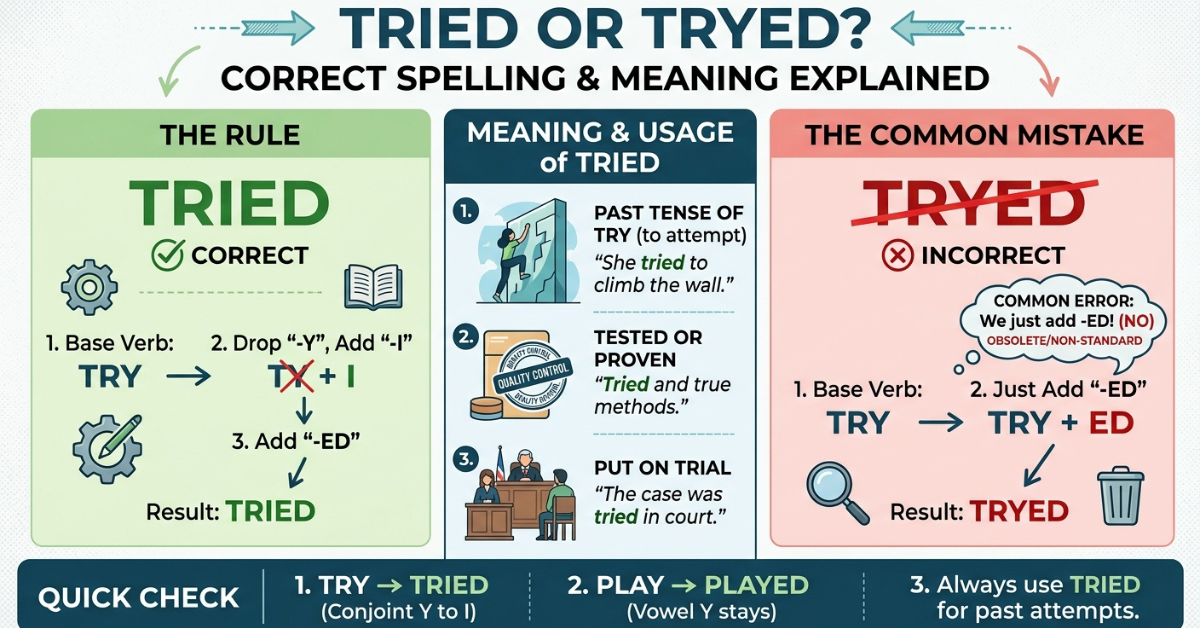
The correct answer is simple: “tried” is correct, while “tryed” is incorrect in standard English.
In this guide, we will explain tried or tryed, the grammar rule behind the spelling, how to use “tried” correctly in sentences, and what phrases like “tried in court” actually mean.
Tried or Tryed: Which One Is Correct?
When asking “is it tried or tryed?”, the correct spelling is:
Correct: Tried
Incorrect: Tryed
“Try” is a verb, and its past tense and past participle form is tried.
For example:
- I tried calling you yesterday.
- She tried her best.
- We tried a new restaurant last weekend.
- They tried to solve the problem.
The spelling “tryed” does not follow standard English grammar rules.
Why Is It “Tried” and Not “Tryed”?
The answer comes down to a basic spelling rule involving verbs that end in the letter Y.
When a verb ends in a consonant + Y, you usually change the Y to I before adding -ed.
The rule:
Try → Tried
Not:
Try → Tryed
Here are some similar examples:
- Cry → Cried
- Carry → Carried
- Study → Studied
- Worry → Worried
- Hurry → Hurried
So, when learning the tried or tryed spelling, remember this simple rule: change the Y to I before adding -ed.
How Do You Spell Tried or Tryed?
If you are wondering “how do you spell tried or tryed?”, the correct spelling is:
T-R-I-E-D
The word comes from the base verb try.
Verb forms of “try”:
| Verb Form | Correct Word |
| Base form | Try |
| Present tense | Try / Tries |
| Past tense | Tried |
| Past participle | Tried |
| Present participle | Trying |
For example:
- I try to exercise regularly.
- She tries to arrive on time.
- Yesterday, I tried to call her.
- I have tried everything.
- They are trying something new.
I Tried or Tryed: Which One Should You Use?
The correct sentence is:
Correct: I tried
Incorrect: I tryed
For example:
I tried to finish the project before the deadline.
Here, “tried” shows that the action happened in the past.
You can also say:
- I tried my best.
- I tried calling you.
- I tried to understand.
- I tried something different.
- I tried again.
So whenever you write about attempting something in the past, “tried” is the correct choice.
What Does “Tried” Mean?
The word tried can have several meanings depending on the context.
1. Tried means attempted
This is the most common meaning.
Example:
She tried to open the door.
This means she attempted to open it.
2. Tried can mean tested
“Tried” can also describe something that has been tested or proven.
For example:
This is a tried and tested method.
This means the method has been used before and has proven to be effective.
3. Tried can relate to a court case
In legal situations, “tried” has a different meaning.
For example:
The defendant was tried in court.
This means the person went through a legal trial where a court examined the case.
Tried or Tryed in Court: What Is the Correct Usage?
The phrase “tried or tryed in court” can confuse people because “tried” has a special legal meaning.
The correct phrase is:
Tried in court
For example:
The case was tried in court.
Or:
He was tried for the crime.
In legal English, to try someone means to examine a case against them in a court of law.
Examples of “tried” in a legal context:
- The suspect was tried in court.
- The case will be tried before a judge.
- She was tried for fraud.
- The defendant was tried and found not guilty.
Again, “tryed in court” is incorrect.
The Grammar Rule Behind Tried
Understanding the spelling rule makes it easier to remember why tried is correct.
When a verb ends in consonant + Y
Change the Y to I and add -ed.
Examples:
- Try → Tried
- Cry → Cried
- Study → Studied
- Copy → Copied
When a verb ends in vowel + Y
Usually, you simply add -ed without changing the Y.
Examples:
- Play → Played
- Stay → Stayed
- Enjoy → Enjoyed
This is because the letter before the Y makes a difference.
In try, the letter before Y is R, which is a consonant. Therefore:
Try → Tried
Common Mistakes People Make With Tried
The most common mistake is writing “tryed” because people assume they can simply add -ed to the word “try.”
However, English spelling rules require a small change first.
Incorrect:
- I tryed my best.
- She tryed to call me.
- They tryed again.
Correct:
- I tried my best.
- She tried to call me.
- They tried again.
Another common mistake is confusing tried with trying.
Example:
I am trying.
This is present continuous tense.
I tried.
This refers to something that happened in the past.
Tried vs Try: Understanding the Difference
The difference between try and tried is mainly about time.
Try
“Try” usually refers to the present or future.
I will try again tomorrow.
I try to stay positive.
Tried
“Tried” refers to the past.
I tried again yesterday.
She tried to help him.
A quick way to remember it is:
- Try = present or future
- Tried = past
Examples of Tried in Everyday Sentences
Here are some natural examples to help you understand how to use the word correctly:
- I tried to call you last night.
- She tried a new recipe for dinner.
- We tried our best to finish on time.
- He tried to fix the computer.
- They tried a different approach.
- I tried learning Spanish last year.
- She tried but couldn’t solve the problem.
- Have you tried this product before?
- We tried several options before choosing one.
- He tried again after making a mistake.
A Simple Trick to Remember Tried or Tryed
If you are still unsure about how to spell tried or tryed, remember this:
Try has a Y, but tried changes the Y to I.
Think about similar words:
- Cry → Cried
- Study → Studied
- Carry → Carried
Once you remember this pattern, choosing between tried or tryed becomes much easier.
“Tried and Tested” Meaning
You may also see the phrase “tried and tested.”
This expression means something has been used or tested before and has proven to work well.
For example:
This is a tried and tested strategy for improving productivity.
It suggests that the strategy is reliable because people have already tested it successfully.
Other examples include:
- A tried and tested recipe
- A tried and tested method
- A tried and tested approach
Is “Tryed” Ever Correct?
In standard modern English, “tryed” is not considered the correct spelling of the past tense of “try.”
The correct form is always:
Try → Tried
If you see “tryed” in a message, social media post, or informal writing, it is generally a spelling mistake rather than an accepted grammatical form.
For formal writing, school assignments, professional emails, articles, and business communication, always use “tried.”
Frequently Asked Questions
Is it tried or tryed?
The correct spelling is tried. “Tryed” is incorrect in standard English.
How do you spell tried or tryed?
The correct spelling is T-R-I-E-D.
Why is it tried and not tryed?
Because when a verb ends in a consonant followed by Y, the Y usually changes to I before adding -ed. Therefore, try becomes tried.
Is “I tried” correct?
Yes. “I tried” is grammatically correct and refers to an attempt made in the past.
Can I say “I tryed my best”?
No. The correct sentence is:
“I tried my best.”
What does “tried in court” mean?
“Tried in court” means that a legal case was examined and decided through a judicial trial.
For example:
The defendant was tried in court.
What is the past tense of try?
The past tense of try is tried.
What is the difference between try and tried?
“Try” refers to the present or future, while “tried” refers to the past.
For example:
- I will try tomorrow.
- I tried yesterday.
Final Thoughts: Tried or Tryed?
When it comes to tried or tryed, there is only one correct spelling in standard English: tried.
The word follows a common grammar rule where verbs ending in a consonant plus Y change the Y to I before adding -ed. That is why try becomes tried, just like cry becomes cried and study becomes studied.
So, whether you are writing “I tried my best,” asking about the tried or tryed spelling, or using the phrase “tried in court,” remember that “tried” is always the correct form.
The next time you hesitate over how to spell tried or tryed, you can confidently choose tried.





