
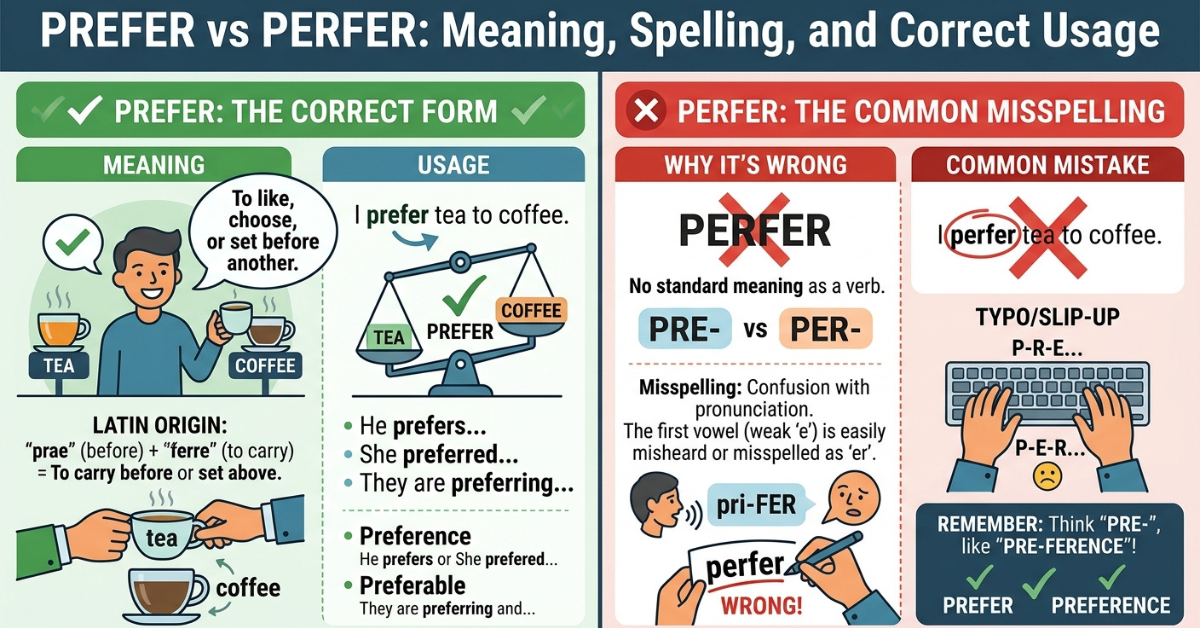
Have you ever typed “perfer” when you actually meant “prefer”? You are definitely not alone. This is a common spelling mistake, especially because the letters r and e can easily get switched while typing quickly.
When comparing prefer vs perfer, the answer is simple: prefer is the correct English word, while perfer is generally a misspelling of prefer. Understanding the difference can help you improve your writing, avoid embarrassing spelling errors, and communicate more clearly.
In this article, we will explain the meaning of prefer, why people mistakenly write perfer, how to use the word correctly, and several easy tricks to remember the right spelling.
Prefer vs Perfer: The Quick Answer
Here is the simplest explanation:
- Prefer is the correct spelling and a real English word.
- Perfer is a misspelling of prefer in standard English.
For example:
Correct: I prefer tea over coffee.
Incorrect: I perfer tea over coffee.
So, whenever you are confused about prefer vs perfer, remember that prefer is the word you should use.
What Does “Prefer” Mean?
The word prefer is a verb that means to like one thing more than another or to choose something over another option.
For example:
- I prefer pizza to burgers.
- She prefers working from home.
- They prefer traveling by train.
- Would you prefer coffee or tea?
- I prefer quiet places to crowded ones.
In simple words, when you prefer something, it means you like or choose it more than another option.
Prefer Meaning in Simple Words
You can think of prefer as meaning:
- Like better
- Choose over something else
- Want more
- Favor one option
- Find one thing more suitable
For instance, if someone asks whether you want to watch a movie or play a game and you choose the movie, you could say:
“I prefer watching a movie.”
Is “Perfer” a Real Word?
In modern standard English, perfer is not the correct spelling when you mean “to like one thing more than another.”
Most of the time, people write perfer because they accidentally switch the positions of the letters r and e in prefer.
This type of mistake is common when:
- Typing quickly
- Writing without checking spelling
- Learning English as a second language
- Relying on pronunciation instead of spelling
For example:
Incorrect: I perfer staying at home.
Correct: I prefer staying at home.
Spell-check tools may catch this mistake, but it is still useful to learn the correct spelling yourself.
Why Do People Confuse Prefer and Perfer?
The confusion between prefer vs perfer mainly happens because of spelling patterns and fast typing.
The correct spelling is:
P-R-E-F-E-R
The incorrect version is:
P-E-R-F-E-R
The letters R and E are simply placed in the wrong order.
A Simple Trick to Remember the Spelling
One easy way to remember prefer is to focus on the beginning:
PRE + FER
The word starts with “pre”, not “per.”
You can also remember this phrase:
I PREfer the correct spelling.
The beginning PRE can help you remember that prefer comes before the incorrect spelling perfer.
How to Use “Prefer” Correctly
The verb prefer can be used in several sentence structures. Learning these patterns will make your English sound more natural.
Prefer Something to Something
One of the most common structures is:
prefer + something + to + something
Examples:
- I prefer summer to winter.
- She prefers books to movies.
- He prefers tea to coffee.
- We prefer online shopping to visiting crowded stores.
Notice that we usually use to, not than, in this structure.
Incorrect: I prefer tea than coffee.
Correct: I prefer tea to coffee.
Prefer Doing Something
You can also use prefer before an activity.
Examples:
- I prefer reading at night.
- She prefers working alone.
- They prefer traveling during the summer.
- He prefers cooking at home.
This structure is useful when you are talking about activities rather than physical objects.
Prefer to Do Something
Another correct structure is:
prefer + to + verb
Examples:
- I prefer to work from home.
- She prefers to walk instead of driving.
- We prefer to eat early.
- He prefers to study in the morning.
Both “prefer reading” and “prefer to read” can be grammatically correct, although the most natural choice may depend on the sentence.
Would Prefer vs Prefer
There is also a difference between prefer and would prefer.
Prefer
Use prefer when talking about general likes or habits.
For example:
- I prefer tea to coffee.
- She prefers quiet places.
- They prefer working remotely.
Would Prefer
Use would prefer when talking about a specific choice or situation.
For example:
- I would prefer tea, please.
- We would prefer to leave early today.
- She would prefer a window seat.
In short:
- Prefer = general preference
- Would prefer = preference in a particular situation
Common Examples of Prefer in Sentences
Here are some everyday examples to help you understand how to use the word naturally:
- I prefer listening to music while working.
- Do you prefer hot coffee or iced coffee?
- She prefers living in a quiet neighborhood.
- We prefer quality over quantity.
- He prefers to spend weekends with his family.
- I prefer walking to taking a taxi.
- They prefer simple designs.
- Would you prefer to sit inside or outside?
- My sister prefers chocolate to vanilla.
- I prefer working in the morning.
All of these examples use prefer correctly.
Prefer vs Perfer: Common Spelling Mistakes
When writing quickly, people may make several variations of the same spelling mistake.
Common incorrect forms include:
- Perfer
- Preffer
- Prefered
- Prefering
The correct forms are:
- Prefer
- Preferred
- Preferring
Why Is “Preferred” Spelled With Double R?
This can be slightly confusing.
The base word is:
Prefer
When changing it to the past tense, it becomes:
Preferred
Example:
- I preferred the first option.
The word follows a spelling pattern where the final consonant is doubled before adding -ed.
Similarly:
- Prefer → Preferred
- Prefer → Preferring
Examples:
- She preferred the blue dress.
- He is preferring a quieter option.
However, in everyday English, prefer is usually used as a stative verb, so forms like “is preferring” are less common and may sound unnatural in many contexts.
How Do You Pronounce “Prefer”?
The pronunciation of prefer can vary slightly depending on the accent.
In general, it sounds like:
pri-FER
The stress is usually placed on the second syllable.
Even though pronunciation can help you recognize the word, spelling should still be remembered separately because perfer may sound similar when spoken quickly.
Common Grammar Rules for Using Prefer
Knowing the spelling is important, but using prefer correctly in a sentence also matters.
Here are some useful grammar rules.
1. Prefer X to Y
Use:
prefer + X + to + Y
Example:
I prefer cats to dogs.
Not:
I prefer cats than dogs.
2. Prefer Doing Something to Doing Something
Example:
- I prefer walking to driving.
- She prefers cooking to ordering food.
- They prefer studying at home to studying in a library.
3. Prefer to Do Something Rather Than Do Something
Example:
- I prefer to stay home rather than go out.
- She prefers to read rather than watch television.
This structure is useful when comparing two actions.
Prefer vs Rather
Another common area of confusion involves prefer and rather.
Both words can express a choice, but they are used differently.
Prefer
Prefer is generally used when talking about liking one option more than another.
Example:
- I prefer tea to coffee.
Would Rather
Would rather is often used when making a choice about a particular action.
Example:
- I would rather drink tea than coffee.
Both sentences express a similar idea, but the grammar is different.
Easy Ways to Avoid Writing “Perfer”
If you often type perfer instead of prefer, these tips can help.
1. Remember That It Starts With “Pre”
The correct spelling is:
PREfer
Think of the first three letters:
P-R-E
2. Slow Down When Typing
Many spelling mistakes happen simply because we type faster than we think. Taking a moment to review your writing can catch errors like perfer.
3. Use Spell Check
Tools such as word processors and grammar checkers can help identify common spelling mistakes.
However, do not depend completely on automated tools. Understanding the correct spelling yourself will improve your writing in the long term.
4. Practice Using the Word
Try writing a few sentences about your own preferences.
For example:
- I prefer ______ to ______.
- I prefer to ______.
- I would prefer ______.
The more often you use the word correctly, the easier it becomes to remember.
Prefer vs Perfer: Side-by-Side Comparison
| Word | Correct? | Meaning |
| Prefer | Yes | To like or choose one thing more than another |
| Perfer | No | Usually a misspelling of “prefer” |
This is the key difference between prefer vs perfer: only prefer is the correct spelling for standard English usage.
Examples of Incorrect and Correct Usage
Here are a few examples showing the difference clearly.
Example 1
Incorrect: I perfer working at night.
Correct: I prefer working at night.
Example 2
Incorrect: Which color do you perfer?
Correct: Which color do you prefer?
Example 3
Incorrect: She perfer coffee over tea.
Correct: She prefers coffee to tea.
Example 4
Incorrect: I would perfer to stay home.
Correct: I would prefer to stay home.
Example 5
Incorrect: They perfer online classes.
Correct: They prefer online classes.
Why Correct Spelling Matters
A small spelling mistake may not always stop people from understanding you, but correct spelling can make your writing look more professional and trustworthy.
This is especially important in:
- Job applications
- Professional emails
- Academic writing
- Blog posts
- Social media captions
- Business communication
- Resumes and portfolios
Writing prefer correctly shows attention to detail, particularly in professional settings where clear communication matters.
Frequently Asked Questions
Is it prefer or perfer?
The correct spelling is prefer. Perfer is generally a misspelling.
What does prefer mean?
Prefer means to like, choose, or favor one thing more than another.
For example:
I prefer tea to coffee.
Why do I keep spelling prefer as perfer?
This usually happens because the letters R and E are accidentally switched. Remember that the word begins with PRE, as in P-R-E-F-E-R.
Is “I prefer this than that” correct?
No. The more standard structure is:
I prefer this to that.
For example:
I prefer tea to coffee.
Is preferred spelled with one R or two?
The correct spelling is preferred, with a double R.
Example:
I preferred the first design.
Can I say “I prefer to” without finishing the sentence?
Yes, in some contexts where the rest of the meaning is already understood.
For example:
“Do you want to stay or leave?”
“I prefer to stay.”
However, the sentence usually needs a verb or object after prefer to clearly complete the meaning.
What is the opposite of prefer?
Depending on the context, possible opposites include dislike, avoid, or choose against.
For example, if you prefer one option, you may dislike or choose against another option.
Final Thoughts on Prefer vs Perfer
The difference between prefer vs perfer is straightforward once you know the correct spelling. Prefer is the correct English word and means to like or choose one thing more than another. Perfer, on the other hand, is usually just a spelling mistake.
To remember the correct version, focus on the beginning: PREfer, not PERfer. You can also practice using the word in everyday sentences, such as “I prefer tea to coffee” or “I prefer to work in the morning.”
Small spelling corrections can make a big difference in the quality of your writing. If you regularly confuse similar words, consider exploring other common English spelling and grammar mistakes to strengthen your vocabulary and write with greater confidence.





