
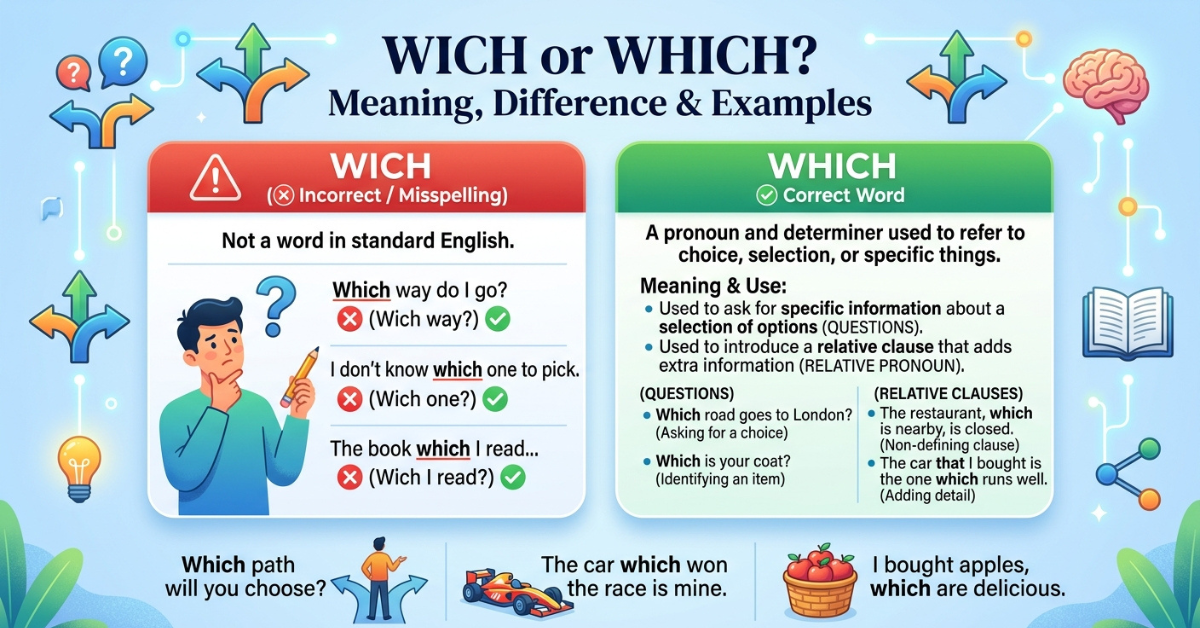
Have you ever typed “wich or which” and suddenly wondered whether you’ve been spelling the word correctly all along? You’re not alone. “Which” is a common English word, but its spelling can easily cause confusion because “wich” looks like it could be a shorter version.
The good news is simple: “which” is the standard English spelling when you mean “what one” or “what ones.” “Wich” is generally not the correct spelling of this word in modern standard English, although it can appear in place names, surnames, dialects, or specialized contexts.
In this guide, we’ll look at the wich or which meaning, wich or which difference, grammar rules, examples, and when to use which so you can confidently choose the right word.
Wich or Which: Which Is Correct?
The correct spelling is which when you are using the word as an English pronoun, determiner, or relative pronoun.
Correct:
- Which dress do you like?
- Which one should I choose?
- I don’t know which option is better.
- The book, which I bought yesterday, is excellent.
Incorrect in standard English:
- Wich dress do you like?
- Wich one should I choose?
- I don’t know wich option is better.
So, if you’re asking “is it wich or which?”, the answer is which.
The extra h is important. A useful way to remember the spelling is to think of which as:
W + H + I + C + H
Wich or Which Meaning
The word which generally refers to a person, thing, or choice from a limited or known group.
For example:
Which color do you prefer?
Here, the speaker is asking someone to choose from available colors.
Which can also introduce additional information about something that has already been mentioned:
I bought the blue sofa, which was on sale.
In this sentence, “which was on sale” gives extra information about the sofa.
Simple meaning of “which”
Depending on the sentence, which can mean:
- What one?
- What ones?
- What particular choice?
- The one or ones that…
- Referring to something previously mentioned
Wich or Which One?
One of the most common searches is “wich or which one.”
The correct phrase is:
Which one?
For example:
- Which one do you want?
- Which one is yours?
- Which one should I buy?
- Which one looks better?
Here, which is asking someone to identify or select one thing from a group.
Example
Imagine you have three bags on a table. You might ask:
Which one is yours?
You would not write:
Wich one is yours?
The second version contains a spelling mistake.
Wich or Which Examples
Seeing the difference in real sentences makes the rule much easier to remember.
Examples with “which”
- Which restaurant are we going to?
- Which phone do you prefer?
- Which color should I choose?
- Which one belongs to you?
- Do you know which train we need?
- I can’t decide which dress to wear.
- Which subject do you enjoy most?
- She asked which book I wanted.
- The car, which was parked outside, belongs to my brother.
- I chose the apartment which had the largest balcony.
In every example above, which has the standard spelling.
When to Use Wich or Which?
If you’re wondering “when to use wich or which?”, there’s an easy rule:
Use “which” when you mean “what one,” “what ones,” or when introducing certain additional information about something.
In standard English writing, you normally do not use “wich” as an alternative spelling of “which.”
For example:
Which movie should we watch?
Here, you’re asking someone to choose from several movies.
Another example:
She showed me two dresses and asked which one I preferred.
Again, which identifies a choice.
A quick rule to remember
If you’re asking a question such as:
- Which one?
- Which book?
- Which person?
- Which option?
- Which color?
Use which, not wich.
Wich or Which Difference
The wich or which difference is mainly a matter of spelling and usage.
| Word | Standard English Use | Example |
| Which | Correct spelling for the common English word | Which one do you want? |
| Wich | Not normally used as the standard spelling of “which” | Usually incorrect in ordinary sentences |
| Witch | A completely different word | The story was about a witch. |
The important point is that these words aren’t interchangeable.
Which is usually used for questions and relative clauses.
Witch refers to a person traditionally associated with magic or witchcraft.
Wich may appear in proper names or historical terms, but it is not normally the spelling you want when writing the everyday English word which.
Wich or Which or Witch?
This is where things can get especially confusing.
Although wich, which, and witch look and sound somewhat similar, they have different roles.
1. Which
Which is used when asking about a choice or referring to something.
Which shirt do you want?
The house, which is near the park, is expensive.
2. Witch
Witch is a noun referring to a person traditionally believed to practice magic or supernatural arts.
The story was about a mysterious witch.
The word witch is completely different in meaning from which.
3. Wich
Wich is generally not the standard spelling of the everyday English word which.
However, you may encounter wich in historical names, place names, surnames, or words with Old English origins. That doesn’t make it a standard substitute for which in modern sentences.
Is It Wich or Which?
If you’re writing a normal English sentence and you’re asking yourself “is it wich or which?”, choose which.
For example:
Incorrect: Wich movie do you want to watch?
Correct: Which movie do you want to watch?
Incorrect: Wich one is yours?
Correct: Which one is yours?
Incorrect: I don’t know wich option is best.
Correct: I don’t know which option is best.
The easiest solution is to remember that the everyday English word is spelled with h: which.
Is It Spelled Wich or Which?
The spelling is which.
It contains two h’s:
W-H-I-C-H
A common mistake is dropping the first h and writing wich. This often happens because the pronunciation doesn’t make the spelling obvious.
When proofreading your writing, look for the phrase “wich.” If you intended to ask “what one?” or refer to something with the word “which,” add the missing h.
Which as a Question Word
Which is often used as a question word when there is a limited number of possibilities.
For example:
Which cake would you like?
Which route should we take?
Which candidate received the most votes?
Which shoes match this outfit?
It differs slightly from what because which often suggests a choice from a particular set.
Compare:
Which dress do you want?
This can suggest that several specific dresses are available.
What dress do you want?
This can sound more open-ended.
The distinction isn’t always absolute, but it can help you understand why which is used in particular questions.
Which as a Relative Pronoun
Which can also connect additional information to a noun.
For example:
I bought a laptop, which was on sale.
The clause “which was on sale” provides additional information about the laptop.
Another example:
She visited Paris, which is famous for its architecture.
Here, which connects the extra information to Paris.
This use is common in both everyday and formal English.
Which vs. That
English learners sometimes confuse which with that, especially in relative clauses.
Consider:
The book that I bought was expensive.
Here, “that I bought” identifies which book is being discussed.
Now consider:
The book, which I bought yesterday, was expensive.
The phrase between commas adds extra information.
A simple rule often taught to learners is:
- That commonly introduces essential information.
- Which commonly introduces nonessential information, especially when set off by commas.
Real-world grammar can be more nuanced, but this distinction is a useful starting point.
Common “Wich” Spelling Mistakes
Because which is pronounced without making every letter obvious, spelling mistakes are common.
Here are some examples:
| Incorrect | Correct |
| Wich one? | Which one? |
| Wich color? | Which color? |
| Wich book? | Which book? |
| Wich is better? | Which is better? |
| Wich option? | Which option? |
| Wich way? | Which way? |
If you see wich in ordinary English writing, it is usually a typo for which.
Wich or Which in Texting and Social Media
In casual texting, people sometimes make spelling mistakes because they type quickly. You may therefore see:
Wich one do you like?
Most readers will understand what the writer means, but wich is still not the standard spelling.
If you’re writing something professional, academic, or public-facing, use which.
This includes:
- Emails
- School assignments
- Blog posts
- Resumes
- Business documents
- Social media captions
- Website content
A simple spelling check can make your writing look much more polished.
Wich or Which Español
If you’re searching for “wich or which español,” the closest common Spanish equivalents of which depend on the sentence.
For example:
- Which one? → ¿Cuál?
- Which book? → ¿Qué libro? / ¿Cuál libro? depending on context and regional usage
- Which do you prefer? → ¿Cuál prefieres?
The exact translation changes according to grammar and context.
The key point is that English which does not always translate into one single Spanish word. Spanish commonly uses words such as qué and cuál, depending on what is being expressed.
How to Remember the Correct Spelling
If you frequently confuse wich or which, try one of these memory tricks.
Remember the “H”
Think:
WHICH has an H before the I.
Break it down:
WH + I + CH = WHICH
You can also connect it with other common WH question words:
- What
- When
- Where
- Who
- Why
- Which
Seeing which as part of this group can make its spelling easier to remember.
Use a sentence
When you’re unsure, mentally complete the phrase:
Which one?
If you’re asking someone to choose, the answer almost certainly needs which, not wich.
Quick Comparison: Wich, Which, and Witch
Here’s the simplest way to keep all three words straight:
Which
Meaning: What one or what ones; also used as a relative pronoun.
Example:
Which movie should we watch?
Witch
Meaning: A person traditionally associated with magic or witchcraft.
Example:
The witch appeared in the old story.
Wich
Meaning: Not normally the standard spelling of “which.”
Example:
“Wich movie?” is normally a spelling mistake; write “Which movie?”
Frequently Asked Questions About Wich or Which
Is it “wich” or “which”?
The correct standard English spelling is which when you’re asking “what one?” or using the word as a relative pronoun. Wich is generally a spelling error in this context.
Is “wich” a word?
Wich can occur in certain historical, dialectal, or proper-name contexts, but it is not the standard modern English spelling of which. In an ordinary sentence, use which.
Is it “wich one” or “which one”?
The correct phrase is which one.
For example:
Which one do you like?
What is the meaning of “which”?
Which is generally used to ask someone to identify or choose one or more things from a particular group. It can also introduce additional information about something already mentioned.
When do you use “which”?
Use which when asking about a choice or referring to something with a relative clause.
Examples include:
Which color do you prefer?
I bought the phone, which was on sale.
Is “witch” the same as “which”?
No. Witch and which have completely different meanings. Witch refers to a person traditionally associated with magic, while which is used for questions, choices, and relative clauses.
How do you spell “which”?
It is spelled:
W-H-I-C-H
A common mistake is leaving out the first h and writing wich.
Why do people write “wich” instead of “which”?
Usually, wich is simply a spelling mistake or typo. The pronunciation of which doesn’t clearly reveal every letter, so it can be easy to miss the first h.
Final Thoughts on Wich or Which
When it comes to wich or which, the answer is straightforward: which is the standard spelling for the common English word used to ask about choices or introduce certain relative clauses.
Remember the three-way distinction:
- Which = a question or relative pronoun
- Witch = a person associated with traditional magic
- Wich = generally not the standard spelling of “which”
So the next time you’re wondering “is it wich or which?”, remember the extra h: WHICH.
Correct spelling may seem like a small detail, but using the right word makes your writing clearer and more professional. If you’re learning English, keep practicing which, what, that, and other commonly confused words—they’ll become much easier with regular use.





