
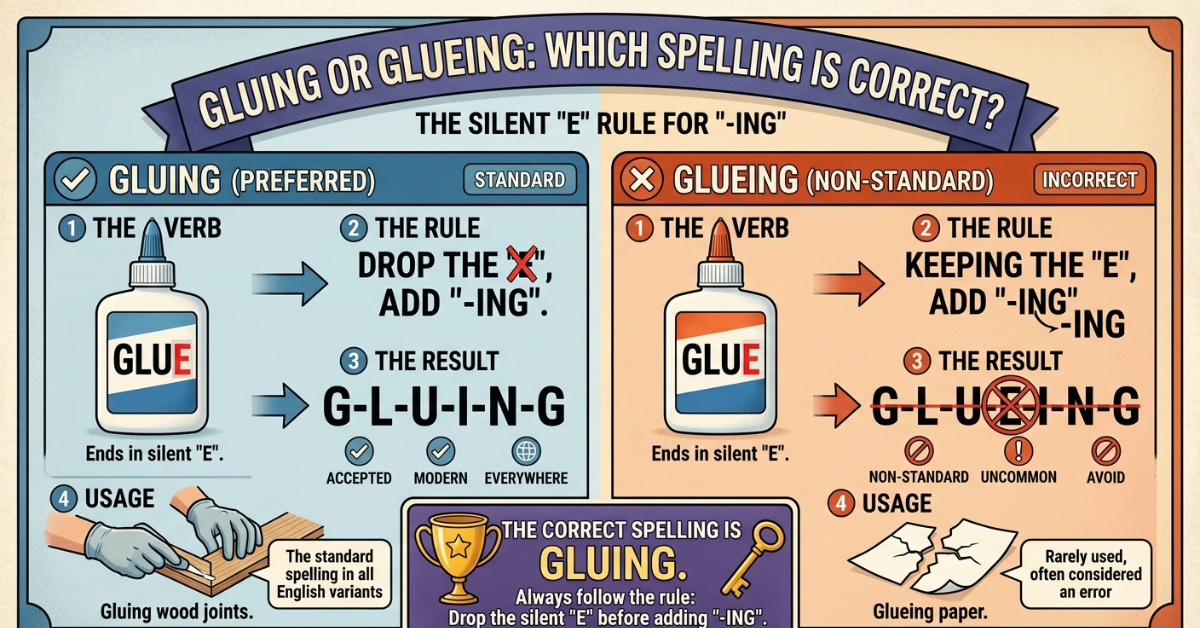
Have you ever typed “glueing” and then stopped to wonder whether it actually looks right? You’re not alone. The spelling can be surprisingly confusing because the word glue ends in a silent e, and English has a few different rules for adding endings to words like this.
So, is it gluing or glueing? The standard and preferred spelling is gluing. Although glueing can occasionally be found, especially in older or less standardized writing, gluing is the spelling you should normally use.
In this guide, we’ll look at why gluing is correct, how dictionaries treat the word, and whether spelling changes in the UK, Australia, or Canada.
Gluing or Glueing: Which Is Correct?
Gluing is the standard spelling of the present participle and gerund of the verb glue.
For example:
- I am gluing the pieces together.
- She spent the afternoon gluing photographs into her scrapbook.
- The children are gluing paper shapes onto the poster.
- He is gluing the broken pieces back together.
The spelling glueing is sometimes seen, but it is generally considered less common and is not the preferred modern spelling.
Quick answer
Correct: gluing
Less common: glueing
If you’re writing an essay, email, article, school assignment, professional document, or social media post, gluing is the safer choice.
Is It Spelled Gluing or Glueing?
The correct modern spelling is gluing.
At first glance, glueing might seem more logical because you are adding -ing to glue. However, English spelling conventions don’t always work by simply attaching an ending to the original word.
When glue becomes gluing, the final e is dropped before adding -ing:
glue + ing → gluing
The same general pattern can be seen in other English words:
- make → making
- bake → baking
- use → using
- write → writing
- move → moving
- glue → gluing
There are exceptions to English spelling rules, of course, but gluing follows the familiar pattern of removing a final silent e before adding -ing.
Why Is It Gluing Instead of Glueing?
The confusion comes from the spelling of the base word glue.
Because the word ends in e, it is tempting to keep the letter when adding -ing. But in standard English spelling, a final silent e is commonly removed before a suffix beginning with a vowel.
That gives us:
GLUE → GLUING
rather than:
GLUE → GLUEING
This is why gluing is the spelling you’ll generally find in modern dictionaries and edited English.
It’s worth remembering that English spelling has developed over centuries, so not every word follows one perfectly predictable rule. Nevertheless, for everyday writing, gluing is the form to choose.
How to Spell Gluing or Glueing
If you’re wondering how to spell gluing or glueing, remember this simple version:
Glue + ing = gluing
The final e disappears.
Examples of “gluing” in a sentence
- I’m gluing the cardboard pieces together.
- She is gluing a label onto the box.
- We spent an hour gluing the model together.
- The students are gluing pictures onto their project boards.
- He was gluing the loose parts back into place.
Notice that gluing works as both a present participle and a gerund.
For example:
- Present participle: She is gluing the pieces together.
- Gerund: Gluing requires patience.
Gluing or Glueing in the Oxford Dictionary
People often search for “gluing or glueing Oxford Dictionary” when they want authoritative confirmation.
Oxford dictionaries use gluing as the standard spelling of the form of glue ending in -ing. This reflects the conventional modern spelling used in standard English.
If you’re checking a word for academic, professional, or formal writing, a reputable dictionary is always a useful reference. However, you don’t need to overthink this one: gluing is the standard choice.
Gluing or Glueing in the UK
In British English, gluing is the standard spelling.
You may occasionally encounter glueing, particularly in older texts or informal writing, but it isn’t the usual modern form.
So if you’re writing for a British audience, use:
gluing
For example:
The students were gluing pieces of colored paper onto the board.
British English has many spelling differences compared with American English, such as colour versus color and centre versus center. However, gluing is not one of those major UK-US spelling differences.
Gluing or Glueing in Australia
Australian English also generally uses gluing.
Australian spelling has strong historical connections with British English, so you might expect some differences from American English. However, when it comes to this particular word, gluing remains the normal spelling.
For Australian writing, therefore:
Preferred: gluing
Less common: glueing
Gluing or Glueing in Canada
Canadian English can combine features of British and American spelling, which sometimes makes spelling questions particularly interesting.
For glue + ing, however, the standard form is still gluing.
So Canadian writers should generally use:
She is gluing the pieces together.
rather than:
She is glueing the pieces together.
Gluing vs. Glueing: At a Glance
| Spelling | Usage | Recommendation |
| Gluing | Standard modern English | Preferred |
| Glueing | Occasional/less common variant | Usually avoid |
The important takeaway is simple: choose “gluing” in modern standard English.
Examples of Gluing in Everyday English
The word gluing can describe many different activities. It isn’t limited to arts and crafts.
Arts and crafts
I’m gluing the decorations onto the card.
DIY projects
He spent the morning gluing the wooden pieces together.
School projects
The students are gluing photographs onto their presentation boards.
Repairs
She is gluing the broken ceramic pieces together.
Manufacturing
The workers were gluing the components before assembly.
In every example, gluing is the preferred spelling.
Common Mistakes With Gluing
Because the word looks unusual, writers sometimes make a few predictable mistakes.
1. Writing “glueing”
This is the most common alternative spelling.
While you may see it from time to time, gluing is the standard modern form.
2. Adding an extra “e”
Some people assume that because glue ends in e, the complete word should be glueing. English spelling rules don’t always work that way.
Remember:
glue → gluing
3. Confusing “gluing” with “glued”
These are different grammatical forms:
- glue — base verb
- gluing — -ing form
- glued — past tense and past participle
- glues — third-person singular present
For example:
I glue the pieces together.
I am gluing the pieces together.
I glued the pieces together yesterday.
Is “Glueing” Ever Used?
Yes, you may encounter glueing in dictionaries, older publications, online writing, or texts produced by people who follow a different spelling preference.
That doesn’t mean it is the best choice for modern standard writing.
Language changes over time, and variant spellings can appear even when one form is much more widely accepted. In contemporary English, gluing is the form that will look natural to most readers.
If you’re unsure which version to use, choose gluing.
Gluing or Glueing? A Simple Memory Trick
Here’s an easy way to remember the spelling:
If you’re “using glue,” you’re “gluing.”
You can also remember the pattern:
- use → using
- make → making
- write → writing
- glue → gluing
The silent e usually doesn’t stick around when -ing is added.
Frequently Asked Questions
Is it gluing or glueing?
Gluing is the standard and preferred spelling in modern English. Glueing is an occasional variant but is much less common.
Is it spelled gluing or glueing in British English?
Gluing is the standard spelling in British English. British writers should normally use gluing rather than glueing.
Is gluing correct in American English?
Yes. Gluing is the standard American English spelling.
Is gluing or glueing correct in Australia?
Gluing is the preferred spelling in Australian English.
Is gluing or glueing correct in Canada?
Gluing is generally the standard spelling in Canadian English as well.
How do you spell gluing?
The correct spelling is G-L-U-I-N-G: gluing.
Why isn’t it spelled glueing?
When -ing is added to glue, the final silent e is normally dropped, producing gluing.
Which is correct: gluing or glueing?
Gluing is the preferred modern spelling. If you’re choosing between the two for formal or everyday writing, use gluing.
Is “glueing” grammatically wrong?
Not necessarily. It can be found as a variant spelling, but gluing is the conventional modern form and is the better choice for most writing.
What is the past tense of glue?
The past tense is glued.
For example:
She glued the broken pieces together.
Final Verdict: Gluing or Glueing?
So, gluing or glueing? The answer is straightforward: gluing is the standard spelling you should use.
Although glueing may occasionally appear, particularly in older or less edited writing, gluing is the conventional modern form across major varieties of English, including US, UK, Australian, and Canadian English.
The easiest way to remember it is:
glue + ing = gluing
Drop the final e, add -ing, and you’re good to go.
If you’re working on your English vocabulary or frequently run into confusing spelling choices, checking related word forms and dictionary entries can help build confidence. Once you remember the pattern behind gluing, this particular spelling question becomes much easier.





