
Have you ever typed “imput” and wondered whether it was actually the right spelling? You’re not alone. The confusion between input vs imput is surprisingly common, especially because “imput” can sound natural when spoken quickly.
So, what is the correct word?
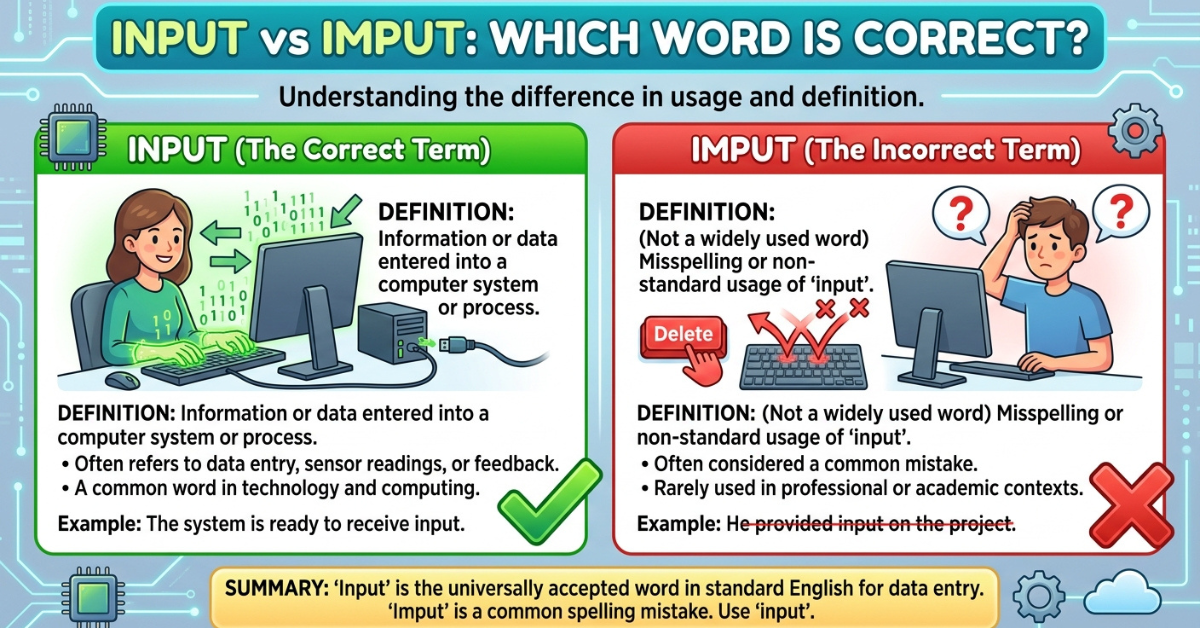
The answer is simple: input is the correct English spelling. Imput is a common misspelling and is not considered a standard English word. In this guide, we’ll explain the input vs imput meaning, definition, pronunciation, grammar, and examples so you can use the word confidently.
Input vs Imput: The Quick Answer
If you’re trying to decide between input and imput, always choose input.
- Input — Correct spelling
- Imput — Incorrect spelling or common misspelling
The word input can be used as both a noun and a verb. It generally refers to information, data, ideas, or something that is provided to a person, system, or process.
For example:
Please enter your input into the system.
Or:
I’d appreciate your input on this design.
The spelling “imput” is not the standard form in modern English.
Input vs Imput Meaning
The input vs imput meaning becomes much easier once you know that only one of these spellings is correct.
What Does Input Mean?
Input refers to something that is put into a system, process, situation, or discussion.
It can mean:
- Information or data entered into a computer or system
- Advice, ideas, or opinions given to someone
- Something used as an ingredient or resource in a process
For example:
- Enter your input into the required field.
- I value your input on this project.
- The machine requires electrical input to operate.
In simple terms, input is something you put in.
What Does Imput Mean?
Imput is generally a misspelling of input.
If someone writes “imput” when they mean information, advice, or data that is entered into a system, the intended word is almost certainly input.
For example:
Incorrect: Please provide your imput before Friday.
Correct: Please provide your input before Friday.
Therefore, if you’re looking up input vs imput definition, there isn’t really a standard English definition for “imput” comparable to “input.” It is primarily encountered as a spelling error.
Input vs Imput in English
When considering input vs imput in English, the important distinction is spelling.
Input is an established English word with several meanings and grammatical uses. It appears regularly in dictionaries, academic writing, business communication, technology, and everyday conversation.
Imput, on the other hand, is not the standard spelling.
This is one of those mistakes that can happen because English pronunciation doesn’t always make spelling obvious. When people hear the word “input,” the consonant sounds can sometimes make an incorrect spelling such as “imput” seem reasonable.
However, written English uses input, not imput.
Why Do People Spell Input as Imput?
There are a few reasons this spelling mistake happens.
1. Pronunciation Can Be Misleading
When spoken naturally, input may sound somewhat like “imput.” This can cause people to spell it the way they think they hear it.
English has many words where pronunciation doesn’t provide a perfect guide to spelling.
2. The Prefix “Im-” Is Common
English frequently uses im- as a prefix, particularly before certain consonants.
Examples include:
- impossible
- immature
- impatient
- imperfect
Because “im-” is so common, someone may instinctively write imput instead of input.
3. Typing Errors Are Easy
On keyboards and phones, a single letter can change a word. Since “imput” looks quite similar to “input,” the error may go unnoticed during quick typing.
4. The Mistake Gets Repeated
If someone has seen “imput” written incorrectly several times, it can start to look familiar. Familiarity, however, doesn’t make the spelling correct.
Input Definition: What Does Input Mean?
To define input, we can look at its main uses.
Input as a Noun
As a noun, input can mean information, advice, or an opinion provided by someone.
Example:
We need your input before we finalize the plan.
Here, “input” means the person’s thoughts, ideas, or advice.
It can also refer to data entered into a computer or other system.
Example:
The software processes the user’s input.
In this context, input means information provided to the software.
Input as a Verb
Input can also function as a verb meaning to enter information into a computer or system.
Example:
Please input your email address.
Another example:
The employee input the customer’s details into the database.
In everyday modern English, enter is often used instead of “input,” particularly when talking about typing information into a form.
Common Examples of Input
Here are some everyday examples that show how input is used:
- Your input would be helpful before we make a decision.
- Enter your input into the text box.
- The computer receives input from the keyboard.
- She gave valuable input during the meeting.
- The designer asked the client for input.
- The program uses user input to generate a result.
- We need everyone’s input before moving forward.
Notice that the spelling remains input in every example.
Input vs Imput Examples
Seeing the words side by side can make the difference easier to remember.
| Incorrect | Correct |
| Please give me your imput. | Please give me your input. |
| Enter the imput into the system. | Enter the input into the system. |
| We need your imput on this idea. | We need your input on this idea. |
| The software receives imput. | The software receives input. |
The rule is straightforward: use input, never imput, when you mean information, advice, data, or something entered into a system.
How to Remember the Correct Spelling
A simple trick can help you remember input vs imput.
Think of the word as:
IN + PUT = INPUT
Something is being put in.
For example:
- Information is put in a computer.
- Your ideas are put in a discussion.
- Data is put in a form.
So remember:
Input = in + put
This makes it easier to avoid accidentally writing “imput.”
Input in Technology and Computing
The word input is especially common in technology.
In computing, input refers to data or instructions provided to a computer or digital system.
Common examples include:
- Keyboard input
- Mouse input
- Touchscreen input
- Voice input
- User input
- Text input
- Data input
For example, when you type a password into a login box, the characters you enter are input.
The computer then processes that input and produces an output.
This gives us a useful relationship:
Input → Processing → Output
For instance:
You enter numbers into a calculator → the calculator processes them → it displays the answer.
Input in Business and Everyday Communication
“Input” isn’t limited to computers.
In business, education, design, and everyday conversations, input often means someone’s opinion, advice, or contribution.
For example:
The client provided valuable input on the interior design concept.
Here, “input” doesn’t mean something typed into a computer. It means feedback, ideas, or suggestions.
You might also hear:
- “I’d like your input.”
- “Thanks for your input.”
- “We need some input from the team.”
- “Your input helped us improve the project.”
In these cases, replacing “input” with “opinion,” “feedback,” or “advice” may help clarify its meaning.
Is Imput a Word?
In standard modern English, imput is not the correct spelling of the word commonly intended in this context.
If you’re writing an email, assignment, report, website, résumé, or professional document, use input.
For example:
Incorrect: I would appreciate your imput.
Correct: I would appreciate your input.
Using “input” will ensure that your spelling is correct and your writing looks professional.
Input vs Imput Pronunciation
Another reason people confuse these words is pronunciation.
Input is commonly pronounced approximately as:
IN-put
The first syllable sounds like “in,” while the second sounds like “put.”
Because the two sounds blend together during normal speech, some speakers may perceive or reproduce the word as “imput” when spelling it.
However, pronunciation does not change the standard spelling.
Correct: input
Incorrect: imput
Input vs Imput: Common Grammar Mistakes
The spelling isn’t the only thing worth knowing. Here are a few common usage points.
“Input” Can Be Singular or Uncountable
When “input” means advice or feedback, it is often used as an uncountable noun.
I need your input.
This sounds natural.
You can also use “input” in a countable sense when referring to distinct contributions in certain contexts, although the uncountable form is very common.
“Inputted” vs “Input”
The past tense of input can be confusing.
Both input and inputted are used in English, depending on context and style.
For example:
She input the data yesterday.
You may also encounter:
She inputted the data yesterday.
“Input” is particularly common in technical and formal contexts, while “inputted” is also recognized and used.
For everyday writing, entered is often the simplest alternative:
She entered the data yesterday.
Synonyms for Input
Depending on the context, you can replace input with several related words.
When input means an opinion or contribution, possible alternatives include:
- Feedback
- Advice
- Opinion
- Suggestion
- Contribution
- Perspective
- Comment
- Guidance
When input means data or information entered into a system, alternatives may include:
- Data
- Information
- Entry
- Details
- Instructions
However, these words aren’t always interchangeable. The best synonym depends on the sentence.
How to Use Input Correctly
If you’re unsure whether you’re using input correctly, ask yourself what you mean.
Use “input” when you mean:
- Information entered into a system
- Data provided to a computer
- An opinion or suggestion
- Feedback from another person
- A contribution to a discussion
- Something supplied to a process
Avoid “imput”
If you’ve written imput, stop and check whether you meant input.
In most ordinary English contexts, changing “imput” to “input” will fix the spelling mistake.
Input vs Imput: Quick Comparison
| Feature | Input | Imput |
| Standard English word? | Yes | No |
| Correct spelling? | Yes | No |
| Can be a noun? | Yes | No, in this intended sense |
| Can be a verb? | Yes | No, in this intended sense |
| Used in technology? | Yes | No |
| Used for opinions or feedback? | Yes | No |
| Commonly confused with the other? | Yes | Yes, as a misspelling |
Frequently Asked Questions About Input vs Imput
Is “input” or “imput” correct?
Input is correct. Imput is a common misspelling.
What is the input vs imput meaning?
“Input” means information, data, advice, feedback, or something provided to a system or process. “Imput” is generally an incorrect spelling of “input.”
How do you define input vs imput?
The correct word to define is input. It can mean information entered into a system or an opinion, idea, or contribution provided by someone. “Imput” is not the standard spelling.
Is imput a real English word?
“Imput” is not the standard English spelling for the word meaning information, data, feedback, or contribution. In most cases, it is simply a misspelling of input.
Why do people say “imput”?
The confusion is likely caused by pronunciation. When spoken quickly, “input” can sound similar to “imput,” making the incorrect spelling seem natural.
How do you spell input correctly?
The correct spelling is I-N-P-U-T: input.
A helpful way to remember it is IN + PUT.
What is an example of input?
The manager asked for everyone’s input before making the final decision.
In this sentence, “input” means everyone’s opinions or suggestions.
What is the opposite of input?
In computing, the opposite or corresponding concept is often output. Input is information supplied to a system, while output is the result produced by that system.
Is “input” a noun or a verb?
Input can be both a noun and a verb.
As a noun:
Your input is valuable.
As a verb:
Please input the information into the form.
Final Thoughts on Input vs Imput
When it comes to input vs imput, there isn’t much ambiguity once you know the correct spelling. Input is the standard English word, while imput is generally a misspelling.
Remember the simple trick: IN + PUT = INPUT.
Whether you’re talking about computer data, someone’s opinion, feedback from a colleague, or information entered into a form, input is the spelling you should use.
So, the next time you’re unsure whether to write input or imput, choose input with confidence. If you’re interested in improving your English vocabulary and avoiding other commonly confused words, exploring related spelling and grammar guides can be a useful next step.





