
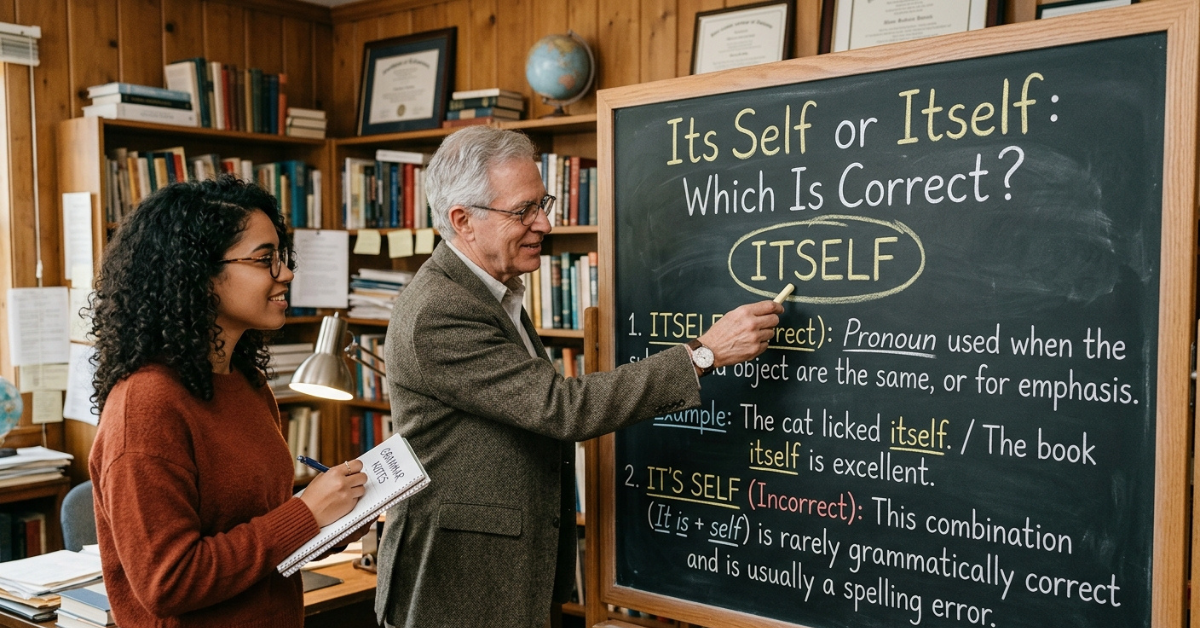
- The door opened by itself.
- The company has established itself as a market leader.
- The problem will eventually resolve itself.
In each example, “itself” refers back to a thing or concept mentioned earlier.
Why “its self” is usually incorrect
Its is a possessive determiner. It shows that something belongs to or is associated with a thing.
For example:
- The dog wagged its tail.
- The company changed its policy.
- The phone lost its connection.
Self, on the other hand, is a noun meaning the individual identity or nature of a person or thing.
When these words are placed together as “its self,” they do not normally function as the reflexive pronoun. In everyday writing, replacing “itself” with “its self” is considered incorrect.
What Does “Itself” Mean?
Itself means “that thing itself” or refers back to a thing that has already been mentioned.
It can be used in several ways.
1. As a reflexive pronoun
A reflexive pronoun refers back to the subject of a sentence.
For example:
The computer restarted itself.
Here, “itself” refers to the computer.
Another example:
The cat cleaned itself.
The cat is both the subject and the thing receiving the action, so “itself” is appropriate.
2. For emphasis
“Itself” can also emphasize a noun or pronoun.
For example:
The building itself is beautiful.
The sentence does not mean that the building performed an action on itself. Instead, “itself” emphasizes that the building, rather than something surrounding it, is beautiful.
Another example:
The idea itself is not difficult.
Here, “itself” adds emphasis to “the idea.”
To Its Self or To Itself?
If you are specifically asking whether the phrase should be “to its self” or “to itself,” use:
“to itself”
For example:
- The door slowly closed to itself.
- The system can adapt to itself over time.
- The argument refers back to itself.
However, the exact wording of a sentence matters. In many cases, another construction may sound more natural than “to itself.”
For instance:
The organization became focused on itself.
This is more natural than trying to construct a sentence around “its self.”
Examples of “to itself”
Here are some natural examples:
- The company drew attention to itself.
- The machine can adjust itself automatically.
- The software updated itself overnight.
- The discussion eventually turned to itself.
- The organization became too focused on itself.
Notice that the preposition can change—to itself, on itself, by itself, for itself, and so on—but “itself” remains one word.
Itself vs. Its: What’s the Difference?
One of the easiest ways to understand the difference is to remember that its and itself serve different grammatical purposes.
| Word | Function | Example |
| its | Shows possession | The company changed its logo. |
| itself | Reflexive or emphatic pronoun | The company redesigned the logo itself. |
Compare these two sentences:
The dog hurt its paw.
Here, “its” shows possession. The paw belongs to the dog.
The dog hurt itself.
Here, “itself” refers back to the dog because the dog is both performing and receiving the action.
This distinction is important because “its” cannot normally replace “itself.”
Itself vs. It’s: Don’t Confuse Them
Another common English mistake is confusing itself with it’s.
They are completely different.
It’s
It’s is a contraction of either:
- it is
- it has
Examples:
It’s raining.
Meaning:
It is raining.
Another example:
It’s been a long day.
Meaning:
It has been a long day.
Itself
Itself is a pronoun.
Example:
The machine repaired itself.
A simple trick is to remember:
It’s = it is / it has
Its = possessive
Itself = reflexive or emphatic pronoun
Common Examples of Itself in a Sentence
Understanding examples is often easier than memorizing grammar rules. Here are some common uses of itself.
Reflexive use
The bird injured itself.
The computer shut itself down.
The door locked itself automatically.
Emphatic use
The product itself is excellent.
The plan itself is quite simple.
The house itself needs some repairs.
After a preposition
“Itself” can follow a preposition when the meaning requires it.
Examples include:
- by itself
- for itself
- in itself
- on itself
- to itself
For example:
The machine operates by itself.
The situation is complicated in itself.
The organization brought attention to itself.
“By Itself” vs. “By Its Self”
The phrase “by itself” is particularly common.
It usually means alone, without assistance, or independently.
For example:
The child opened the door by itself.
The computer restarted by itself.
The plant cannot survive by itself.
The standard spelling is always “by itself”, not “by its self.”
When Can “Its Self” Appear?
There are unusual contexts where “its self” can technically appear as two separate words, but this is not the ordinary way of expressing the reflexive pronoun.
In such a construction, self would have to be functioning as an actual noun, with its modifying it.
For example, in highly philosophical, literary, or specialized writing, someone might discuss an object’s “self” as though “self” were a separate conceptual noun.
A sentence might theoretically say:
The machine’s designers were interested in its self as an autonomous system.
However, this is highly unusual and can sound awkward. It is not the standard grammatical alternative to itself.
For normal writing—especially emails, essays, websites, academic assignments, and professional communication—use “itself.”
Its Self or Itself: Quick Comparison
If you are unsure which form to use, this quick comparison can help:
Use “itself” when:
- You need a reflexive pronoun.
- The word refers back to a thing or idea.
- You want to emphasize a noun.
- You are using phrases such as “by itself” or “in itself.”
- You are writing ordinary modern English.
Use “its” when:
- You are showing possession.
- A noun follows it.
Examples:
- The company updated its website.
- The company updated the website itself.
- The machine fixed itself.
- The machine operates by itself.
Common Mistakes With Itself
Here are some errors worth avoiding.
Incorrect: The phone turned its self off.
Correct: The phone turned itself off.
Incorrect: The door opened by its self.
Correct: The door opened by itself.
Incorrect: The company introduced its self to the public.
Correct: The company introduced itself to the public.
Incorrect: The idea in its self is interesting.
Correct: The idea in itself is interesting.
These mistakes usually happen because its and itself sound related. Remember that itself is a single word when it functions as a reflexive or intensive pronoun.
How to Remember the Correct Spelling
A simple memory trick is to think of the common pronoun family:
- myself
- yourself
- himself
- herself
- itself
- ourselves
- yourselves
- themselves
Notice that itself follows the same pattern as the other reflexive pronouns.
You would not normally write “my self” when you mean the reflexive pronoun myself. Similarly, you should write itself, not “its self,” when referring back to an object or idea.
Is “Itself” Always Correct?
Not necessarily. Itself is correct when the grammar calls for a reflexive or intensive pronoun, but that does not mean it belongs in every sentence involving the word “it.”
For example:
The company changed its policy.
This sentence needs the possessive determiner its, not itself.
But:
The company changed the policy itself.
Here, “itself” emphasizes that the company performed the action.
So the choice depends on what you are trying to say.
Frequently Asked Questions
Is it “its self” or “itself”?
Itself is the correct standard form when you need the reflexive or emphatic pronoun. “Its self” is generally not used for this purpose.
Is “to its self” correct?
Usually, no. If you mean the reflexive pronoun, write “to itself.” For example, “The company drew attention to itself.”
Is “by its self” correct?
No, not when you mean “alone” or “without assistance.” The correct phrase is “by itself.”
What is the difference between its and itself?
Its is a possessive determiner, while itself is a reflexive or intensive pronoun.
For example:
The dog moved its leg.
The dog injured itself.
Is “itself” one word?
Yes. Itself is normally written as one word.
Can “its self” ever be used?
It can appear in rare, specialized contexts where self is deliberately being treated as a separate noun. However, this is uncommon and should not be used as a substitute for the standard pronoun itself.
What is an example of itself?
A simple example is:
The computer restarted itself.
Here, “itself” refers back to “the computer.”
Conclusion: Its Self or Itself?
When deciding between “its self or itself,” the answer is straightforward in almost every ordinary situation: use “itself.”
“Itself” is a standard reflexive and intensive pronoun used to refer back to a thing, animal, idea, or situation. By contrast, its is used to show possession, while “its self” is rarely appropriate in everyday English.
So remember:
- Itself = reflexive or emphatic pronoun
- Its = possessive determiner
- It’s = it is / it has
- Its self = rarely used as two separate words
If you are writing a sentence such as “by ___,” “to ___,” “on ___,” or “in ___,” and the word refers back to the thing already mentioned, itself will usually be the form you need.
A little attention to this distinction can make your writing clearer, more polished, and grammatically accurate.





