
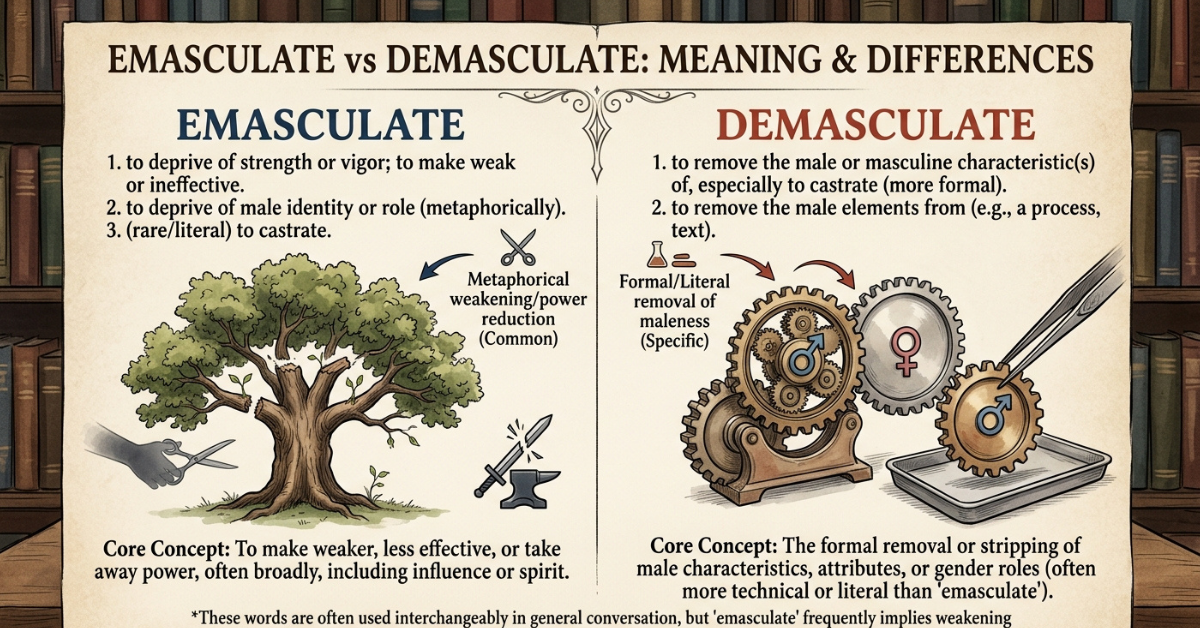
Words that look almost identical can sometimes cause surprisingly confusing grammar questions. Emasculate vs demasculate is a good example. Both appear to describe the loss or removal of masculine qualities, but they do not have the same status or usage in standard English.
The key point is simple: emasculate is an established English word, while demasculate is extremely rare and is generally not the word you should use in ordinary writing. Understanding this distinction can help you choose the correct term when you’re describing masculinity, confidence, authority, or physical characteristics.
Let’s break down the emasculate vs demasculate meaning, pronunciation, usage, and examples so there’s no confusion.
What Does Emasculate Mean?
Emasculate is a verb that traditionally means to deprive a man of his male reproductive organs or of characteristics associated with masculinity. In modern English, it is also commonly used figuratively.
For example, someone might say that a person was emasculated after losing authority, confidence, independence, or a sense of power.
Emasculate Meaning in Simple English
In simple terms, emasculate can mean:
- To castrate or remove the male reproductive organs.
- To make someone feel less masculine.
- To weaken someone’s confidence, authority, or power.
- To deprive something of its strength or effectiveness.
The figurative meaning is particularly common in everyday and literary English.
Examples of Emasculate
Here are a few examples:
- The criticism made him feel emasculated.
- He felt emasculated after being publicly undermined by his colleagues.
- The injury left him worried that he had been physically emasculated.
- The new restrictions emasculated the organization by limiting its authority.
Notice that the word does not always have to refer directly to biological sex. It can describe a perceived loss of power, independence, strength, or masculine identity.
What Does Demasculate Mean?
Demasculate is a much less common word. It is sometimes used to mean removing or reducing masculine characteristics, essentially resembling the figurative sense of emasculate.
However, it is not nearly as established or widely used in standard English.
If you’re writing an article, essay, professional email, academic assignment, or other formal content, emasculate is usually the safer and more recognizable choice.
Is Demasculate a Real Word?
This is where the confusion comes from.
You may encounter demasculate in dictionaries, specialist writing, historical texts, or online discussions. Its existence as a rare formation does not mean that it is interchangeable with the much more common emasculate.
English frequently creates words by adding prefixes such as de-, which can give the impression that demasculate should be the natural opposite or alternative to emasculate. But language does not always work that neatly.
A word can be understandable and occasionally attested while still being extremely uncommon.
Emasculate vs Demasculate Meaning
The easiest way to understand the distinction is to compare their typical usage.
| Word | Meaning | Commonness | Recommended Usage |
| Emasculate | To deprive of masculine qualities, strength, authority, or male reproductive organs | Common | Yes |
| Demasculate | A rare term relating to removing masculine characteristics | Very rare | Usually avoid |
| Emasculated | Made to feel less masculine, powerful, or authoritative | Common | Yes |
| Demasculated | Rare form related to demasculate | Extremely uncommon | Usually avoid |
So, when someone searches for emasculate vs demasculate meaning, the practical answer is that emasculate is the standard and widely recognized word, whereas demasculate is rare and generally unnecessary.
Why Do People Confuse Emasculate and Demasculate?
The confusion largely comes from the way the words are constructed.
The prefix de- can mean removal, reversal, or reduction in many English words. Because of this, someone may naturally assume that demasculate is the proper word for “removing masculinity.”
But emasculate has a long-established history in English and already carries this meaning.
In other words, you don’t need to create a new word when an established word already expresses the idea clearly.
Emasculate in Literal vs Figurative Use
One reason emasculate can be confusing is that it has both literal and figurative meanings.
Literal Meaning
Historically and medically, emasculate can refer to castration or the removal of male reproductive organs.
For example:
The procedure left the animal emasculated.
This is a literal use of the term.
Figurative Meaning
In modern conversations, you’re more likely to see emasculate used figuratively.
For example:
Losing his leadership position made him feel emasculated.
Here, nobody is suggesting a physical procedure. The word describes a perceived loss of masculine confidence, status, authority, or power.
The figurative meaning can also apply to organizations or systems:
Excessive regulations emasculated the department.
In this sentence, the department has not literally become less masculine. Instead, its power or effectiveness has been weakened.
Is Emasculate Always About Masculinity?
Not necessarily.
Although the word is strongly associated with masculinity, its figurative meaning can extend to weakening power, effectiveness, authority, or strength.
For example:
- “The amendments emasculated the bill.”
- “Budget cuts emasculated the program.”
- “The new rules emasculated the committee’s authority.”
In these examples, emasculate means something closer to weaken, undermine, or deprive of effectiveness.
However, because the word has strong associations with masculinity, writers should consider whether another word, such as weaken, undermine, or cripple, would communicate the idea more precisely.
Synonyms for Emasculate
Depending on the context, several words can replace emasculate.
When referring to masculinity
- Castrate
- Unman
- Make less masculine
- Strip of masculine confidence
When referring to power or authority
- Weaken
- Undermine
- Disempower
- Enfeeble
- Cripple
- Neutralize
- Reduce
The best synonym depends heavily on context.
For instance, weaken works well when discussing an institution, while emasculate may be appropriate when the focus is specifically on a perceived loss of masculine identity or confidence.
Emasculate vs Unman
Another word that sometimes appears alongside emasculate is unman.
Both can describe depriving someone of traditionally masculine qualities, but they have slightly different tones.
Emasculate is more established and can be used both literally and figuratively. Unman is less common in contemporary everyday English and can sound literary or old-fashioned.
For most modern writing, emasculate will be the more familiar choice.
Emasculate vs Demasculate: Which Word Should You Use?
If you’re deciding between the two, use emasculate in almost all ordinary situations.
Choose emasculate when you mean:
- To deprive a man of male reproductive organs.
- To make someone feel less masculine.
- To undermine someone’s masculine confidence.
- To weaken authority or effectiveness figuratively.
Use demasculate only when you have a specific reason to use this rare term and have checked that it fits the context.
For SEO content, academic writing, workplace communication, and general-purpose writing, emasculate is much more recognizable to readers.
Common Mistakes With Emasculate
Here are some mistakes worth avoiding.
1. Treating Demasculate as the Standard Opposite
Because de- often suggests removal, writers may assume that demasculate is the standard term.
It isn’t the normal choice in contemporary English.
2. Assuming Emasculate Always Means Castration
The word has a literal meaning related to castration, but it also has an important figurative meaning.
For example, “He felt emasculated” usually refers to an emotional or psychological experience rather than a literal physical change.
3. Using Emasculate When Weaken Is Clearer
Because emasculate carries gender-related associations, it may sound unnecessarily loaded when you’re simply talking about reducing the effectiveness of something.
Instead of:
The new policy emasculated the department.
you might simply write:
The new policy weakened the department.
Both can work, but the second is more straightforward.
How to Remember the Difference
A simple memory trick can make this easier:
Emasculate = the established word.
Think of emasculate whenever you’re talking about reducing masculinity or figuratively taking away someone’s strength, authority, or effectiveness.
Demasculate = rare.
If you come across demasculate, don’t automatically assume it’s the preferred alternative. In most everyday writing, emasculate is the clearer and more conventional choice.
Emasculate vs Demasculate Examples
Let’s compare them in practical sentences.
Emasculate
- The experience left him feeling emasculated.
- The criticism seemed to emasculate his confidence.
- The reforms emasculated the agency’s authority.
- The historical practice was intended to emasculate the defeated enemy.
Demasculate
- The term demasculate occasionally appears in specialized or uncommon usage.
- Demasculate is much less familiar to modern English speakers than emasculate.
If your goal is clear communication, the first group is far more natural.
Frequently Asked Questions
Is “demasculate” a word?
Yes, demasculate can be found in rare usage, but it is extremely uncommon. Emasculate is the established and much more widely recognized term.
What is the difference between emasculate and demasculate?
The main difference is usage and familiarity. Emasculate is a standard English verb meaning to deprive someone of masculine qualities or, literally, male reproductive organs. Demasculate is a rare term with a similar general idea but is not normally preferred in everyday English.
Is emasculate a negative word?
It can have a negative or sensitive connotation, particularly when describing someone’s masculinity or self-confidence. Its figurative use can imply that a person has been made to feel weak, powerless, or less masculine.
Can you emasculate a woman?
Traditionally, emasculate refers specifically to removing male reproductive organs or masculine qualities. When used figuratively, it generally concerns masculinity, so using it for a woman can sound unusual unless the context specifically involves traditionally masculine characteristics or power.
What is the opposite of emasculate?
The opposite depends on the context. If you’re talking about masculinity, possible ideas include masculinize or strengthen masculine qualities. If you’re talking about power, empower, strengthen, or reinforce may be better opposites.
What does “feeling emasculated” mean?
Feeling emasculated generally means feeling that your masculinity, confidence, authority, independence, or sense of strength has been diminished. The meaning is usually emotional or psychological rather than literal.
Is emasculate the same as castrate?
Not always. Castrate specifically refers to removing the testicles or rendering an animal or person incapable of reproduction. Emasculate can refer literally to castration, but it also has broader figurative meanings involving masculinity, confidence, power, or effectiveness.
Final Takeaway: Emasculate vs Demasculate
When it comes to emasculate vs demasculate, there is a clear practical winner. Emasculate is the established, familiar English word and can describe both the literal removal of male reproductive organs and the figurative loss of masculinity, confidence, authority, or effectiveness.
Demasculate is a rare term that you may encounter, but it is not the natural choice for most modern English writing. If you’re unsure which word to use, emasculate is generally the better option.
When precision matters, though, consider the context. If you simply mean “make weaker,” words such as weaken, undermine, or disempower may communicate your meaning more clearly.





