
Have you ever typed, “I’m laying on the bed,” and suddenly wondered whether it should actually be “I’m lying on the bed”? You’re definitely not alone. Laying vs. lying is one of the most confusing grammar questions in English, even for native speakers.
The confusion happens because the verbs lay and lie look and sound similar, but they have different meanings and follow different grammar rules. One usually involves putting something somewhere, while the other describes a person or thing resting in a horizontal position.
In this guide, we’ll break down the laying vs. lying difference, explain when to use each word, and look at plenty of simple examples. By the end, you’ll know whether you should say “I’m laying down” or “I’m lying down” without second-guessing yourself.
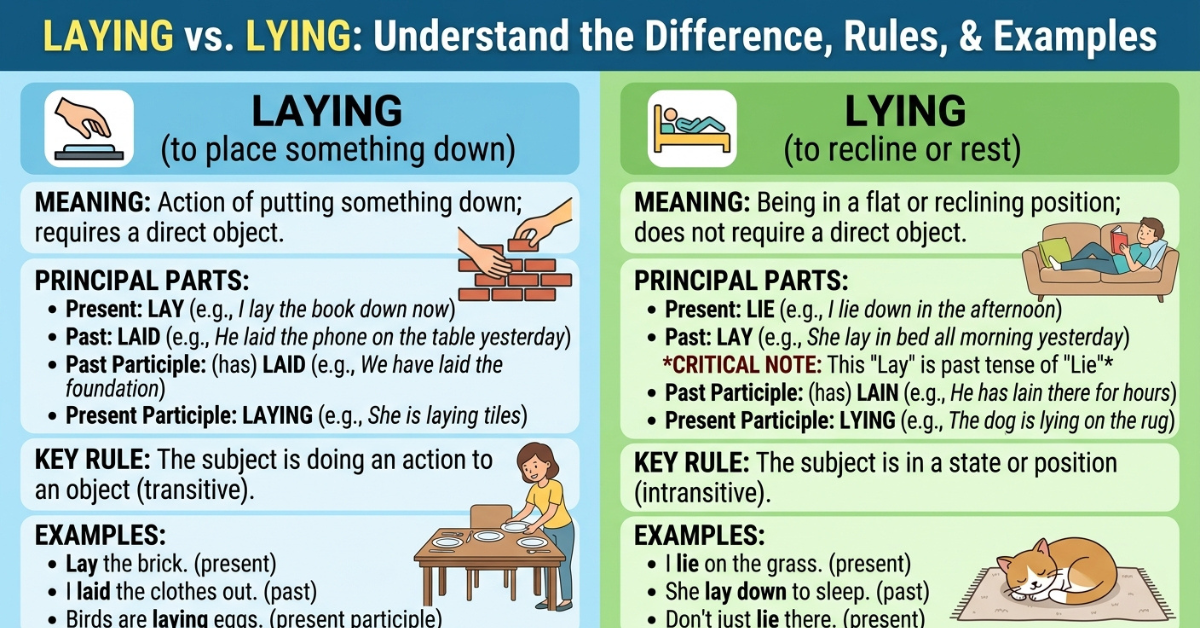
Laying vs. Lying Definition
The easiest way to understand laying vs. lying meaning is to remember one important difference:
- Lay / laying usually requires an object.
- Lie / lying usually does not require an object.
Let’s make that much simpler.
What Does “Laying” Mean?
Laying is the present participle of lay. It means putting or placing something somewhere.
For example:
- She is laying the book on the table.
- He is laying the baby in the crib.
- They are laying tiles on the floor.
In each sentence, someone is placing something somewhere.
You can ask:
Laying what?
If you have an answer, laying may be correct.
For example:
She is laying the book on the table.
The book is the object being placed.
What Does “Lying” Mean?
Lying is the present participle of lie when lie means resting in a horizontal position.
For example:
- She is lying on the sofa.
- The dog is lying on the floor.
- I am lying in bed.
Here, nobody is placing another object somewhere. The subject is simply resting or reclining.
You can think of lying as meaning:
- Resting
- Reclining
- Being flat or horizontal
The Main Difference Between Laying vs. Lying
Here is the simplest grammar rule to remember:
| Word | Meaning | Needs an Object? |
| Laying | Putting something somewhere | Yes, usually |
| Lying | Resting or reclining | No |
Compare These Examples
Correct:
- I am lying on the bed.
- She is lying on the ground.
- The cat is lying on the floor.
Correct:
- I am laying the blanket on the bed.
- She is laying the keys on the table.
- He is laying the baby down.
The key question is:
Are you resting yourself, or are you placing something somewhere?
If you are resting yourself, use lying.
If you are placing something, use laying.
Laying vs. Lying Down: Which Is Correct?
One of the most common searches is laying vs. lying down.
In standard English grammar, when you mean reclining or resting, lying down is correct.
Correct:
- I am lying down because I’m tired.
- She is lying down on the couch.
- The baby is lying down for a nap.
Grammatically incorrect in standard usage:
- I am laying down because I’m tired.
Why?
Because laying generally needs an object.
However, you can correctly say:
- I am laying down the book.
- She is laying down the rules.
- He is laying down the carpet.
In these examples, something is being placed or established.
So, if you mean resting your body, the correct phrase is usually:
“I’m lying down.”
Laying vs. Lying in Bed
The same rule applies when talking about being in bed.
Correct:
- I am lying in bed.
- She is lying in bed reading a book.
- He spent the morning lying in bed.
Incorrect in formal grammar:
- I am laying in bed.
The reason is simple: you are not placing something. You are resting yourself.
Therefore:
Correct: I’m lying in bed.
Incorrect: I’m laying in bed.
That said, “laying in bed” is common in casual speech in some regions. But if you are writing professionally, academically, or formally, lying in bed is the better choice.
Laying vs. Lying on the Ground
If someone or something is resting on the ground, use lying.
Examples:
- He was lying on the ground.
- The injured player was lying on the ground.
- The dog is lying on the grass.
However, use laying when someone is placing something on the ground.
Examples:
- She is laying the blanket on the ground.
- They are laying bricks on the ground.
- He is laying the bag down.
So:
Person resting = lying
Object being placed = laying
Laying vs. Lying on the Floor
This follows exactly the same grammar rule.
Correct:
- The baby is lying on the floor.
- I found the cat lying on the floor.
- He was lying flat on the floor.
Correct use of “laying”:
- She is laying the carpet on the floor.
- They are laying wooden panels on the floor.
The difference depends on whether the subject is resting or placing something.
Laying vs. Lying Around
Another common expression is lying around.
When something is resting somewhere without being actively used, lying around is generally correct.
Examples:
- There are clothes lying around the room.
- My phone was lying around somewhere.
- He spent all day lying around the house.
When talking about relaxing lazily, you would say:
I’ve been lying around all day.
Not:
I’ve been laying around all day.
Again, in casual conversation, people often say laying around, but lying around is grammatically correct when referring to resting or reclining.
When to Use Laying vs. Lying
Here is a quick test you can use whenever you get confused.
Use “Lying” When Someone or Something Is Resting
Use lying when:
- A person is in bed.
- Someone is resting on a sofa.
- An animal is on the floor.
- Something is positioned naturally somewhere.
Examples:
- I’m lying on the couch.
- She is lying in bed.
- The dog is lying on the rug.
- The papers are lying on the desk.
Use “Laying” When Something Is Being Placed
Use laying when someone is putting something somewhere.
Examples:
- She is laying the phone on the desk.
- He is laying the baby in the crib.
- They are laying tiles on the floor.
- I’m laying the clothes on the bed.
A helpful question is:
Laying what?
If you can answer that question, laying is probably appropriate.
Laying vs. Lying Grammar Rules
The confusion becomes easier to understand when we look at the verb forms.
Forms of “Lie” Meaning to Rest
When lie means to recline or rest:
| Tense | Verb Form |
| Present | Lie |
| Present participle | Lying |
| Past | Lay |
| Past participle | Lain |
Examples:
- I lie down every afternoon.
- I am lying down now.
- Yesterday, I lay down for an hour.
- I have lain down.
Yes, this is where things get confusing.
The past tense of lie is actually lay.
For example:
Yesterday, I lay on the couch.
That’s completely correct.
Forms of “Lay” Meaning to Place Something
When lay means to put or place something:
| Tense | Verb Form |
| Present | Lay |
| Present participle | Laying |
| Past | Laid |
| Past participle | Laid |
Examples:
- I lay the book on the table.
- I am laying the book down.
- Yesterday, I laid the book there.
- I have laid the book on the desk.
This is why laying vs. lying grammar can feel so confusing: lay is both a verb in its own right and the past tense of lie.
Lying vs. Laying vs. Lying: Understanding the Confusion
You may sometimes see searches like “lying vs laying vs lying”, which shows just how often people mix these forms up.
The main thing to remember is that lying can have two completely different meanings depending on context.
“Lying” Can Mean Resting
- She is lying on the bed.
Here, lying means reclining.
“Lying” Can Also Mean Not Telling the Truth
- He is lying about what happened.
Here, lying means being dishonest.
These are two different verbs:
Lie = Recline
- I am lying down.
Lie = Tell an Untruth
- He is lying to me.
The spelling is the same, but the meanings are different.
Context tells you which meaning is intended.
Laying vs. Lying in a Sentence
Here are some side-by-side examples to make the difference clearer.
Example 1
Incorrect: I am laying on the couch.
Correct: I am lying on the couch.
You are resting, so lying is correct.
Example 2
Incorrect: She is lying the book on the table.
Correct: She is laying the book on the table.
She is placing the book somewhere, so laying is correct.
Example 3
Incorrect: The dog is laying on the floor.
Correct: The dog is lying on the floor.
The dog is resting.
Example 4
Incorrect: I’m laying down because I’m tired.
Correct: I’m lying down because I’m tired.
You are reclining.
Example 5
She is laying the baby down for a nap.
This is correct because she is placing the baby down.
Laying vs. Lying Examples
Here are more everyday examples.
Examples of “Lying”
- I’m lying in bed.
- She is lying on the sofa.
- The cat is lying in the sun.
- He was lying on the ground.
- We spent the afternoon lying around.
- The papers are lying on the desk.
- She is lying flat on her back.
Examples of “Laying”
- She is laying the book on the table.
- He is laying the baby in the crib.
- They are laying new flooring.
- The workers are laying bricks.
- I’m laying the clothes on the bed.
- She is laying the documents on his desk.
Laying vs. Lying Flat
When describing someone who is completely horizontal, lying flat is usually correct.
Examples:
- He was lying flat on the ground.
- She is lying flat on her back.
- The patient was lying flat in bed.
Why?
Because the person is resting or reclining.
However, laying something flat is also correct when you are placing an object in a flat position.
Example:
- She is laying the paper flat on the table.
So again, ask yourself:
- Who is resting? → lying flat
- What is being placed? → laying flat
A Simple Trick to Remember the Difference
Here’s an easy memory trick for when to use laying vs. lying:
LIE = You
Think of lie as something you do yourself.
- I lie down.
- I am lying down.
LAY = Something
Think of lay as something you do to another object.
- I lay the book down.
- I am laying the book down.
You can also remember this simple formula:
Lie = recline
Lay = place
That one rule will solve most laying vs. lying grammar difference questions.
Why Do People Say “Laying Down” So Often?
Even though lying down is traditionally correct when talking about reclining, laying down has become extremely common in casual English.
Language changes through everyday speech, and many people use laying and lying interchangeably in informal conversations.
For example, you may hear:
“I’m going to lay down for a while.”
This is common in spoken English, but traditional grammar recommends:
“I’m going to lie down for a while.”
If you’re writing a school assignment, professional document, article, or formal email, it’s best to follow the standard grammar rule.
Laying vs. Lying: Quick Grammar Cheat Sheet
If you only remember one section of this article, make it this one.
Use LYING for:
- Lying down
- Lying in bed
- Lying on the floor
- Lying on the ground
- Lying on the couch
- Lying around
- Lying flat
Use LAYING for:
- Laying a book down
- Laying a baby in a crib
- Laying tiles
- Laying bricks
- Laying clothes on a bed
- Laying something on a table
Common Mistakes With Laying and Lying
Mistake 1: “I’m laying in bed.”
Better:
I’m lying in bed.
You are resting yourself.
Mistake 2: “The dog is laying on the floor.”
Better:
The dog is lying on the floor.
The dog is reclining.
Mistake 3: “She is lying the baby down.”
Better:
She is laying the baby down.
She is placing the baby somewhere.
Mistake 4: “Yesterday, I laid on the couch.”
Better:
Yesterday, I lay on the couch.
This is tricky because the past tense of lie (meaning recline) is lay.
Frequently Asked Questions
Is it laying down or lying down?
If you mean resting or reclining, lying down is grammatically correct.
For example:
I’m lying down because I’m tired.
Use laying down when placing something somewhere:
She is laying down the book.
Is it laying in bed or lying in bed?
The correct phrase is lying in bed when you mean resting in bed.
I spent the morning lying in bed.
Is it laying on the floor or lying on the floor?
Use lying on the floor when someone or something is resting there.
The dog is lying on the floor.
Use laying when someone is placing something on the floor.
She is laying the carpet on the floor.
What is the difference between laying and lying?
The main laying vs. lying difference is that laying usually means placing something somewhere, while lying means resting or reclining.
Why is “laying down” sometimes considered incorrect?
When laying down means resting yourself, traditional grammar prefers lying down because lay generally requires an object.
However, laying down is common in informal speech.
Can “lying” mean two different things?
Yes. Lying can mean:
- Resting in a horizontal position.
- Saying something that is not true.
For example:
- She is lying on the bed.
- She is lying about what happened.
The meaning depends on the context.
How do I remember laying vs. lying?
Use this simple trick:
- Lie = recline
- Lay = place something
If you are resting, use lying.
If you are placing something somewhere, use laying.
Conclusion: Laying vs. Lying Made Simple
The laying vs. lying debate becomes much easier once you understand one basic rule: lying means resting, while laying means placing something somewhere.
So, you are usually lying in bed, lying on the ground, or lying on the floor. But you are laying a book on the table, laying tiles on the floor, or laying a baby in a crib.
The next time you’re unsure, ask yourself one simple question: Am I resting, or am I placing something? If you’re resting, choose lying. If you’re putting something somewhere, choose laying.
Understanding this small but important grammar difference can make your English writing sound clearer and more natural. For more useful grammar guides, explore related topics such as lie vs. lay, affect vs. effect, and other commonly confused English words.





