
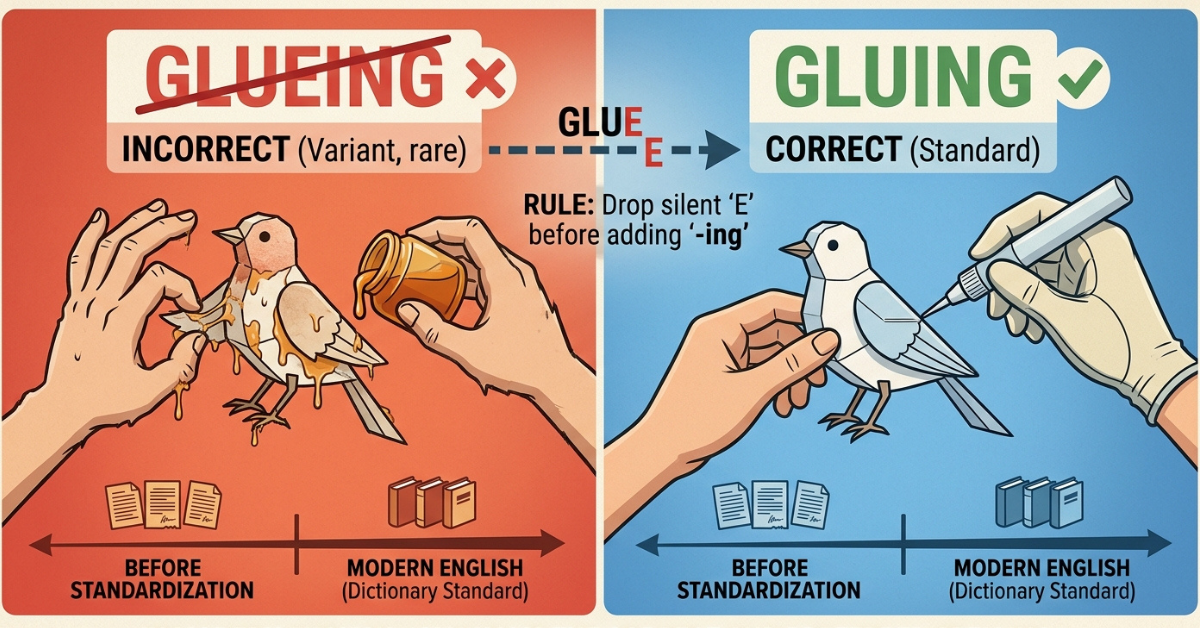
Have you ever typed “glueing” and wondered whether it looks right? You are not alone. The spelling glueing or gluing can be confusing because the word glue ends in a vowel followed by e, making the usual English spelling rules feel less straightforward.
So, is it glueing or gluing? In modern English, gluing is generally the preferred spelling. It is the present participle and gerund form of the verb glue, as in “She is gluing the pieces together.”
That said, glueing does appear in some dictionaries and written sources, particularly because it follows a more literal approach to adding -ing to glue. Understanding why both forms exist—and which one you should use—makes the choice much easier.
Glueing or Gluing: What Is the Correct Spelling?
The short answer is:
Gluing is the preferred and more common spelling.
When the verb glue takes the -ing ending, the final e is normally dropped:
- Glue → gluing
- Glue → glued
- Glue → glues
- Glue → gluing
For example:
I am gluing the broken pieces together.
She spent the afternoon gluing photographs into her scrapbook.
They are gluing the paper to the cardboard.
Although glueing can be found in dictionaries and published writing, gluing is the spelling most readers will expect.
Is It Glueing or Gluing?
If you are asking “is it glueing or gluing?”, use gluing in most everyday and formal writing.
The reason comes from a common English spelling convention. When a verb ending in a silent e takes a suffix beginning with a vowel, the final e is often removed.
For example:
- make → making
- take → taking
- write → writing
- bake → baking
- use → using
- glue → gluing
There are exceptions to English spelling rules, of course, but gluing follows this familiar pattern.
Why Does “Glueing” Exist?
The form glueing is understandable because writers may treat glue differently from verbs such as make or take. Since glue ends in -ue, keeping the final e can seem more natural.
It is not simply a random misspelling. Glueing has been used historically and is still recognized by some dictionaries as a variant. However, that does not make it the best choice for modern general writing.
If your goal is to use the spelling that is most widely accepted and recognizable today, gluing is the safer option.
Glueing or Gluing UK: Which Spelling Is Used?
When comparing glueing or gluing UK spelling, the preferred form is also generally gluing.
British English often retains certain spellings that American English changes, such as:
- colour instead of color
- favourite instead of favorite
- organise instead of organize
However, glueing vs. gluing is not primarily a UK-versus-US spelling difference.
British English commonly uses gluing, just as American English does.
For example:
The children are gluing pieces of coloured paper together.
So, if you are writing for a UK audience, gluing is a perfectly appropriate choice.
Glueing or Gluing UK Spelling
The phrase “glueing or gluing UK spelling” can make the issue sound like there is a special British rule. There isn’t really a separate UK rule that requires glueing.
Gluing is the standard choice for most contemporary British writing.
Glueing or Gluing Australia: Which One Should You Use?
The same general rule applies to Australian English.
If you are wondering about glueing or gluing Australia, gluing is the preferred spelling in ordinary modern usage.
Australian English shares many spelling conventions with British English, although it also has its own usage preferences. In this particular case, there is no strong Australian spelling distinction that requires glueing.
For example:
The students are gluing their projects together.
is naturally written with gluing.
Therefore, whether you are writing in Australia, the UK, or the US, gluing is usually the best choice.
Is “Glueing” Wrong?
Not necessarily.
This is where the spelling question gets a little more interesting.
Glueing is not an invented word, and you may encounter it in dictionaries, books, websites, or other written material. Some dictionaries list it as a variant spelling of gluing.
However, there is a difference between a spelling being recognized and being the preferred modern spelling.
If you are writing:
- an essay
- a professional email
- a school assignment
- a website
- an article
- a report
- a product description
then gluing is generally the better choice.
It is shorter, more common, and follows the standard spelling pattern used with many verbs ending in silent e.
Spelling Glueing or Gluing: The Easy Rule
If you keep forgetting which spelling to use, remember this simple version:
Glue + ing = gluing
The final e is removed before adding -ing.
Here are some examples:
| Base verb | -ing form |
| glue | gluing |
| make | making |
| bake | baking |
| write | writing |
| take | taking |
| close | closing |
| use | using |
This makes gluing easier to remember.
However, English spelling has plenty of exceptions, so it is always worth checking a dictionary when a particular word looks unusual.
Gluing Meaning and Grammar
Gluing is the -ing form of the verb glue.
The verb glue means to join or attach something using glue or an adhesive. It can be used literally or, occasionally, figuratively.
As a present participle
You can use gluing with a form of be to describe an action happening now.
Examples:
- She is gluing the broken vase.
- He is gluing the labels onto the boxes.
- They are gluing the photographs into the album.
As a gerund
The word can also function as a noun.
Examples:
- Gluing requires patience.
- Gluing paper can be a fun craft activity.
- I enjoy gluing pieces of wood together.
In both cases, gluing is spelled without the final e from glue.
Glueing or Gluing English: Does It Depend on the Country?
Not in any major way.
People sometimes expect glueing to be British English and gluing to be American English, but that is an oversimplification.
The spelling gluing is widely used across English varieties, including:
- British English
- American English
- Australian English
- Canadian English
- International English
Glueing may still appear in some sources, but it is less common as the preferred modern spelling.
So if you are looking for a spelling that will work well for an international English-speaking audience, gluing is the safest choice.
Gluing vs. Glueing Examples
Seeing the two forms side by side makes the difference clearer.
Preferred: Gluing
- I am gluing the pieces together.
- She is gluing a photo into her notebook.
- We spent an hour gluing the decorations onto the card.
- He is gluing the broken model back together.
Variant: Glueing
- I am glueing the pieces together.
- She is glueing a photo into her notebook.
The second form can be encountered in English, but gluing is generally the more conventional modern spelling.
Why Is “Gluing” Spelled Without an E?
English commonly removes a final silent e before a suffix beginning with a vowel.
The suffix -ing begins with a vowel, so the final e in glue is dropped:
glue + ing → gluing
The same basic process occurs in:
- hope + ing → hoping
- move + ing → moving
- love + ing → loving
- bake + ing → baking
The spelling can look slightly strange at first because glue has the unusual ending -ue, but the result is still gluing.
Common Mistakes With Gluing
When writing about adhesives, crafts, DIY projects, or repairs, people commonly make a few spelling mistakes.
1. Using “glueing” automatically
Because the base word is glue, it is tempting to write glueing. While the spelling is recognized as a variant, gluing is normally preferable.
2. Adding another letter
Some people may write forms such as glueeing. This is incorrect.
The correct form is:
gluing
3. Confusing “glue” and “glued”
Remember that the past tense is glued, not glud.
For example:
She glued the broken pieces together yesterday.
Meanwhile, an ongoing action uses gluing:
She is gluing the pieces together now.
When Should You Use “Gluing”?
Use gluing whenever you need the present participle or gerund form of glue.
For instance, use it when:
- describing an action happening now
- talking about an activity generally
- explaining a craft technique
- giving DIY instructions
- describing an industrial process
- writing about adhesives or repairs
Examples:
Start by gluing the two surfaces together.
Make sure the pieces are clean before gluing them.
Gluing the material requires a suitable adhesive.
Quick Trick to Remember the Correct Spelling
Here’s an easy memory trick:
If the verb ends in a silent e and you add -ing, think about dropping the e.
So:
glue → gluing
You can also remember the phrase:
“Glue loses e when it starts gluing.”
It is a little playful, but it works.
Glueing or Gluing: Quick Comparison
| Question | Answer |
| Is “gluing” correct? | Yes |
| Is “glueing” used? | Yes, as a variant in some sources |
| Which spelling is more common? | Gluing |
| Which should I use in formal writing? | Gluing |
| Is gluing used in UK English? | Yes |
| Is gluing used in Australian English? | Yes |
| Is glueing always considered wrong? | No, but it is generally less preferred |
| Correct base verb | Glue |
| Correct -ing form | Gluing |
FAQs About Glueing or Gluing
Is it glueing or gluing?
Gluing is generally the preferred spelling. It is the -ing form of the verb glue, with the final e removed.
Is “glueing” a correct spelling?
Glueing is recognized as a variant spelling in some dictionaries and sources, so it is not simply meaningless or unintelligible. However, gluing is the more common and generally preferred modern spelling.
Is glueing or gluing UK spelling?
In British English, gluing is generally the preferred spelling. Glueing can be encountered as a variant, but there is no special UK rule requiring it.
Is it glueing or gluing in Australia?
Gluing is generally preferred in Australian English as well. The spelling does not typically change to glueing simply because the writing is Australian.
Is “gluing” grammatically correct?
Yes. Gluing is both the present participle and gerund form of glue.
For example:
She is gluing the pieces together.
and:
Gluing the pieces together took several minutes.
Why isn’t it spelled “glueing”?
English spelling commonly drops a final silent e before adding -ing. Therefore, glue becomes gluing.
What is the past tense of glue?
The past tense and past participle are glued.
Example:
He glued the pieces together yesterday.
Which spelling should I use in an essay?
Use gluing. It is the more widely accepted and recognizable form in contemporary English and is suitable for academic, professional, and general writing.
Is “glueing” British English?
It can be found in British English, but it is not exclusively British. Gluing is also standard and generally preferred in British writing.
Final Verdict: Glueing or Gluing?
So, is it glueing or gluing?
The answer is gluing.
While glueing exists as a variant and may appear in some dictionaries or older writing, gluing is the spelling you will generally want to choose in modern English. It works naturally in British, American, Australian, and international English.
The simplest rule to remember is:
Glue + -ing = gluing
Once you know that pattern, the spelling becomes much easier. Whether you are writing a school assignment, DIY instructions, a professional article, or simply a quick message, gluing is the safe and standard choice.





