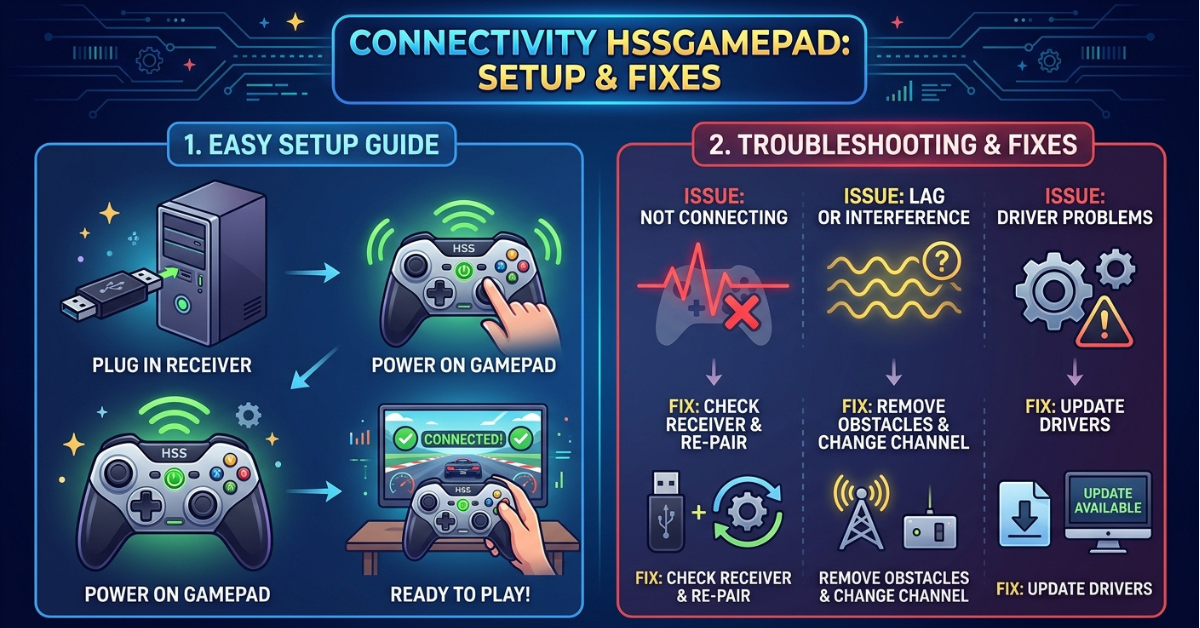
A gamepad is only useful when it actually responds when you press a button. If you are searching for connectivity hssgamepad, you are probably trying to connect an HSS Gamepad to a PC, phone, tablet, TV, or another compatible device—or fix a connection that keeps dropping.
The good news is that most controller connectivity problems have fairly simple causes. Battery level, pairing mode, wireless interference, USB connections, device compatibility, and incorrect controller modes can all affect how reliably a gamepad communicates with your device. Public information about HSSGamepad is limited, and features can differ between models, so it is important to check the manual for your specific controller before using model-specific button combinations.
What Does Connectivity HSSGamepad Mean?
Connectivity HSSGamepad simply refers to the way an HSS Gamepad communicates with the device you are using for gaming.
Depending on the particular model, a controller may connect through:
- Bluetooth
- A dedicated 2.4GHz wireless receiver
- A wired USB connection
- USB OTG on compatible mobile devices
Not every HSSGamepad model necessarily supports all of these options. The presence of a USB port also does not automatically mean it supports wired gameplay, because some ports may primarily be intended for charging.
Understanding the connection type is the first step in solving a connectivity problem. Bluetooth troubleshooting will not help much if the controller is actually configured to use a USB receiver.
H2: How HSSGamepad Connectivity Works
The controller sends information such as joystick movement, button presses, and trigger inputs to the host device. The device then interprets those signals as game controls.
The connection method affects convenience, stability, and potential input delay.
Bluetooth Connectivity
Bluetooth is useful when you want a wireless connection without carrying a separate receiver. It can be convenient for compatible phones, tablets, laptops, and other devices.
However, Bluetooth operates in a busy wireless environment. Other Bluetooth equipment and nearby wireless devices can contribute to interference, particularly when several devices are operating close together.
2.4GHz Wireless Connectivity
Some wireless controllers use a dedicated 2.4GHz USB receiver. Instead of relying on the computer’s built-in Bluetooth connection, the controller communicates with its matching receiver.
This can be useful for PC or compatible TV setups where you want wireless freedom while keeping the receiver connected to a USB port. The receiver must normally be compatible with the controller, so keeping the original dongle is important.
Wired USB Connectivity
A wired USB connection removes many of the variables associated with wireless communication. There is no Bluetooth pairing process and no wireless signal to interfere with.
It can therefore be useful when troubleshooting a wireless connection. The tradeoff is simple: you have to stay connected to the device with a cable.
How to Connect HSSGamepad Through Bluetooth
The exact pairing procedure can vary between controller models. However, the general Bluetooth process is straightforward.
Step 1: Charge the Controller
Start with a reasonable battery level. A controller with insufficient power may fail to enter pairing mode or may disconnect unexpectedly.
Charging the gamepad first also eliminates battery problems as one possible cause.
Step 2: Disconnect Previous Connections
If the controller has previously been paired with another phone, computer, or tablet, disconnect or forget the old connection if necessary.
A controller attempting to reconnect to a previously used device may not appear as expected on your new device.
Step 3: Enter Bluetooth Pairing Mode
Turn on the controller and activate its Bluetooth pairing mode according to the instructions for your particular model.
Look for a flashing status LED or another pairing indicator. Because button combinations differ between controllers, use the supplied manual rather than assuming a particular Home-button combination applies to every HSSGamepad.
Step 4: Open Bluetooth Settings
On your target device:
- Open Bluetooth settings.
- Make sure Bluetooth is enabled.
- Search for available devices.
- Look for the controller’s displayed name.
- Select it to begin pairing.
- Wait for the device to confirm the connection.
Once paired, test the controller in a game that is known to support gamepads.
Connecting HSSGamepad With a USB Cable
Wired connectivity is often the easiest way to determine whether a wireless problem is actually related to Bluetooth or another wireless connection.
Connect the controller to a compatible USB port using a data-capable cable. Then wait for your operating system to recognize the controller.
If it works correctly through USB but fails wirelessly, the problem is more likely related to wireless pairing, interference, battery condition, or the controller’s wireless mode.
Keep in mind that not every USB cable supports data transfer. Some inexpensive cables are designed primarily for charging.
Common Connectivity HSSGamepad Problems
Different symptoms point toward different causes. Instead of trying random fixes, identify what the controller is actually doing.
H3: HSSGamepad Does Not Appear in Bluetooth
If the controller does not appear in the Bluetooth device list, check these points:
- Confirm that Bluetooth is enabled on the host device.
- Make sure the controller is actually in pairing mode.
- Charge the controller.
- Turn off Bluetooth on previously connected devices temporarily.
- Restart Bluetooth on the host device.
- Move closer to the device.
- Check the controller’s manual for the correct pairing procedure.
If the controller still does not appear, try another compatible device. This can help determine whether the problem is with the gamepad or the original host device.
H3: HSSGamepad Connects but Disconnects
Random disconnections can have several causes.
A weak battery is one possibility. Wireless interference is another. Outdated drivers, power-management settings, or stale pairing information can also cause problems depending on the host device.
Try the following:
- Fully charge the controller.
- Forget the existing Bluetooth pairing.
- Restart the host device.
- Pair the controller again.
- Move away from crowded wireless environments.
- Test the controller on another compatible device.
If it works normally on another device, the original device’s Bluetooth settings, drivers, or compatibility may be responsible.
H3: HSSGamepad Connects but Buttons Do Not Work
This situation is different from a failed connection.
Your device may recognize the controller but interpret it using the wrong input mode. On computers, for example, controllers can use different input standards such as XInput and DirectInput. Some games support one more readily than another.
If the controller connects but behaves incorrectly:
- Check the game’s controller settings.
- Confirm that the controller is recognized as a gamepad.
- Look for an input-mode option in the controller manual.
- Test it in another game.
- Check Windows’ game-controller settings if you are using a PC.
Avoid randomly pressing button combinations unless they are documented for your model.
How to Reduce HSSGamepad Input Lag
Input lag can be frustrating, particularly in racing games, fighting games, shooters, and other fast-paced titles.
First, determine whether the delay comes from the controller or the game itself. Controller latency and online network latency are different things. Your controller communicates locally with the device, while online gameplay also depends on your internet connection and the game’s servers.
For controller-related delay, try:
- Moving the controller closer to the receiver or host device.
- Reducing nearby wireless interference.
- Testing a wired USB connection.
- Using the correct controller mode.
- Closing unnecessary Bluetooth connections.
- Checking for available drivers or firmware updates.
- Testing another game to see whether the problem is game-specific.
A wired connection can also be a useful troubleshooting test because it removes wireless communication from the equation.
Connectivity HSSGamepad: Bluetooth vs USB vs 2.4GHz
| Connection | Main Advantage | Potential Limitation |
| Bluetooth | Convenient and wireless | Can be affected by interference |
| 2.4GHz receiver | Wireless connection through a dedicated receiver | Requires a compatible USB receiver |
| USB wired | Stable physical connection | Limits movement |
| USB OTG | Useful for compatible mobile devices | Requires compatible phone, adapter, cable, and game |
The exact options available depend on the HSSGamepad model. Do not assume that every controller supports all four connection types.
H2: A Simple HSSGamepad Troubleshooting Checklist
If you are dealing with connectivity problems, work through these checks in order:
- Check the battery. Charge the controller.
- Identify the connection method. Bluetooth, USB, or wireless receiver?
- Check pairing mode. Make sure the controller is discoverable.
- Remove old pairings. Forget the controller from previously used devices if necessary.
- Restart both devices. A simple restart can clear temporary Bluetooth problems.
- Reduce interference. Move away from crowded wireless environments.
- Check compatibility. Make sure the host device and game support the controller.
- Test another connection. Wired USB can help isolate wireless problems.
- Check input mode. PC games may expect a particular controller standard.
- Consult the manual. Use model-specific instructions for button combinations or firmware procedures.
This approach is more useful than repeatedly attempting the same pairing process without identifying the underlying problem.
When Should You Suspect a Hardware Problem?
Not every connection problem is a software or pairing issue.
If the controller repeatedly fails on multiple compatible devices, refuses to charge, disconnects even with a wired connection, or shows physical damage, hardware could be involved.
Before replacing the controller, however, test it with a different cable, USB port, or compatible device where possible. This helps separate a controller fault from a problem with the original equipment.
Frequently Asked Questions
What is connectivity HSSGamepad?
Connectivity HSSGamepad refers to how an HSS Gamepad communicates with a gaming device. Depending on the model, this may involve Bluetooth, a 2.4GHz wireless receiver, USB, or another supported connection method.
Why is my HSSGamepad not connecting?
Common causes include low battery, incorrect pairing mode, an existing connection with another device, wireless interference, compatibility problems, or outdated device software. Start by charging the controller and clearing old pairings.
Can HSSGamepad connect to a phone?
Some HSSGamepad models can connect to compatible smartphones through Bluetooth or a wired USB/OTG connection. Compatibility depends on the specific controller and phone, so check the model documentation before assuming a connection method will work.
Why does my HSSGamepad connect but not work in a game?
The operating system may recognize the controller while the game does not support that controller or input mode. Check the game’s controller settings and determine whether the game expects XInput, DirectInput, or another supported input method.
Does a wired connection reduce controller problems?
It can. A wired USB connection removes wireless pairing and signal interference from the equation, making it useful both for gaming and for diagnosing wireless connectivity problems.
Why does my HSSGamepad keep disconnecting?
Possible causes include low battery, wireless interference, corrupted pairing information, power-management settings, drivers, or compatibility issues. Testing the controller on another device is a useful way to narrow down the cause.
Conclusion
Understanding connectivity HSSgamepad does not have to be complicated. The most important thing is to identify how your particular controller connects and then troubleshoot that connection method systematically.
For Bluetooth, focus on pairing mode, battery level, old connections, and interference. For USB, check the cable and port. If the controller connects but does not respond correctly, investigate compatibility and input modes rather than assuming the connection itself has failed.
Because HSSGamepad specifications can vary between models, always use your controller’s documentation for exact button combinations and supported connection modes. With that approach, most connectivity problems can be narrowed down quickly—and you can get back to gaming instead of fighting with your controller.