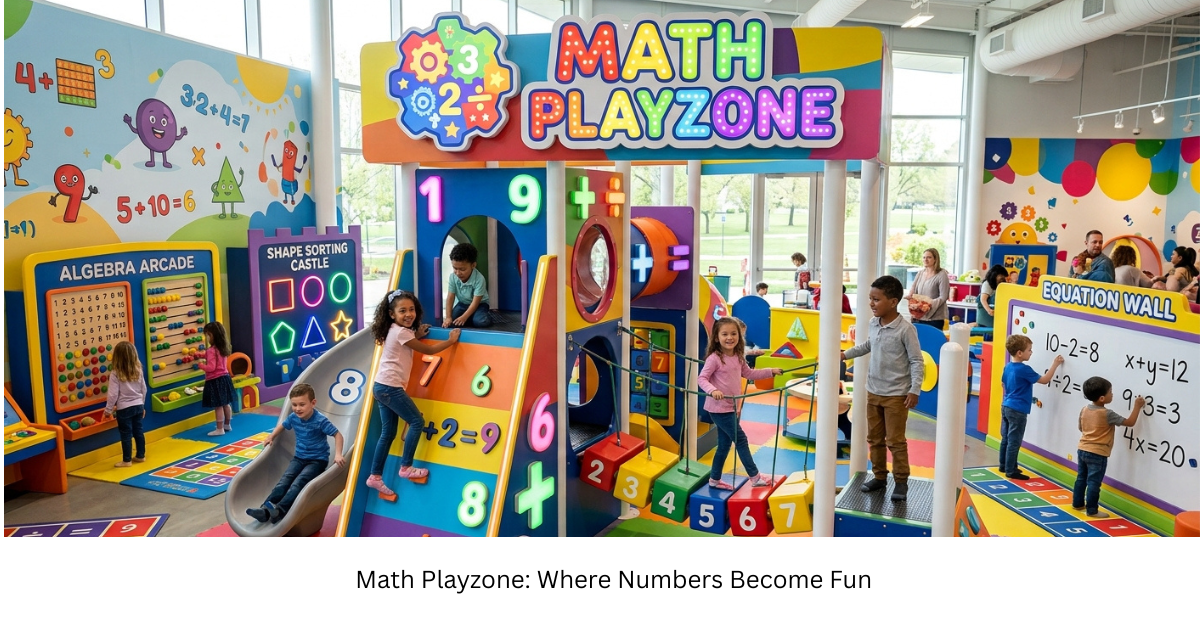
What if learning math felt less like sitting in a classroom and more like playing a game?
That is the idea behind a math playzone—a dedicated environment where children explore numbers, patterns, shapes, measurements, and problem-solving through interactive play. Instead of simply memorizing formulas or completing worksheets, children get opportunities to touch, move, build, count, compare, experiment, and make decisions.
This approach connects mathematics with something children naturally enjoy: play. When math becomes part of an enjoyable activity, children can develop numerical understanding while also building confidence, logical thinking, creativity, and persistence.
What Is a Math Playzone?
A math playzone is an educational play environment designed to introduce mathematical concepts through hands-on activities and games.
It can be a section within a school, museum, children’s learning center, library, indoor playground, or educational attraction. Some spaces focus on early numeracy, while others introduce more advanced concepts such as geometry, probability, measurement, and mathematical reasoning.
Rather than separating learning from entertainment, these spaces combine both.
Typical activities may include:
- Number and counting games
- Shape and geometry stations
- Pattern-building activities
- Measurement challenges
- Logic puzzles
- Sorting and classification games
- Interactive number walls
- Balance and symmetry activities
- Money and shopping simulations
- Mathematical board games
- Construction and building challenges
- Digital math-based games
The goal isn’t simply to make children calculate faster. It is to help them understand how mathematics works and where it appears in everyday life.
Why Learning Math Through Play Works
Children learn differently when they are actively involved.
A worksheet can ask a child to calculate the answer to a problem. An interactive activity can give that same child a reason to use the calculation. That difference matters because children are not just receiving information—they are experimenting with it.
1. It Makes Abstract Ideas Concrete
Concepts such as fractions, proportions, geometry, and measurement can be difficult to understand when they are presented only as symbols.
Hands-on activities give children something physical to work with.
For example, instead of simply explaining fractions, an activity could allow children to divide objects into equal parts. They can see the relationship between a whole and its parts before eventually connecting that experience to numerical notation.
2. It Encourages Problem-Solving
Good mathematical learning isn’t only about knowing the correct formula.
Children also need to learn how to approach unfamiliar problems.
A puzzle that asks a child to find a particular route, balance objects, complete a pattern, or build a symmetrical structure encourages them to:
- Understand the challenge.
- Think about possible solutions.
- Test an idea.
- Notice what worked or failed.
- Try another approach.
- Reach a solution.
These habits are useful far beyond mathematics.
3. It Builds Confidence
Some children develop anxiety around traditional mathematics lessons. A playful environment can make experimentation feel safer.
When mistakes become part of the game rather than something associated with failure, children may become more willing to try again.
That willingness to keep working through a difficult problem is an important part of mathematical learning.
Key Activities to Include in a Math Playzone
A well-designed space can introduce mathematics through different types of experiences.
Number and Counting Games
For younger children, simple counting stations can introduce numbers in an engaging way.
Children might count objects, match quantities to numbers, arrange numbers in sequence, or solve simple addition challenges using physical pieces.
Geometry and Shape Exploration
Geometry becomes much more interesting when children can physically manipulate shapes.
Useful activities include:
- Building structures from geometric blocks
- Creating patterns with tiles
- Matching shapes
- Exploring symmetry
- Constructing 2D and 3D forms
- Finding geometric shapes in everyday objects
These activities can introduce vocabulary such as triangle, square, rectangle, angle, symmetry, perimeter, and volume naturally.
Measurement Challenges
Measurement is everywhere in daily life.
A play-based station could challenge children to estimate and measure:
- Height
- Length
- Weight
- Distance
- Capacity
- Time
Children could first make a prediction and then use rulers, scales, measuring cups, clocks, or other tools to test it.
This creates a simple but powerful learning cycle: predict → measure → compare → understand.
Pattern and Sequence Activities
Patterns are an important foundation for mathematical thinking.
Children can create patterns using colors, shapes, numbers, sounds, or movements. More advanced activities can ask them to identify what comes next or discover the rule behind a sequence.
Pattern recognition also connects mathematics with coding, music, science, and logical reasoning.
Money and Real-Life Math
One of the easiest ways to make mathematics relevant is to connect it to everyday situations.
A miniature shop can allow children to practice:
- Adding prices
- Comparing costs
- Counting money
- Calculating change
- Making purchasing decisions
- Understanding budgets
Instead of asking, “Why do I need to learn this?” children can see a practical reason for using mathematical skills.
How Technology Can Enhance Mathematical Play
Technology can add another layer to interactive learning when it is used thoughtfully.
Touchscreens, projection systems, motion sensors, augmented reality, and interactive displays can turn mathematical concepts into immersive experiences.
For example, a digital projection floor could transform into a giant number line. Children might physically move between numbers to solve addition or subtraction challenges.
However, technology shouldn’t replace hands-on learning.
The strongest environments can combine physical play, social interaction, visual learning, and digital experiences rather than relying entirely on screens.
Designing an Effective Math Learning Space
Creating an engaging mathematical environment requires more than putting educational games into a room.
The space should encourage children to explore independently while also providing opportunities for collaboration.
Consider Different Age Groups
Activities should match children’s developmental levels.
A younger child may benefit from:
- Counting objects
- Color and shape matching
- Simple sorting
- Number recognition
Older children can explore:
- Fractions
- Probability
- Geometry
- Algebraic thinking
- Logic problems
- Measurement
- Financial mathematics
Make the Environment Interactive
Children should be able to touch, move, build, arrange, compare, and experiment.
Interactive elements can include oversized number blocks, puzzle walls, magnetic shapes, balance scales, building stations, and floor-based games.
Encourage Multiple Solutions
Not every activity needs to have only one possible path.
Open-ended challenges can ask children to build the tallest structure, create a particular pattern, divide objects fairly, or design a symmetrical shape.
This encourages creative mathematical thinking instead of simple answer memorization.
The Role of Parents and Teachers
Adults can make interactive math activities even more valuable by asking questions rather than immediately providing answers.
Instead of saying:
“That’s wrong.”
They can ask:
- “What made you choose that?”
- “What could you try next?”
- “Can you find another way?”
- “How do you know?”
- “What happens if we change this?”
- “Can you explain your thinking?”
These questions encourage children to explain their reasoning and become more comfortable with mathematical conversations.
Math Play and STEM Learning
Mathematics is closely connected with other STEM disciplines.
A child designing a bridge from blocks, for example, may unknowingly use concepts involving:
- Measurement
- Geometry
- Balance
- Spatial reasoning
- Proportion
- Problem-solving
Similarly, coding activities involve sequences, patterns, logic, and mathematical thinking.
This makes mathematical play a useful foundation for broader STEM education.
Benefits Beyond Mathematics
The value of interactive math learning isn’t limited to arithmetic.
Well-designed activities can support several broader skills:
- Critical thinking: evaluating possible solutions
- Spatial reasoning: understanding shapes and relationships
- Communication: explaining mathematical ideas
- Collaboration: solving challenges with others
- Creativity: finding alternative solutions
- Persistence: continuing after mistakes
- Decision-making: comparing possible choices
- Fine motor skills: manipulating physical objects
In other words, mathematical play can contribute to a much wider learning experience.
How to Create a Math Playzone at Home
You don’t need a large educational center to introduce playful mathematics.
Parents can create simple activities using everyday materials.
Try these ideas:
- Kitchen mathematics: Ask children to measure ingredients or divide food into equal portions.
- Shopping games: Give children a pretend budget and ask them to choose items without exceeding it.
- Shape hunts: Look around the house for circles, rectangles, triangles, and other shapes.
- Pattern challenges: Create a sequence using toys, blocks, or colored objects.
- Building challenges: Ask children to construct a tower using a limited number of blocks.
- Number treasure hunt: Hide numbers around a room and create clues involving simple calculations.
The important part is not expensive equipment. It is creating opportunities for children to use mathematics naturally.
What Makes a Great Math Playzone?
A successful learning environment should balance education and enjoyment.
Look for these characteristics:
- Age-appropriate activities
- Hands-on experiences
- Clear learning objectives
- Variety of challenges
- Opportunities for independent exploration
- Cooperative activities
- Real-world applications
- Safe and accessible equipment
- Space for experimentation
- Activities that encourage reasoning rather than memorization
The best activities often don’t feel like conventional lessons at all. Children become absorbed in solving a challenge and use mathematical thinking almost naturally.
Frequently Asked Questions
What age is a math playzone suitable for?
It can be designed for almost any age. Younger children can focus on counting, shapes, sorting, and patterns, while older children can explore geometry, probability, measurement, logic, and more advanced mathematical concepts.
Is learning through math games effective?
Games can support mathematical learning by giving children opportunities to practice concepts, solve problems, receive feedback, and apply knowledge in meaningful situations. Their effectiveness depends on the quality of the activity and how well it connects play with the intended learning objective.
What activities are suitable for young children?
Counting games, shape matching, sorting, pattern creation, building blocks, simple puzzles, and measurement activities are suitable starting points for many young learners.
Can mathematical play reduce math anxiety?
A supportive, low-pressure environment may help some children become more comfortable experimenting with mathematical ideas. However, individual experiences differ, and play should complement rather than replace appropriate teaching and support.
Can parents create a math play area at home?
Yes. A small corner with puzzles, blocks, cards, measuring tools, board games, and everyday objects can provide plenty of opportunities for mathematical exploration.
How is a math playzone different from a traditional math classroom?
Traditional classrooms often rely heavily on structured instruction, written exercises, and assessments. A play-based environment emphasizes exploration, physical interaction, games, experimentation, and problem-solving. The two approaches can complement each other.
Conclusion
A math playzone can transform the way children experience mathematics. Instead of seeing numbers as something limited to textbooks and worksheets, children can discover that mathematical thinking exists in games, buildings, shopping, patterns, measurements, technology, and everyday decisions.
The most valuable part isn’t simply making math “fun.” It’s giving children opportunities to explore, question, experiment, make mistakes, and discover solutions for themselves.
Whether you’re a parent, teacher, school administrator, or designer planning an educational space, start with simple questions: What should children discover? What can they physically explore? And how can an ordinary mathematical concept become an experience?
Once those questions guide the design, mathematics can become something children don’t just study—they actively experience.