
Have you ever ended a conversation with someone by saying “all the best” and wondered exactly what you were wishing them? The phrase is short, common, and friendly, but it can carry slightly different feelings depending on the situation.
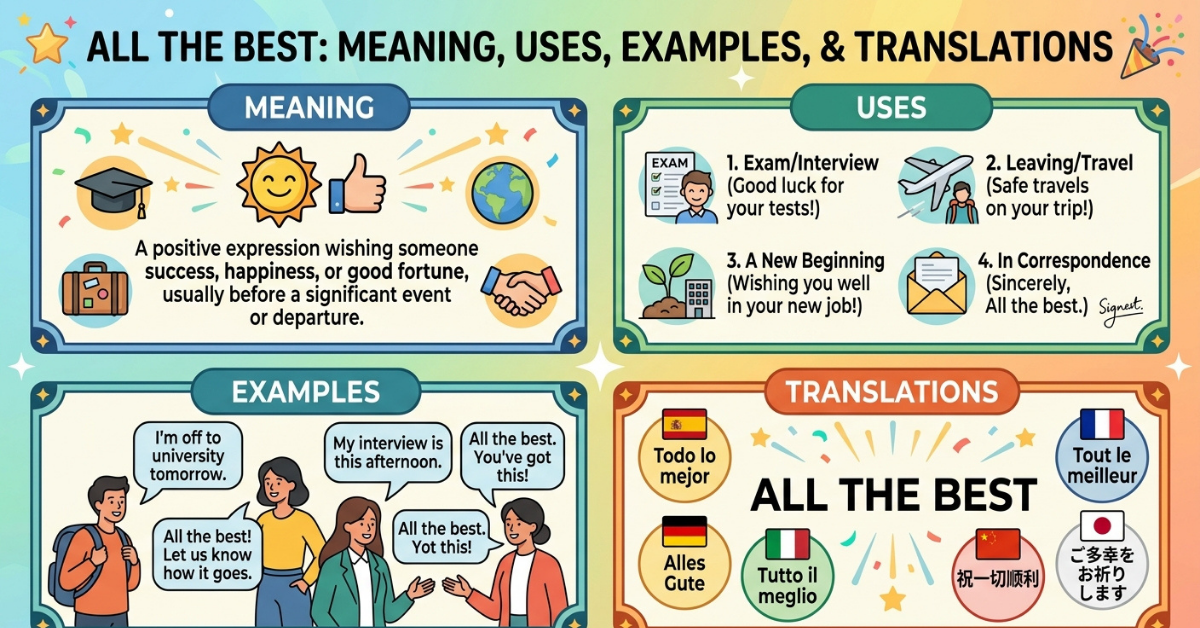
The all the best meaning is essentially a sincere wish for someone’s success, happiness, or good fortune. It is often used when someone is starting something new, facing an important event, leaving a job, taking an exam, or simply moving forward in life.
Let’s break down what “all the best” means, when you should use it, and how it translates into different languages.
All the Best Meaning in English
In simple English, “all the best” means that you hope good things happen to someone.
It can express wishes for:
- Success
- Happiness
- Good luck
- A positive future
- Good health or well-being
- A successful outcome
For example:
“I heard you’re starting a new job. All the best!”
Here, the speaker is expressing genuine good wishes for the person’s new job.
The phrase is similar to “good luck,” “best wishes,” or “I hope everything goes well.” However, “all the best” often sounds a little warmer and more personal than simply saying “good luck.”
What Does “I Wish You All the Best” Mean?
“I wish you all the best” means “I hope everything goes well for you and that you have success and happiness in the future.”
It is a polite and positive expression that can be used in both personal and professional situations.
For example:
“It was wonderful working with you. I wish you all the best in your new role.”
This sentence doesn’t necessarily mean that something bad has happened. It simply communicates goodwill as someone moves into a new stage of life.
Wish You All the Best Meaning
“Wish you all the best” has the same basic meaning as “I wish you all the best,” but it is slightly less formal because the subject “I” is omitted.
For example:
“Good luck with your exams. Wish you all the best!”
This is common in casual messages, texts, and social media conversations.
Wishing You All the Best Meaning
“Wishing you all the best” means that you are sending someone your sincere good wishes for their future or for a particular situation.
It is especially common in cards, messages, emails, and farewell notes.
For example:
“Wishing you all the best as you begin this exciting new chapter.”
The expression sounds warm, encouraging, and thoughtful.
Wishing All the Best Meaning
“Wishing all the best” conveys good wishes, but “wishing you all the best” is grammatically more complete because it clearly identifies the person receiving the wishes.
For a natural sentence, use:
“Wishing you all the best!”
rather than simply:
“Wishing all the best.”
“All the Best” Meaning in Email
The phrase “all the best” in email can have two common uses.
1. As a Sign-Off
“All the best” is frequently used at the end of an email as a friendly professional closing.
For example:
Best regards,
Fatima
or:
All the best,
Fatima
It works particularly well when you already have a friendly relationship with the recipient.
2. As a Good-Wishes Expression
You can also use it within the body of an email.
For example:
“Thank you for your help with the project. I wish you all the best in your future work.”
In professional communication, “all the best” is generally warmer and less formal than “sincerely” but still appropriate in many workplace situations.
All the Best Meaning in Hindi
The all the best meaning in Hindi can be expressed as:
“आपको शुभकामनाएँ” (Aapko shubhkaamnayein)
Another natural interpretation is:
“आपको ढेरों शुभकामनाएँ।”
Depending on context, it can also mean:
“आपके लिए मेरी शुभकामनाएँ।”
In everyday Hindi, the English phrase “ऑल द बेस्ट” is also commonly used.
For example:
“तुम्हारी परीक्षा के लिए तुम्हें ढेरों शुभकामनाएँ। ऑल द बेस्ट!”
The meaning is essentially: I hope you succeed and everything goes well.
All the Best Meaning in Urdu
The all the best meaning in Urdu can be expressed as:
“آپ کے لیے نیک خواہشات”
Another natural expression is:
“آپ کو بہت سی نیک تمنائیں”
In Roman Urdu, you could write:
“Aap ke liye nek khwahishat.”
Or:
“Aap ko bohat si nek tamannaen.”
In everyday Pakistani conversations, people also commonly use the English phrase “All the best!” directly.
For example:
“Aap ke exam ke liye bohat si nek tamannaen. All the best!”
The meaning is: I hope you do well and achieve success.
All the Best Meaning in Punjabi
The all the best meaning in Punjabi can be conveyed as:
“ਤੁਹਾਨੂੰ ਸ਼ੁਭਕਾਮਨਾਵਾਂ”
(Tuhānū shubh-kāmanāvāṁ)
Another natural expression is:
“ਤੁਹਾਡੇ ਲਈ ਦਿਲੋਂ ਸ਼ੁਭਕਾਮਨਾਵਾਂ।”
In simple terms, it means:
“I hope everything goes well for you.”
Punjabi speakers may also simply say “All the best” in English, especially in casual conversations.
Wish You All the Best Meaning in Telugu
The wish you all the best meaning in Telugu can be expressed as:
“మీకు శుభాకాంక్షలు”
(Mīku śubhākāṅkṣalu)
A more complete expression can be:
“మీకు అన్నీ మంచిగా జరగాలని కోరుకుంటున్నాను.”
This conveys the idea of wishing that everything goes well and that the person achieves success.
So, if someone says:
“I wish you all the best for your new job.”
The Telugu meaning would communicate the idea:
“మీ కొత్త ఉద్యోగానికి మీకు శుభాకాంక్షలు.”
I Wish You All the Best Meaning in Telugu
“I wish you all the best” in Telugu can be expressed naturally as:
“మీకు అన్నీ మంచిగా జరగాలని కోరుకుంటున్నాను.”
The literal wording may vary depending on the situation, but the intended meaning remains the same: I hope you have success, happiness, and good things in the future.
Wish You All the Best Meaning in Nepali
The wish you all the best meaning in Nepali can be expressed as:
“तपाईंलाई धेरै शुभकामना।”
(Tapāīṁlāī dherai śubhakāmanā.)
Another natural expression is:
“तपाईंको सफलताको लागि शुभकामना।”
The first is a general good-wishes expression, while the second is more specifically focused on success.
Wish U All the Best Meaning
You may have seen “wish u all the best” in texts, Instagram messages, WhatsApp chats, or other informal communication.
Here, “u” is simply an abbreviated form of “you.”
Therefore:
“Wish u all the best” = “Wish you all the best.”
It means:
“I hope everything goes well for you.”
The abbreviated version is perfectly understandable in casual texting, but it is better to write “I wish you all the best” in professional emails, applications, formal messages, or workplace communication.
“I Hope You All the Best” Meaning
There is an important grammar point here.
“I hope you all the best” is not standard English when you mean that you are wishing someone good things.
The natural expression is:
“I wish you all the best.”
Or:
“I hope all the best for you.” — understandable, but less natural.
Even better:
“I hope everything goes well for you.”
Why?
The verb “wish” can be followed directly by the person and the thing being wished:
“I wish you all the best.”
With “hope,” we normally use a clause:
“I hope you have a wonderful future.”
So if you’re writing a professional message, “I wish you all the best” is the safest and most natural choice.
“We Wish You All the Best” Meaning
“We wish you all the best” simply changes the speaker from one person to a group.
It means:
“Everyone in our group hopes that you have success, happiness, and good fortune.”
For example:
“Thank you for everything you’ve done for our company. We wish you all the best in your future career.”
This expression is particularly useful for:
- Farewell messages
- Company announcements
- Team messages
- Graduation cards
- Retirement wishes
- Formal letters
“Wish Her All the Best” Meaning
“Wish her all the best” means that you want someone to communicate your good wishes to another woman or girl.
For example:
“Please wish her all the best from me.”
This means:
“Please tell her that I hope everything goes well for her.”
The same structure works with other pronouns:
- Wish him all the best.
- Wish them all the best.
- Wish you all the best.
When Should You Say “All the Best”?
There are many situations where this phrase feels completely natural.
1. Before an Exam
“Your exam is tomorrow? All the best!”
2. Starting a New Job
“Congratulations on the new position. Wishing you all the best!”
3. Moving to a New City
“I hope you enjoy your new home. All the best!”
4. Graduation
“Congratulations on graduating! I wish you all the best for your future.”
5. Farewell
“It was great working with you. All the best for your next chapter.”
6. Starting a New Business
“Congratulations on your new business. Wishing you all the best!”
Is “All the Best” Formal or Informal?
The phrase can be both formal and informal, depending on how it is used.
| Situation | Is “All the Best” Suitable? |
| Texting a friend | Yes |
| WhatsApp message | Yes |
| Farewell card | Yes |
| Professional email | Yes |
| Email to a colleague | Yes |
| Formal legal letter | Usually use a more formal closing |
| Academic application | Depends on context |
As an email sign-off, “All the best” has a friendly, professional tone. It is less formal than “Yours sincerely” but generally more polished than very casual closings such as “Cheers” or “Take care.”
“All the Best” vs. “Best Wishes”
These expressions are very similar, but there is a slight difference in tone.
All the best sounds natural and conversational. It can be used when saying goodbye, responding to someone’s plans, or wishing them success.
Best wishes can sound slightly more traditional and is particularly common in cards, letters, and formal messages.
For example:
- All the best with your new job!
- Best wishes on your wedding!
Both communicate positive feelings, so the choice often comes down to personal style and context.
“All the Best” vs. “Good Luck”
Although they are sometimes interchangeable, they aren’t exactly the same.
Good luck focuses more directly on success in a particular event:
“Good luck with your interview!”
All the best is broader:
“All the best for your new job and everything ahead.”
You can also combine them:
“Good luck with your interview. All the best!”
Examples of “I Wish You All the Best”
Here are some natural examples you can use in everyday situations:
- I wish you all the best in your new job.
- I wish you all the best for your future.
- I wish you all the best in your studies.
- I wish you all the best with your new business.
- I wish you all the best as you begin this new chapter.
- I wish you all the best and hope you achieve your goals.
- It was lovely working with you. I wish you all the best!
“I Wish You All the Best” Meaning: Quotes and Messages
If you’re looking for a thoughtful way to use the phrase, you can expand it with a personal message.
Here are a few original examples:
- “I wish you all the best in everything that comes next. May your hard work lead you to something wonderful.”
- “Wishing you all the best as you begin a new chapter filled with opportunities and possibilities.”
- “I wish you all the best for your future. Keep believing in yourself and moving forward.”
- “All the best for your next adventure. I hope it brings you happiness and success.”
Frequently Asked Questions
What is the all the best meaning?
“All the best” is a phrase used to express good wishes for someone’s success, happiness, or future. It is similar to saying “I hope everything goes well for you.”
What does “I wish you all the best” mean?
It means “I hope you have success, happiness, and good things in the future.” It is commonly used when someone is starting a new journey or saying goodbye.
Is “all the best” a good email sign-off?
Yes. “All the best” is a friendly and professional email closing, especially when you have an established relationship with the recipient.
What is all the best meaning in Hindi?
“All the best” can be translated as “आपको शुभकामनाएँ” (Aapko shubhkaamnayein). It expresses good wishes for someone’s success or well-being.
What is all the best meaning in Urdu?
A natural Urdu equivalent is “آپ کے لیے نیک خواہشات”, meaning “best wishes for you.”
What is “wish u all the best” meaning?
It means “I wish you all the best.” The letter “u” is simply an informal texting abbreviation for “you.”
Is “I hope you all the best” grammatically correct?
Not in the intended sense. The natural expression is “I wish you all the best” or “I hope everything goes well for you.”
Can I say “all the best” to a friend?
Absolutely. It is a common, friendly way to wish a friend success, happiness, or good luck.
Is “all the best” formal?
It is semi-formal and versatile. It works well in many professional and personal situations, although highly formal letters may call for a more traditional closing.
Conclusion
The all the best meaning is simple but genuinely positive: you’re wishing someone success, happiness, and good things ahead. Whether you say “all the best,” “I wish you all the best,” “wishing you all the best,” or “we wish you all the best,” the basic message remains one of goodwill and encouragement.
The phrase also works naturally across languages. In Hindi, Urdu, Punjabi, Telugu, and Nepali, there are several ways to express the same idea of sending someone sincere good wishes.
So the next time someone starts a new job, takes an important exam, graduates, moves away, or begins a new chapter, a simple “I wish you all the best!” is a warm and perfectly natural way to show your support.





