
Sometimes, a simple question can sound a little more formal than “How are you?” One good example is “How are you faring?” If you have come across this phrase in a conversation, email, book, or movie, you may have wondered what it actually means.
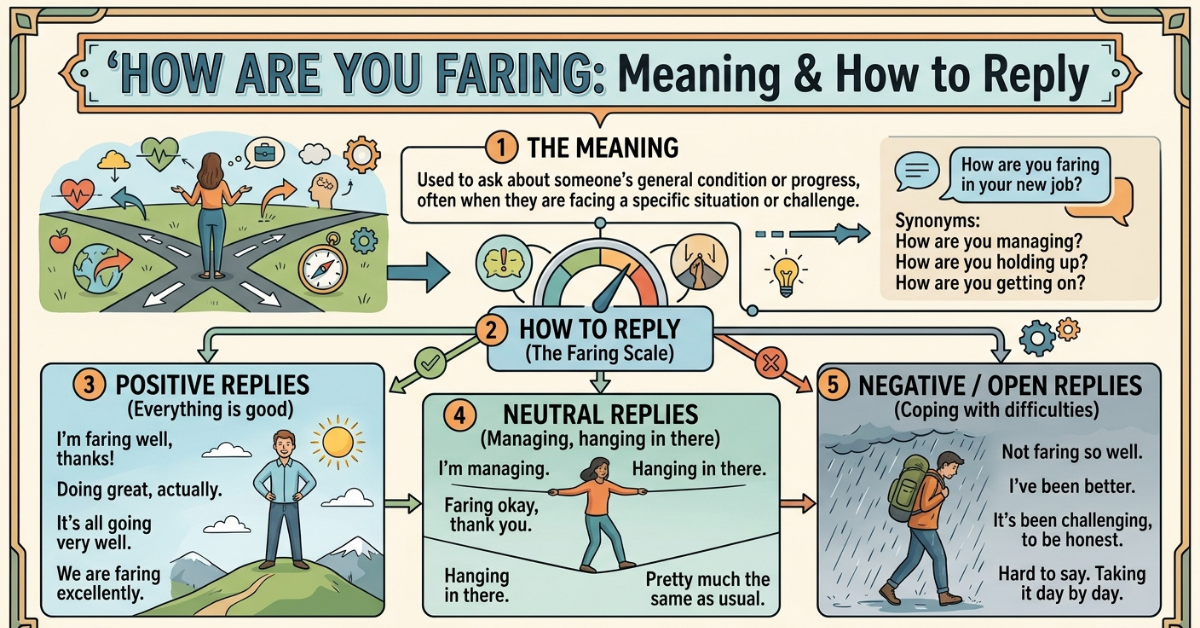
The how are you faring meaning is essentially “How are you doing?”, “How are things going for you?”, or “How are you managing?” The word faring refers to how someone is doing or progressing in a particular situation.
Although the phrase is grammatically correct and still used today, it can sound slightly formal or old-fashioned compared with everyday expressions such as “How are you doing?” or “How’s it going?”
What Does “How Are You Faring?” Mean?
“How are you faring?” means “How are you doing?” or “How are things going for you?”
It is usually used when someone wants to know about your situation, progress, or general well-being.
For example:
“How are you faring in your new job?”
This means:
“How are you doing in your new job?”
The question can be about someone’s overall situation or about how they are coping with a particular circumstance.
What Does “Faring” Mean?
The verb fare means to get along, progress, or experience a particular situation.
So, when someone asks:
“How are you faring?”
they are asking about how well or badly things are going for you.
Here are a few examples:
- “How are you faring after moving to a new city?”
- “How are you faring with your studies?”
- “How are you faring in your new position?”
- “How are you faring during the busy season?”
In each case, the speaker wants to know how the person is managing or progressing.
How Are You Faring Meaning in Simple English
If you want to understand the phrase in the easiest possible way, think of it as:
How are you faring? = How are you doing?
Depending on the context, it can also mean:
- How are things going?
- How are you getting on?
- How are you managing?
- How are you doing lately?
- How is everything going for you?
- How are you coping with the situation?
The exact meaning depends slightly on the situation.
For example, if a friend asks, “How are you faring at your new university?”, they are probably asking about your experience and progress rather than simply asking whether you feel well.
How Are You Faring Meaning in Hindi
The how are you faring meaning in Hindi can be expressed in several natural ways depending on the context.
Common translations include:
- आप कैसे हैं? — How are you?
- आपका काम कैसा चल रहा है? — How is your work going?
- आप कैसे कर रहे हैं? — How are you doing?
- आपकी स्थिति कैसी है? — How is your situation?
- आपका अनुभव कैसा चल रहा है? — How is your experience going?
In a general conversation, “आप कैसे हैं?” may be the simplest translation.
However, if the phrase refers to someone’s progress or ability to handle a situation, “आपका काम कैसा चल रहा है?” or “आप कैसे कर रहे हैं?” may communicate the meaning more accurately.
How to Reply to “How Are You Faring?”
Wondering about the how are you faring meaning reply? The good news is that you can answer it much like you would answer “How are you doing?”
Your response should depend on how things are actually going.
If Things Are Going Well
You could say:
- “I’m doing well, thank you.”
- “I’m faring quite well, thanks.”
- “Things are going really well.”
- “I’m doing great so far.”
- “I’m managing well, thank you.”
- “So far, so good!”
For example:
Person A: “How are you faring in your new job?”
Person B: “I’m doing quite well, thanks. I’m enjoying the new responsibilities.”
If Things Are Difficult
You don’t have to pretend everything is perfect. You can give an honest but polite response.
For example:
- “It’s been challenging, but I’m managing.”
- “Things have been a little difficult lately.”
- “I’m getting by, thanks.”
- “It’s been a tough few weeks, but I’m doing okay.”
- “I’m taking things one day at a time.”
These responses work especially well when the question is about a challenging situation.
If You Want a Casual Reply
In an informal conversation, you don’t need a complicated answer.
Try:
- “I’m good, thanks! How about you?”
- “Doing pretty well!”
- “Not bad at all.”
- “I’m hanging in there!”
- “Pretty good. How are things with you?”
The simplest and most natural response is often:
“I’m doing well, thanks. How about you?”
How Are You Faring vs. How Are You Doing
These two expressions are very similar, but they don’t always sound exactly the same.
| Phrase | Meaning | Tone |
| How are you doing? | How are you? / How are things? | Casual and common |
| How are you faring? | How are you managing or progressing? | More formal |
| How’s it going? | How are things? | Very casual |
| How are you getting on? | How are you managing? | Conversational |
| How have you been? | How have things been recently? | Friendly |
“How are you doing?” is much more common in everyday conversation.
“How are you faring?” tends to draw attention to someone’s circumstances, progress, or ability to manage a situation.
Is “How Are You Faring?” Formal?
Yes, “How are you faring?” can sound more formal than “How are you doing?”
It isn’t incorrect or unnatural, but it is less common in casual modern speech.
You are more likely to encounter it in:
- Formal conversations
- Written communication
- News articles
- Books and literature
- Professional discussions
- Conversations about a specific situation
For example:
More casual:
“How are you doing with your new project?”
More formal:
“How are you faring with your new project?”
Both sentences are correct, but the second has a more formal tone.
When Should You Use “How Are You Faring?”
The phrase is particularly useful when you want to ask about someone’s progress or circumstances, rather than simply asking about their mood.
For example:
At Work
“How are you faring in your new role?”
This asks how the person is adjusting to their new position.
During Studies
“How are you faring with your exams?”
This asks how well the person is managing their exams or preparation.
During a Difficult Situation
“How are you faring after the move?”
This asks how the person is coping with the change.
In a New Environment
“How are you faring in your new city?”
This asks how the person is adjusting to their new surroundings.
What Does “How Are You Faring?” Really Ask?
The phrase can have slightly different meanings depending on context.
It may ask about:
- General well-being — Are you doing okay?
- Progress — Are you making progress?
- Performance — How well are you doing?
- Adjustment — How are you adapting?
- Coping — How are you managing a difficult situation?
That’s why context matters.
If someone simply asks, “How are you faring?”, they may just be checking in on you.
But if they ask, “How are you faring in your new job?”, they are specifically interested in how you’re adjusting and performing at work.
Examples of “How Are You Faring?” in Sentences
Here are some examples to make the meaning clearer:
- “How are you faring in your new position?”
- “How are you faring with your English lessons?”
- “How are you faring after the long journey?”
- “How are you faring with all these new responsibilities?”
- “I called to see how you were faring.”
- “How are the students faring in their final exams?”
- “She asked me how I was faring after the move.”
- “How are you faring these days?”
Notice that fare can be used for both people and groups.
For example:
“How are the students faring?”
means:
“How are the students doing?”
Is “How Are You Faring?” a Correct Expression?
Yes. “How are you faring?” is grammatically correct English.
The verb fare is often used to describe how someone or something is doing under particular circumstances.
For example:
- “The company is faring well this year.”
- “The team is faring better than expected.”
- “How did you fare in the interview?”
- “The business fared poorly during the economic downturn.”
So, fare is not limited to the question “How are you faring?” It can be used in many contexts involving results, progress, or circumstances.
Common Mistakes With “Faring”
Because fare isn’t one of the most frequently used verbs in everyday English, it is easy to confuse it with similar-looking words.
Faring vs. Fairing
Faring comes from the verb fare, meaning to do, progress, or manage.
Fairing is a different word. It can refer to a structure or covering designed to reduce air resistance, particularly on vehicles or aircraft.
So:
“How are you faring?”
is correct when asking how someone is doing.
“How are you fairing?”
is not the correct spelling for this meaning.
Fare vs. Fair
These words also have different meanings.
Fare can mean to get along or do, as in:
“How did you fare in the interview?”
It can also mean the price charged for transportation:
“What is the bus fare?”
Fair, meanwhile, has meanings such as reasonable, just, or light in color.
Quick Guide to the Phrase
If you just want the answer at a glance:
- How are you faring? = How are you doing?
- Tone: Slightly formal
- Faring: Getting along, progressing, or managing
- Best casual reply: “I’m doing well, thanks. How about you?”
- Negative reply: “It’s been challenging, but I’m managing.”
- Hindi meaning: आप कैसे हैं? / आपका काम कैसा चल रहा है?
- Common use: Asking about someone’s progress or situation
Frequently Asked Questions
What does “How are you faring?” mean?
“How are you faring?” means “How are you doing?”, “How are things going?”, or “How are you managing?” It often focuses on someone’s situation, progress, or ability to cope.
What is the best reply to “How are you faring?”
A natural response is:
“I’m doing well, thank you. How about you?”
You can also say “I’m doing great,” “I’m managing,” or “Things are going well,” depending on your situation.
Is “How are you faring?” formal or informal?
It is generally more formal or less casual than “How are you doing?” It is perfectly correct but is less common in everyday conversation.
What is the Hindi meaning of “How are you faring?”
Depending on context, it can mean “आप कैसे हैं?”, “आपका काम कैसा चल रहा है?”, or “आप कैसे कर रहे हैं?”
Is “How are you faring?” grammatically correct?
Yes. It is a grammatically correct expression. Faring is the present participle of fare, which means to get along, progress, or do under particular circumstances.
What does “How are you faring in your new job?” mean?
It means “How are you doing in your new job?” or “How well are you managing or adjusting to your new job?”
Can I use “How are you faring?” with friends?
Yes, but it may sound slightly formal depending on your usual way of speaking. With close friends, expressions such as “How are you doing?”, “How’s it going?”, or “How have you been?” usually sound more natural.
Conclusion
So, what is the how are you faring meaning? In simple terms, it means “How are you doing?”, “How are things going?”, or “How are you managing?”
The phrase is especially useful when you’re asking about someone’s progress, circumstances, or ability to deal with a particular situation. While it sounds somewhat formal compared with everyday alternatives, it is completely correct English.
If someone asks you “How are you faring?”, a simple “I’m doing well, thank you. How about you?” is usually all you need.
Understanding small phrases like this can make your English vocabulary more natural and versatile. If you’re learning English, keep exploring similar everyday expressions—the small differences in tone and context can make a big difference in how confidently you communicate.





