
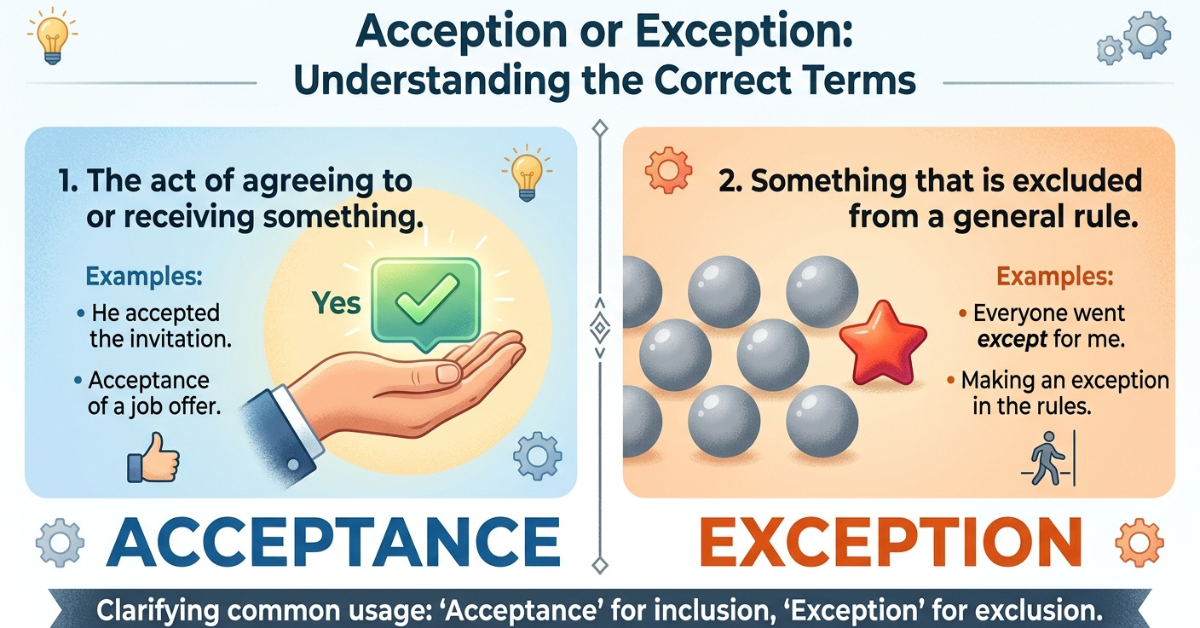
Have you ever typed “acception” and wondered whether it should actually be “exception”? You’re not alone. These two words look remarkably similar, but they do not have the same meaning or usage.
If you’re searching for acception or exception, the answer in modern everyday English is usually exception. For example, if you want to say that a general rule does not apply in one particular situation, the correct word is exception.
But there’s a little more to the story. Let’s look at what each word means, why exception is usually the right choice, and how to avoid common mistakes such as “make an acception or exception.”
Acception or Exception: Which One Is Correct?
In most modern English contexts, exception is the correct word.
Acception is a real word, but it is extremely uncommon in contemporary English. It has historically been used to refer to the acceptance or interpretation of something, particularly a word or expression. However, you are unlikely to need it in ordinary conversation or writing.
Exception, on the other hand, is common and has several established meanings. Most often, it describes something or someone that does not follow a general rule, pattern, or expectation.
Quick answer
| Word | Common today? | General meaning |
| Exception | Yes | Something that does not follow a rule or general statement |
| Acception | Very rare | A historical or specialized term related to acceptance or interpretation |
So, if you’re writing a normal sentence, exception will almost certainly be the word you want.
Acception or Exception Meaning
Understanding the meanings of both words makes the difference much easier to remember.
What does “exception” mean?
An exception is a person, thing, or situation that does not follow a general rule.
For example:
Everyone must attend the meeting, with one exception.
Here, the exception is the person who does not have to attend.
The word can also describe something that stands out from a general pattern:
Most of the students performed well, but Ali was an exception.
What does “acception” mean?
Acception is an uncommon and largely obsolete word. Historically, it could refer to the acceptance or particular interpretation of a word, expression, or statement.
Because it is rarely used in present-day English, using acception when you mean exception can make your sentence sound incorrect.
For everyday communication, it is safer to use exception when referring to something that does not follow a rule.
Is It Acception or Exception?
If you’re asking “is it acception or exception?”, use exception in almost every ordinary situation.
For example:
- Incorrect: There is an acception to the rule.
- Correct: There is an exception to the rule.
- Incorrect: I will make an acception for you.
- Correct: I will make an exception for you.
- Incorrect: With the acception of John, everyone attended.
- Correct: With the exception of John, everyone attended.
The pronunciation and spelling can be confusing because both words contain similar sounds. However, their meanings and modern usage are very different.
“Make an Acception or Exception”?
One of the most common searches is “make an acception or exception.”
The correct expression is:
Make an exception
For example:
I’ll make an exception this time.
This means that you are agreeing not to apply a normal rule in one particular case.
More examples
- I’ll make an exception for you.
- The manager decided to make an exception to the policy.
- We don’t normally allow late applications, but we’ll make an exception this time.
- She made an exception because of the unusual circumstances.
So, when you want to say that you’re allowing something despite a normal rule, “make an exception” is the natural expression.
“I’ll Make an Acception or Exception”
If you’re wondering whether to write “I’ll make an acception or exception,” the correct sentence is:
I’ll make an exception.
The phrase “I’ll make an exception” is commonly used when someone agrees to bend a rule.
For example:
We normally don’t accept returns after 30 days, but I’ll make an exception for you.
Here, exception means that the usual rule will not be applied in this particular situation.
Is “I’ll make an exception” formal?
It can be used in both casual and professional English.
Casual:
You can have the last piece. I’ll make an exception.
Professional:
Although our policy does not normally permit this, we’ll make an exception in this case.
The difference is mainly determined by the surrounding language rather than the expression itself.
“With the Acception or Exception”?
Another common phrase is “with the acception or exception.”
Again, the correct word is exception.
The standard expression is:
with the exception of
This phrase means excluding someone or something.
For example:
Everyone passed the test, with the exception of two students.
This means that two students did not pass.
Examples of “with the exception of”
- The store is open every day with the exception of Sunday.
- Everyone attended with the exception of Sarah.
- I enjoy all kinds of fruit with the exception of grapefruit.
- The entire building was renovated with the exception of the basement.
Remember the pattern:
with the exception of + person/thing
Acception or Exception to the Rule
If you’re talking about something that does not follow a general rule, the correct phrase is:
an exception to the rule
For example:
There is an exception to the rule.
Or:
Children under five are normally required to pay, but there is an exception to the rule.
The expression “exception to the rule” is extremely common in English.
Examples
- Everyone has to wear a uniform, but teachers are an exception to the rule.
- The company normally closes at 6 p.m., but Friday is an exception to the rule.
- There are very few exceptions to this rule.
Do not write:
Incorrect: an acception to the rule
Write:
Correct: an exception to the rule
To Make an Acception or Exception
The phrase “to make an acception or exception” can be confusing because make and exception are often used together.
The correct expression is:
to make an exception
It means to deliberately allow something that would normally not be allowed.
For example:
The teacher decided to make an exception and let the student submit the assignment late.
The rule normally required students to submit their work on time, but the teacher chose not to enforce it in this particular case.
Common examples
- Can you make an exception?
- I’ll make an exception this time.
- The company made an exception to its policy.
- Would you be willing to make an exception?
- We don’t usually do this, but we’ll make an exception.
Why Do People Confuse “Acception” and “Exception”?
The confusion is understandable. The words are visually similar, and both begin with the same ending pattern: -ception.
There are also several familiar English words with similar structures, including:
- acceptance
- conception
- deception
- perception
- reception
- exception
Because acceptance is a very common word, people sometimes mistakenly create acception when they actually mean exception.
A useful way to remember the difference is to connect exception with the idea of excluding something from a rule.
A simple memory trick
Think:
EXCEPTION = EXCLUDE
An exception is something excluded from the normal rule.
For example:
Everyone must attend except John.
Therefore:
John is an exception.
This connection can make the spelling easier to remember.
Exception vs. Except
Another useful distinction is between exception and except.
Except is generally used as a preposition, conjunction, or verb.
Everyone came except John.
Exception is a noun.
John was an exception.
You can think of them as related words:
- except = excluding
- exception = something excluded from a rule or general statement
Compare these sentences
Everyone received a certificate except Maria.
Maria was an exception.
Both sentences communicate a similar idea, but they use different grammatical structures.
Common Mistakes With Exception
Here are some mistakes worth avoiding:
1. Using “acception” instead of “exception”
Incorrect: There was an acception to the rule.
Correct: There was an exception to the rule.
2. Saying “make an acception”
Incorrect: I’ll make an acception for you.
Correct: I’ll make an exception for you.
3. Forgetting “of” after “with the exception”
Incorrect: With the exception John, everyone attended.
Correct: With the exception of John, everyone attended.
4. Confusing “except” and “exception”
Incorrect: John is an except.
Correct: John is an exception.
Is “Acception” Ever Correct?
Technically, acception can be found in historical dictionaries and older texts. It has been used in specialized or archaic contexts involving the acceptance or interpretation of something.
However, that does not mean it is interchangeable with exception.
If you’re writing an email, essay, blog post, social media caption, business document, or everyday message, you almost certainly want exception when you mean something that does not follow a rule.
Unless you’re specifically discussing historical English or a specialized linguistic usage, acception is not the natural choice.
Quick Comparison: Acception vs. Exception
| Feature | Acception | Exception |
| Modern everyday usage | Very rare | Very common |
| Refers to breaking a rule | No | Yes |
| “Make an ___” | No | Yes |
| “___ to the rule” | No | Yes |
| “With the ___ of” | No | Yes |
| Common in ordinary writing | No | Yes |
Examples of Correct Usage
Here are some natural sentences using exception:
- I’ll make an exception this time.
- There is an exception to the rule.
- Everyone came with the exception of Tom.
- She is an exception to the usual pattern.
- The policy applies to everyone, without exception.
- Can you make an exception for me?
- There are a few exceptions to this requirement.
These examples cover many of the situations where people search for acception or exception.
Frequently Asked Questions
Is it “acception” or “exception”?
In modern everyday English, exception is usually the correct word. Acception is a rare, historical term and is not normally used as a synonym for exception.
Is it “make an acception or exception”?
The correct phrase is “make an exception.”
For example:
I’ll make an exception for you.
Is “I’ll make an acception” correct?
No, not if you mean that you will bend or overlook a normal rule. The natural sentence is:
I’ll make an exception.
Is it “with the acception or exception”?
The correct expression is “with the exception of.”
Example:
Everyone attended, with the exception of James.
Is it “exception to the rule” or “acception to the rule”?
The correct phrase is “exception to the rule.”
Example:
There is one exception to the rule.
What is the meaning of exception?
An exception is a person, thing, or situation that does not follow a general rule, statement, or pattern.
What is the difference between except and exception?
Except generally means excluding, while exception is a noun referring to something excluded from a general rule or situation.
Is “acception” a real word?
Yes, acception has appeared in historical and specialized English, but it is extremely uncommon today. It should not normally be used when you mean exception.
Conclusion: Acception or Exception?
So, acception or exception—which one should you use? In modern English, the answer is almost always exception when you’re talking about something that does not follow a rule or general situation.
Remember these common expressions:
- make an exception
- an exception to the rule
- with the exception of
- I’ll make an exception
- without exception
While acception does exist as a rare historical term, it isn’t the word you normally want in everyday writing.
When in doubt, think of exception as something that is excluded from the usual rule. That simple connection can help you choose the right word—and avoid one of the more easily confused spelling mistakes in English.





