
Have you ever typed “puting” and wondered whether you forgot a letter? You’re not alone. The confusion between puting or putting is common, especially because many English words simply add -ing to their base form.
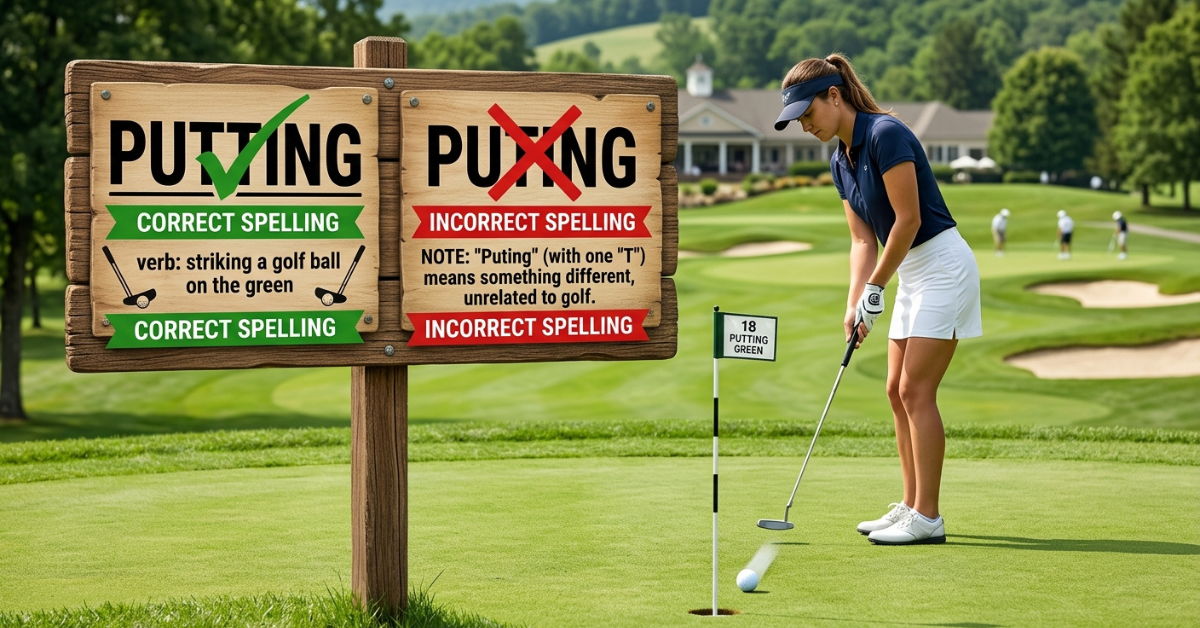
The correct spelling is putting, with two t’s.
“Puting” is an incorrect spelling when you mean the present participle or gerund of the verb put. This article explains the puting or putting meaning, spelling rule, English definition, golf usage, synonyms, and common examples so you can use the word confidently.
Puting or Putting: Which Is Correct?
If you’re asking, “Is it puting or putting?”, the answer is straightforward:
Putting is correct.
Puting is incorrect.
The word putting is formed from the verb put + -ing.
Unlike many English verbs, put keeps its final consonant and does not lose or change the letter t when -ing is added.
Correct examples
- I am putting the books on the shelf.
- She is putting her phone away.
- He enjoys putting in golf.
- They are putting together a new plan.
Incorrect example
- I am puting the books on the shelf.
The correct version is:
- I am putting the books on the shelf.
So, when checking puting or putting spelling, remember the simple rule: put → putting.
Puting or Putting Meaning
The word putting can have several meanings depending on the sentence.
Most commonly, putting is the -ing form of “put.” The verb put means to move, place, or position something somewhere.
For example:
- She is putting the keys on the table.
- He is putting his clothes into the suitcase.
- They are putting the furniture in the room.
Here, putting describes the action of placing something somewhere.
However, putting can also have a specific meaning in golf, where it refers to using a putter to hit the ball toward or into the hole.
Putting Definition in English
The basic putting definition is:
Putting is the present participle or gerund form of the verb put, meaning the act of placing, positioning, or moving something into a particular location.
Depending on context, it can also refer to the action of striking a golf ball with a putter.
For example:
“She is putting the dishes in the cupboard.”
Here, putting means placing.
In:
“His putting was excellent today.”
The word refers specifically to a golf technique.
Why Is It Putting Instead of Puting?
This is where English spelling can get a little tricky.
When forming the -ing form of a verb, spelling rules sometimes require the final consonant to be doubled.
The verb put ends in t, and its spelling remains put when -ing is added, resulting in:
put + ting = putting
This is why there are two t’s in the middle of putting.
It is also worth remembering that put is an unusual verb because its basic forms stay the same:
- Present: put
- Past: put
- Past participle: put
- -ing form: putting
Compare:
- put → putting
- cut → cutting
- hit → hitting
- set → setting
The pattern is easier to remember when you see these words together.
Is It Puting or Putting in English?
If you’re learning English and searching “puting or putting in English,” the standard English spelling is putting.
Puting does not function as the standard spelling of the word. It is generally just a spelling mistake caused by forgetting to double the t.
This mistake is understandable because some verbs form their -ing versions without doubling a consonant:
- play → playing
- read → reading
- help → helping
- open → opening
But put follows the spelling pattern that gives us putting.
Puting or Putting Golf: What Does Putting Mean?
Golf is one area where putting has a very specific meaning.


In golf, putting is the action of hitting the ball with a putter, usually when the ball is on or near the putting green.
The goal is generally to roll the ball into the hole using controlled strokes.
For example:
- She has excellent putting skills.
- His putting improved after practicing on the green.
- The golfer made a long putt.
- Good putting can make a major difference in a golf score.
Putting vs. putt
These two words are closely related but aren’t identical.
Putt can be a noun or verb:
- He made a difficult putt.
- She will putt the ball toward the hole.
Putting is the -ing form:
- He is putting the ball.
- She has been practicing her putting.
So if you’re searching “puting or putting golf,” the correct term is always putting.
Putting in a Sentence
Seeing the word in context is one of the easiest ways to remember its spelling.
Here are some examples:
- I am putting my shoes by the door.
- She is putting the groceries away.
- He is putting together a presentation.
- They are putting their ideas into practice.
- The golfer is putting on the final hole.
- Putting requires patience and control.
- She spent the afternoon practicing her putting.
Notice that the spelling stays putting in every example.
Putting as a Gerund
Putting can also work as a gerund, meaning an -ing form that functions as a noun.
For example:
Putting things off can create unnecessary stress.
Here, putting is part of the noun-like phrase “putting things off.”
Another example is:
Putting is an important part of golf.
In this sentence, putting refers to the activity itself.
This is one reason you may see putting used in different grammatical positions.
Putting as a Present Participle
Putting can also function as a present participle, particularly in continuous verb constructions.
For example:
She is putting the documents in the folder.
The phrase is putting describes an action that is happening at the moment.
Other examples include:
- He is putting on his jacket.
- They are putting the chairs outside.
- I am putting the ingredients into the bowl.
So, putting can be either a gerund or present participle depending on how it functions in the sentence.
Puting or Putting Synonym
If you’re looking for a puting or putting synonym, the best alternative depends on the meaning of the sentence.
When putting means placing something, possible synonyms include:
- placing
- positioning
- setting
- laying
- arranging
- locating
For example:
She is putting the vase on the table.
Could become:
She is placing the vase on the table.
When putting has another meaning, such as “putting effort into something,” different alternatives may be more appropriate:
- applying
- investing
- contributing
- dedicating
For golf, putting is a more specialized term, so general synonyms such as placing usually won’t work.
Common Phrases With Putting
You will encounter putting in many everyday expressions.
Putting away
Means placing something where it belongs or storing it.
I am putting away the dishes.
Putting on
Can mean wearing something or activating something.
She is putting on her coat.
Putting off
Usually means delaying something.
He keeps putting off his homework.
Putting together
Can mean assembling something or organizing ideas.
We are putting together a new project.
Putting into practice
Means using an idea or skill in a real situation.
She is putting her new skills into practice.
These expressions demonstrate why learning putting is useful beyond the basic verb put.
Puting or Putting Spelling: A Quick Memory Trick
Still unsure about the spelling?
Try this simple trick:
Put + ting = putting
Think of the word as:
PUT + TING
That gives you PUTTING, with two t’s.
You can also connect it with other short verbs:
- hit → hitting
- sit → sitting
- cut → cutting
- set → setting
- put → putting
Once you notice the pattern, putting becomes much easier to remember.
Common Mistakes With Putting
The most obvious mistake is writing puting with only one t.
But there are a few other ways learners sometimes misuse the word.
Mistake 1: Using “puting”
Incorrect: She is puting the book on the desk.
Correct: She is putting the book on the desk.
Mistake 2: Confusing “putting” with “put”
Incorrect: She putting the book on the table.
Correct: She is putting the book on the table.
Mistake 3: Confusing “putting” with “putted”
The past tense of put is simply put, not putted.
- Present: I put the book there.
- Past: I put the book there yesterday.
- Continuous: I am putting the book there.
This is an important irregular verb pattern to remember.
Puting or Putting: Quick Comparison
| Word | Correct? | Meaning |
| Putting | Yes | -ing form of “put”; also a golf term |
| Puting | No | Common spelling mistake |
| Put | Yes | Base and past form of the verb |
| Putt | Yes | A golf stroke or the act of making one |
If you’re wondering “Which is correct puting or putting?”, there’s really only one standard answer: putting.
Frequently Asked Questions About Puting or Putting
Is it puting or putting?
Putting is correct. Puting is a misspelling. The verb put becomes putting when the -ing ending is added.
What is the meaning of putting?
Putting is the -ing form of put, generally meaning placing or positioning something. In golf, it means hitting a golf ball with a putter.
How do you spell putting?
The correct spelling is P-U-T-T-I-N-G: putting.
Is “puting” a word?
Puting is not the standard English spelling of the word. If you mean the -ing form of put, use putting.
Why does putting have two t’s?
The correct spelling is putting, which preserves the final t of put and adds the -ing ending, producing two consecutive t’s.
What is putting in golf?
In golf, putting is the act of hitting the ball with a putter, typically on the putting green, with the aim of getting the ball into the hole.
What is a synonym for putting?
Depending on context, synonyms can include placing, positioning, setting, laying, or arranging. However, these alternatives don’t work in every sentence.
Is putting a verb?
Yes. Putting is the present participle of the verb put. It can also function as a gerund when the -ing form acts as a noun.
What is the past tense of put?
The past tense of put is also put.
For example:
I put the keys on the table yesterday.
Not putted.
Final Thoughts on Puting or Putting
When it comes to puting or putting, the correct spelling is simple: putting. Whether you’re talking about placing something somewhere, using an everyday expression such as “putting off,” or discussing putting in golf, the word is spelled with two t’s.
If you’re trying to remember puting or putting spelling, think put + ting = putting. And if you come across “puting,” treat it as a spelling mistake rather than an alternative English form.
Once this small spelling rule sticks, you’ll be able to use putting confidently in everyday writing, schoolwork, professional communication, and conversations about golf.





