
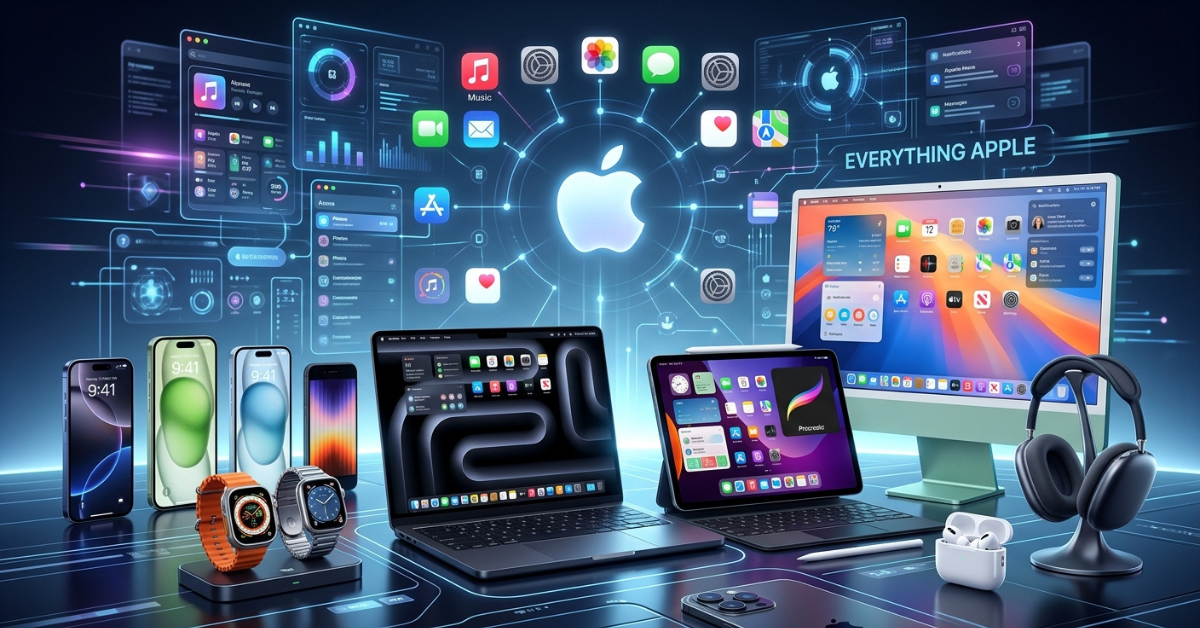
Apple users rarely own just one device anymore. An iPhone can be paired with a Mac, iPad, Apple Watch, AirPods, and several cloud-based services, creating an ecosystem where everything is designed to work together. That is why searches for digitalrgs everything apple are increasingly focused on more than individual products.
The phrase generally refers to content covering Apple devices, software, services, connectivity features, buying advice, troubleshooting, and everyday tips. However, it is worth making one distinction clear: DigitalRGS Everything Apple is not an official Apple product, service, or Apple-owned guide. DigitalRGS.org currently publishes an article using the phrase and presents it as a broad guide to Apple’s ecosystem, while Apple itself remains the authoritative source for specifications, software features, compatibility, and support.
So, what does the topic actually cover? Let’s break it down.
What Is DigitalRGS Everything Apple?
DigitalRGS Everything Apple is best understood as a search phrase associated with third-party content about the Apple ecosystem.
The DigitalRGS.org article associated with the term discusses Apple hardware, services, ecosystem connections, buying decisions, troubleshooting, security, and maintenance. It mentions products such as the iPhone, Mac, iPad, Apple Watch, Apple TV, and HomePod, alongside services including iCloud, Apple Music, Apple TV+, and Apple Arcade.
However, readers should distinguish between information published by a third-party website and information officially provided by Apple.
For example, Apple’s own website and support resources provide the definitive information about current products, operating-system compatibility, technical specifications, repairs, and official features.
Is DigitalRGS affiliated with Apple?
There is no indication in the sources reviewed that DigitalRGS is an official Apple publication or Apple-owned service.
That means readers should treat DigitalRGS material as third-party information and verify important technical or purchasing details through Apple’s official website, especially when dealing with compatibility, warranties, security, repairs, or newly released features.
Understanding the Apple Ecosystem
One of Apple’s biggest strengths is the way its hardware and software can communicate across devices.
Instead of treating an iPhone, Mac, and iPad as completely separate products, Apple provides features that allow compatible devices to share information and continue tasks across screens.
Depending on the devices and software versions involved, Apple’s ecosystem can include:
- iPhone
- iPad
- Mac
- Apple Watch
- AirPods
- Apple TV
- Apple Vision Pro
- iCloud
- Apple Music
- Apple TV+
- App Store
- Apple services and accessories
Apple’s current product lineup continues to expand, with newer generations of iPhone, Mac, iPad, Apple Watch, and AirPods products appearing alongside established categories.
Continuity, Handoff, and Universal Clipboard
The ecosystem becomes particularly useful when several devices are used together.
Features such as Handoff and Universal Clipboard can make it easier to move between compatible Apple devices. For example, a user might begin working on one device and continue on another instead of manually recreating the task.
Other ecosystem features, such as AirDrop and iCloud, are designed to simplify file sharing and synchronization.
The exact features available depend on the devices, operating systems, account settings, and regional availability, so checking Apple’s current support documentation is important before assuming a feature will work on a particular setup.
Apple Devices Covered by the Everything Apple Topic
iPhone
The iPhone remains the center of Apple’s mobile ecosystem for many users.
It combines communication, photography, entertainment, applications, payments, navigation, and other everyday functions in one device. Apple’s current lineup includes several models designed for different budgets and use cases.
When comparing iPhones, don’t focus only on the processor or camera count. Consider:
- Screen size
- Battery requirements
- Camera capabilities
- Storage
- Connectivity
- Software support
- Apple Intelligence compatibility
- Price
- How long you expect to keep the phone
Mac
Mac computers serve a different role from the iPhone.
MacBook models are designed for portable computing, while desktop Macs can be used for demanding creative, professional, and productivity workloads. Apple’s current Mac lineup includes MacBook Air, MacBook Pro, MacBook Neo, iMac, Mac mini, Mac Studio, and Mac Pro models.
For buyers, the most important question is usually not simply “Which Mac is best?”
Instead, ask what you actually do with it.
A student writing documents and browsing the web may have very different requirements from a video editor, software developer, architect, or 3D artist.
iPad
The iPad sits somewhere between a traditional smartphone and computer.
Depending on the model and accessories, it can be used for:
- Note-taking
- Digital drawing
- Reading
- Streaming
- Schoolwork
- Illustration
- Photo editing
- Video editing
- Productivity
For creative users, Apple Pencil compatibility and display characteristics can be just as important as processing performance.
Apple Watch
Apple Watch extends many iPhone-related functions to the wrist.
It can display notifications, support communication, track workouts, provide navigation information, and work with health and fitness features. Apple also highlights the relationship between Apple Watch and iPhone as part of its broader ecosystem.
AirPods
AirPods are another example of Apple’s ecosystem approach.
They are primarily wireless audio products, but their integration with Apple devices makes them useful for calls, music, podcasts, and other everyday activities.
Apple’s current accessory lineup includes multiple AirPods models and related charging accessories.
Apple Services and iCloud
Hardware is only one part of the Apple experience.
Services such as iCloud help synchronize information across supported devices. Depending on the service and settings, this can include photos, files, backups, passwords, notes, and other personal information.
Other major Apple services include:
- Apple Music
- Apple TV+
- Apple Arcade
- Apple Fitness+
- iCloud+
- App Store services
Before subscribing, check exactly what is included in the plan and whether you actually need it. A larger cloud-storage plan, for example, can be useful for someone with several Apple devices but unnecessary for a user who stores very little data.
Apple Intelligence and the Modern Apple Experience
Artificial intelligence has become an increasingly important part of Apple’s software strategy.
Apple introduced Apple Intelligence as a system integrated into supported iPhone, iPad, and Mac experiences. Its capabilities include language tools, image-related functions, assistance across apps, and other AI-powered features.
In 2026, Apple announced another generation of Apple Intelligence features across its platforms, including improvements involving apps, image creation and editing, Safari, Siri, and other experiences.
However, Apple Intelligence is not available on every Apple device. Compatibility depends on the hardware and software version.
That’s an important point when buying an older iPhone, iPad, or Mac: a device can still work perfectly well while lacking newer AI capabilities.
How to Choose the Right Apple Device
Buying an Apple product shouldn’t start with the most expensive model.
Instead, start with your actual needs.
1. Define your main purpose
Are you buying the device for:
- University or office work?
- Photography?
- Gaming?
- Graphic design?
- Video editing?
- Communication?
- Entertainment?
- Professional creative work?
Your answer immediately narrows the options.
2. Think about longevity
If you plan to keep a device for several years, newer hardware may provide greater access to future software features.
This is particularly relevant as Apple continues adding AI capabilities and new operating-system features.
3. Consider the whole ecosystem
If you already own an iPhone, an Apple Watch or Mac may provide additional convenience because of ecosystem integration.
On the other hand, if you only need a basic phone or computer, buying multiple devices simply for ecosystem features may not make financial sense.
4. Check compatibility before buying
This step is easy to overlook.
Before purchasing an older Apple device, check:
- Current operating-system compatibility
- Apple Intelligence compatibility
- Accessory compatibility
- Storage requirements
- Connectivity requirements
- Software support
- Repair options
Apple Security and Privacy Basics
Security should be part of any Apple buying or usage guide.
A few simple practices can significantly improve account security:
- Use a strong device passcode.
- Enable two-factor authentication where available.
- Keep your operating systems updated.
- Don’t share your Apple Account password.
- Review connected devices and account settings.
- Be careful with suspicious links and messages.
- Maintain current backups of important information.
Apple also emphasizes privacy in its approach to Apple Intelligence. Its current materials describe a combination of on-device processing and Private Cloud Compute for supported AI tasks.
Still, privacy claims should always be understood in the context of Apple’s specific technical documentation and the particular feature being used.
Common Apple Troubleshooting Steps
When an Apple device suddenly stops behaving normally, there’s no need to panic.
Start with the basics:
Restart the device
A simple restart can resolve temporary software problems.
Check for updates
Software updates can include bug fixes, security improvements, and compatibility changes.
Check your connection
For problems involving iCloud, App Store downloads, messaging, or other online services, check your Wi-Fi or cellular connection.
Check storage
Very limited storage can interfere with certain tasks. Removing unnecessary files and applications can help.
Check Apple’s support resources
For more serious problems, Apple’s official support platform provides troubleshooting information for iPhone, Mac, iPad, Apple Watch, AirPods, account issues, billing, and repairs.
Should You Trust DigitalRGS for Apple Information?
This is where readers should use a little judgment.
DigitalRGS.org does publish content using the “Everything Apple” terminology, but the phrase itself is not an official Apple designation. Third-party websites can be useful for explaining complicated topics in simpler language, but their claims should be checked against primary sources when accuracy matters.
A good approach is:
- Use third-party guides for explanations and context.
- Use Apple for official specifications.
- Use Apple Support for troubleshooting.
- Check compatibility directly before purchasing.
- Be cautious of unsupported claims about testing, performance, or future products.
This is especially important with rapidly changing technology. A guide written several months ago may contain information that is already outdated.
DigitalRGS Everything Apple: Key Takeaways
If you searched for digitalrgs everything apple, the most important thing to understand is that the phrase refers to third-party Apple-related guide content rather than an official Apple product.
The broader topic covers Apple’s hardware, software, services, ecosystem features, AI capabilities, security, troubleshooting, and purchasing considerations.
The key points are:
- DigitalRGS Everything Apple is not an Apple-owned product name.
- DigitalRGS.org has published content using the term.
- Apple’s official website remains the best source for current product information.
- Apple devices are designed to work together through ecosystem features.
- Compatibility can vary between devices and software versions.
- Apple Intelligence is becoming a major part of the company’s current software strategy.
- Security, backups, updates, and account protection are essential for Apple users.
Frequently Asked Questions
What is DigitalRGS Everything Apple?
DigitalRGS Everything Apple is a search phrase associated with third-party content covering Apple products, services, ecosystem features, buying advice, troubleshooting, and security.
Is DigitalRGS an official Apple website?
No official Apple source reviewed identifies DigitalRGS as an Apple-owned website or official Apple publication. DigitalRGS.org is a separate third-party website that has published articles using the “Everything Apple” terminology.
Does DigitalRGS Everything Apple cover iPhone and Mac?
Yes. The DigitalRGS article associated with the phrase discusses iPhone and Mac alongside iPad, Apple Watch, Apple TV, HomePod, and other parts of the Apple ecosystem.
What is the Apple ecosystem?
The Apple ecosystem refers to Apple’s connected collection of hardware, software, and services. Features such as iCloud and Continuity can allow compatible Apple devices to share information and work together.
Is Apple Intelligence available on every iPhone?
No. Apple Intelligence requires compatible hardware and software. Apple’s current compatibility list includes selected newer iPhone models as well as supported iPad and Mac devices.
Where should I check official Apple information?
Apple’s official website and Apple Support are the most appropriate sources for current product specifications, compatibility information, software support, troubleshooting, and repair options.
Should I verify information from DigitalRGS before buying an Apple product?
Yes. Third-party guides can provide useful explanations, but prices, specifications, compatibility, software features, and availability can change. Verify important purchasing information against Apple’s current product pages before spending money.
Conclusion
DigitalRGS Everything Apple is best viewed as a third-party search topic surrounding Apple’s increasingly connected world of devices, software, services, and features. It can help users discover information about iPhones, Macs, iPads, Apple Watch, AirPods, iCloud, Apple Intelligence, troubleshooting, and everyday Apple usage.
The important part is knowing where the information comes from. For general explanations, third-party guides can be useful, while Apple’s official resources should be your final reference for specifications, compatibility, software updates, security information, and support.
If you’re researching an Apple device today, start by identifying what you actually need, compare compatible models, and verify the latest information directly with Apple before making your decision.





