
Words that sound similar can be surprisingly easy to mix up. Phasing vs pacing is one of those pairs because both words are connected to how something happens over time, but they describe very different ideas.
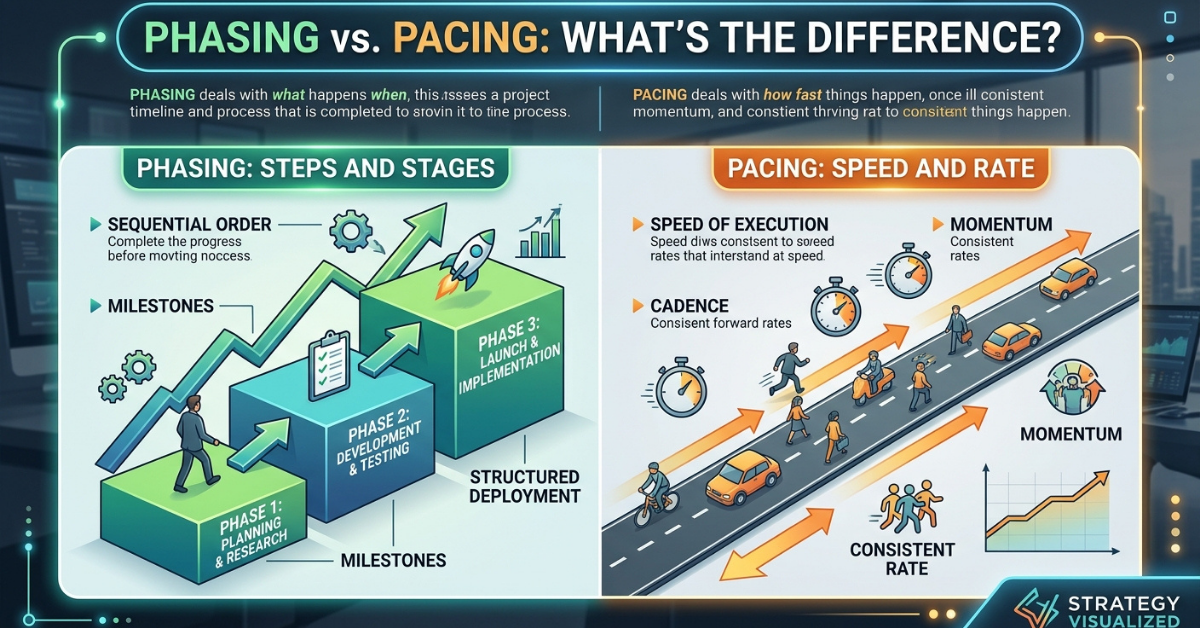
Phasing usually refers to arranging something in stages or gradually introducing different parts of a plan. Pacing, on the other hand, describes the speed, rhythm, or rate at which something happens.
In simple terms, phasing is about stages, while pacing is about speed.
Understanding this small distinction can help you use both words correctly in writing, project planning, storytelling, business, and everyday conversation.
What Does Phasing Mean?
Phasing is the process of dividing something into separate stages or introducing it gradually rather than doing everything at once.
The word comes from phase, which means a distinct period, stage, or part of a process.
For example, a company might phase in a new software system instead of switching every employee to it on the same day.
Examples of Phasing
Here are a few examples:
- The company is phasing in its new payment system.
- The construction project will be completed in three phases.
- The government plans to phase out older vehicles.
- The school introduced the new curriculum in phases.
In each case, the emphasis is on stages or gradual implementation.
Common Expressions With Phasing
You may encounter several common expressions involving this word:
Phase in: Introduce something gradually.
The company is phasing in the new software over six months.
Phase out: Gradually stop using or providing something.
The manufacturer is phasing out the older model.
Phased approach: A plan carried out in several stages.
The team used a phased approach to complete the renovation.
What Does Pacing Mean?
Pacing refers to the speed, rhythm, or rate at which something happens or progresses.
It is commonly used when talking about stories, conversations, projects, presentations, exercise, and other activities.
For example, a novel with excellent pacing gives readers information and events at a rhythm that keeps them interested.
Similarly, someone giving a presentation needs to pace themselves so they don’t rush through important information.
Examples of Pacing
Consider these sentences:
- The movie has excellent pacing.
- You should slow down the pace of your presentation.
- The runner maintained a steady pace throughout the race.
- The project is progressing at a comfortable pace.
- The story’s slow pacing gives the characters more time to develop.
Here, the focus isn’t on stages. Instead, it is on how quickly or slowly something progresses.
Phasing vs Pacing: The Key Difference
The easiest way to remember the difference is:
| Term | Main Meaning | Focus | Example |
| Phasing | Dividing something into stages | Structure or sequence | The project is being completed in phases. |
| Pacing | Controlling the rate or speed | Timing or rhythm | The project is moving at a steady pace. |
Think of it this way:
Phasing asks: “What happens at each stage?”
Pacing asks: “How quickly does it happen?”
That distinction is the key to understanding phasing vs pacing.
Phasing and Pacing in Project Management
The difference becomes especially clear in project management.
Imagine a company is renovating a large office.
The manager might divide the renovation into three phases:
- Demolish and prepare the space.
- Install electrical and plumbing systems.
- Complete furniture, finishes, and decoration.
That’s phasing because the work is organized into stages.
Now imagine the manager decides that each stage should take two months instead of one. That’s related to pacing, because the change affects the rate at which the work progresses.
A project can therefore have:
- Well-planned phasing but poor pacing.
- Fast pacing but poorly organized phases.
- Both effective phasing and effective pacing.
Phasing vs Pacing in Writing and Storytelling
These terms are also useful when discussing books, movies, television shows, and other forms of storytelling.
Phasing in a Story
Phasing can describe how a story or process is divided into different sections or stages.
For example, a story may move through:
- Introduction of the characters
- Development of the conflict
- Rising tension
- Climax
- Resolution
These are structural stages, so the concept is related to phasing.
Pacing in a Story
Pacing describes how quickly the reader or viewer moves through those events.
An action scene may have rapid pacing, with short scenes and frequent events. A character-development section might have slower pacing, giving the audience more time to understand emotions and relationships.
A good story doesn’t necessarily need to be fast all the time. Effective pacing means using the right speed for the moment.
Phasing vs Pacing in Everyday Language
Although both words can relate to time, they aren’t normally interchangeable.
For example:
Correct:
“The project will be completed in three phases.”
This tells us how the project is divided.
Correct:
“The project is moving at a slow pace.”
This tells us how quickly the project is progressing.
Replacing one word with the other changes the meaning.
A Simple Memory Trick
If you’re unsure which word to use, remember:
PHASING = PHASES
Think about stages, steps, or gradual implementation.
PACING = PACE
Think about speed, rhythm, or rate.
This simple association makes the difference much easier to remember.
Common Mistakes With Phasing and Pacing
One common mistake is using pacing when talking about separate stages.
For example:
“The project will be completed in three pacing.”
This is incorrect.
The natural expression is:
“The project will be completed in three phases.”
Another mistake is using phasing when the intended meaning is speed.
For example:
“The team needs to improve its phasing.”
If the writer means that the team needs to work faster or establish a better rhythm, pacing may be the appropriate word instead.
However, context matters. A project can have both phases and a pace, so sometimes both words can correctly appear in the same sentence.
Can Phasing and Pacing Be Used Together?
Yes. In fact, they can describe two different aspects of the same activity.
For example:
“The project has a clear phasing plan, but its pacing is slower than expected.”
Here, phasing refers to the project’s stages, while pacing refers to the speed of progress.
Another example:
“The marketing campaign will be launched in phases, with the pacing adjusted according to customer response.”
The campaign’s phasing determines when different parts are introduced, while its pacing determines the rate at which those activities occur.
Phasing vs Pacing: Which Word Should You Use?
Choose phasing when you’re talking about:
- Stages
- Steps
- Gradual implementation
- A sequence of periods
- Introducing or removing something over time
- Project phases
Choose pacing when you’re talking about:
- Speed
- Rate
- Rhythm
- Timing
- Progress
- Storytelling
- Presentation delivery
- Exercise or athletic performance
Quick Comparison
Use “phasing” for structure.
Use “pacing” for speed.
If you’re describing when different parts happen, think phasing.
If you’re describing how fast something happens, think pacing.
Frequently Asked Questions About Phasing vs Pacing
Is phasing the same as pacing?
No. Phasing refers to dividing something into stages or introducing it gradually, while pacing refers to the speed or rhythm at which something happens.
What is an example of phasing?
“The company is phasing in the new system over the next year.”
This means the system will be introduced gradually in stages.
What is an example of pacing?
“The pacing of the movie becomes faster during the final act.”
Here, pacing refers to the speed and rhythm of the story.
Is it correct to say “phased approach”?
Yes. A phased approach means completing something through a series of planned stages rather than handling everything simultaneously.
Is pacing about speed?
Generally, yes. Pacing describes the rate, rhythm, or speed at which something progresses. However, good pacing isn’t always about being fast; it is about choosing an appropriate rhythm.
What is the easiest way to remember phasing vs pacing?
Remember phasing = phases and pacing = pace. Phasing focuses on stages, while pacing focuses on speed or rhythm.
Can you use phasing and pacing in the same sentence?
Yes. For example: “The project will be completed in four phases, but its pacing will depend on available resources.” The first word describes the stages, while the second describes the rate of progress.
Final Thoughts on Phasing vs Pacing
The difference between phasing vs pacing becomes simple once you focus on what each word is describing.
Phasing is about stages and structure. Pacing is about speed, rhythm, and timing.
Whether you’re discussing a business strategy, construction project, marketing campaign, presentation, or story, knowing this distinction can make your writing more precise.
When you’re unsure, ask yourself one question: Am I talking about the stages of something, or how quickly it happens? If it’s stages, use phasing. If it’s speed or rhythm, use pacing.
Once you make that distinction, these two easily confused words become much easier to use correctly.





