
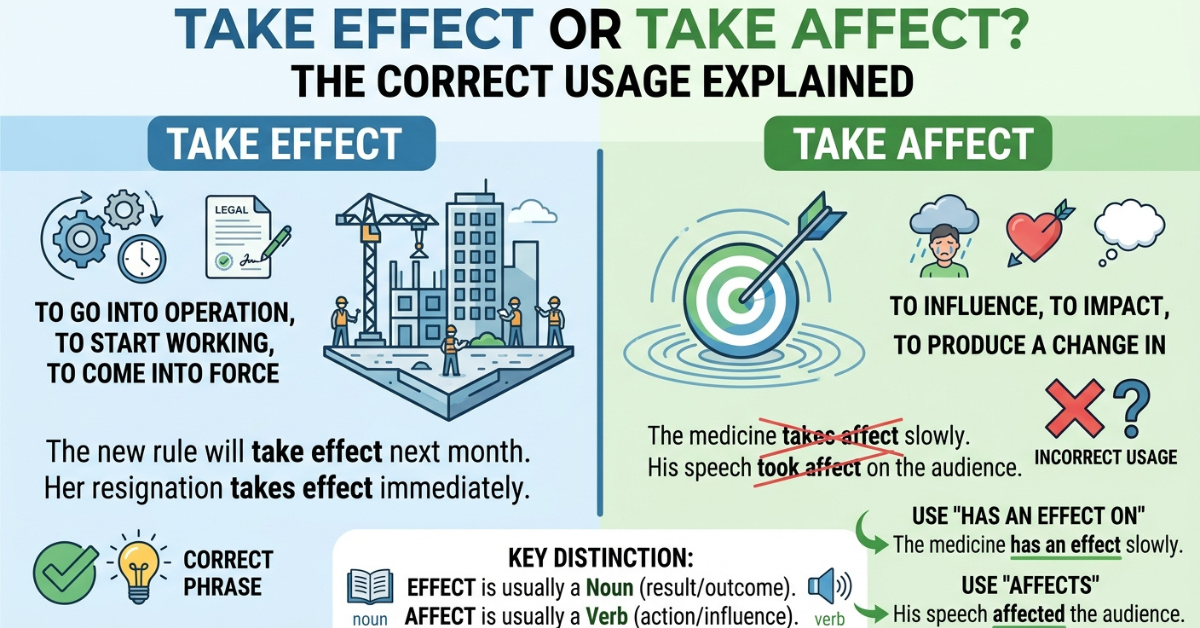
Have you ever paused while writing and wondered whether the correct phrase is take effect or take affect? Although these two words sound very similar, using the wrong one can completely change the grammar of your sentence.
So, is it take effect or take affect? The correct phrase is take effect. We use it when something begins working, becomes active, or starts producing a result.
For instance, a new law may take effect on a certain date, while medicine may take effect after a few minutes. Understanding this small difference can, therefore, make your writing clearer and more professional.
Is It Take Effect or Take Affect?
The correct expression is:
Correct: Take effect
Meanwhile, the incorrect expression in standard English is:
Incorrect: Take affect
The phrase take effect means that something begins to work or officially becomes active.
For example:
- The new law will take effect next year.
- The medicine should take effect within an hour.
- The changes will take effect immediately.
In each example, something is beginning to work or produce a result.
What Does “Take Effect” Mean?
The expression take effect has a straightforward meaning. Essentially, it refers to something becoming active or starting to produce results.
It can mean:
- To begin working
- To become active
- To start producing results
- To officially begin applying
Consequently, the phrase is often used when discussing laws, rules, medicines, policies, agreements, and major changes.
For example, a government policy may take effect on a specific date. Similarly, a painkiller may take effect after it enters your system.
Take Effect or Take Affect: Why Is “Take Affect” Incorrect?
The confusion between take effect or take affect is understandable because the two words sound alike. However, they have different meanings and grammatical functions.
Generally, affect is used as a verb, whereas effect is usually used as a noun.
Therefore, the phrase take effect is correct because it refers to something beginning to produce a result.
Affect Is Usually a Verb
In most situations, affect means to influence or change something.
For example:
- The weather can affect your mood.
- Lack of sleep may affect your concentration.
- Rising prices can affect families.
Here, affect describes an action. In other words, something is influencing another thing.
Effect Is Usually a Noun
On the other hand, effect usually refers to a result, outcome, or consequence.
Consider these examples:
- The new treatment had a positive effect.
- The policy had little effect on sales.
- Stress can have a serious effect on your health.
As a result, effect fits naturally into the phrase take effect because the expression refers to something beginning to produce its intended result.
The Simple Grammar Rule to Remember
If you are wondering whether to use take effect or take affect, remember this easy rule:
Something affects something else, but something takes effect when it begins to work.
For instance:
- The new rule may affect employees.
- The new rule will take effect next month.
Although both words are related to influence and results, they perform different jobs in a sentence.
To Take Effect or Take Affect?
The correct phrase is always:
To take effect
This form is commonly used when discussing something that is expected or planned to become active.
Examples include:
- The new regulations are scheduled to take effect in January.
- The medication needs time to take effect.
- The agreement will begin to take effect after approval.
Therefore, to take affect is incorrect in this context.
Will Take Effect or Take Affect?
When discussing a future event, the correct phrase is:
Will take effect
For example:
- The new tax rules will take effect next year.
- The discount will take effect tomorrow.
- The company’s new policy will take effect in January.
So, if you are asking “will take effect or take affect?”, the answer is clear: use will take effect.
Take Effect or Take Affect in a Sentence
Seeing the phrase in context makes it much easier to remember. Here are several examples from everyday situations.
Laws and Rules
- The new law will take effect in July.
- Updated regulations took effect last week.
- After final approval, the policy will take effect immediately.
Medicine and Treatment
- The painkiller should take effect within 20 minutes.
- This medication may take some time to take effect.
- Fortunately, the treatment took effect faster than expected.
Policies and Changes
- The price increase will take effect next month.
- After the announcement, the company’s changes took effect immediately.
- The new system is expected to take effect soon.
Affect vs. Effect: What Is the Difference?
The easiest way to understand the difference is to focus on how each word is normally used.
| Word | Usually Used As | Meaning | Example |
| Affect | Verb | To influence something | The weather affects my mood. |
| Effect | Noun | A result or outcome | The weather had an effect on my mood. |
However, English does contain a few exceptions.
For example, effect can occasionally be used as a verb in formal English. In that situation, it means to bring something about.
For instance:
- The company hopes to effect change.
Nevertheless, this formal use is completely different from the expression take effect.
An Easy Trick to Remember “Take Effect”
A simple memory trick can help you avoid this mistake.
Think of:
Effect = End result
Since an effect is usually a result or outcome, take effect means that something starts producing its result.
Another helpful comparison is:
- Affect = Action
- Effect = End result
While this shortcut does not cover every exception in English, it works well in most everyday situations.
Common Mistakes to Avoid
People often make the mistake of replacing effect with affect because the words sound similar.
Incorrect Examples
- The new policy will take affect tomorrow.
- The medicine takes affect quickly.
- The changes took affect immediately.
Correct Examples
- The new policy will take effect tomorrow.
- The medicine takes effect quickly.
- The changes took effect immediately.
No matter whether you are discussing the past, present, or future, the expression remains connected to effect.
Takes Effect, Took Effect, and Will Take Effect
The word take changes depending on the tense. However, effect stays the same.
Present: Takes Effect
Use takes effect when discussing something happening in the present or something that generally happens.
Examples:
- The medication takes effect within an hour.
- The policy takes effect after approval.
Past: Took Effect
Use took effect when something became active in the past.
For example:
- The new law took effect last year.
- Fortunately, the medicine took effect quickly.
Future: Will Take Effect
For future events, use will take effect.
Examples include:
- The changes will take effect next month.
- The new system will take effect soon.
Can “Affect” Ever Be Used With “Take”?
Yes, the words take and affect can appear in the same sentence. However, they should not form the phrase take affect.
For example:
- The decision may take time to affect the market.
- It may take several weeks for the changes to affect customers.
In these sentences, take belongs to another phrase, such as take time. Meanwhile, affect remains a separate verb meaning “to influence.”
Why Is the Mistake So Common?
Several factors make take effect or take affect confusing.
1. The Words Sound Similar
In everyday speech, affect and effect can sound very similar. As a result, many people spell the phrase incorrectly.
2. Their Meanings Are Connected
Something can affect a situation and eventually produce an effect. Therefore, the relationship between the words can make them difficult to separate.
3. The Phrase Appears in Formal Writing
You may often see take effect in contracts, workplace policies, legal documents, and government announcements.
Because the phrase is frequently used in formal contexts, people sometimes memorize it incorrectly without understanding the grammar behind it.
Quick Summary: Take Effect vs. Take Affect
Here are the main points to remember:
- Take effect means to begin working or become active.
- Take affect is incorrect in standard English.
- Affect usually means to influence something.
- Effect usually refers to a result or consequence.
- Use takes effect for the present.
- Use took effect for the past.
- Use will take effect for the future.
Frequently Asked Questions
Is it take effect or take affect?
The correct phrase is take effect. It means that something begins working, becomes active, or starts producing results.
Why do we say “take effect”?
We use take effect because the phrase refers to something beginning to produce a result. Therefore, effect is the correct word.
Is “take affect” ever correct?
No, take affect is not the standard English expression. However, affect can be used separately as a verb meaning “to influence.”
Will the new policy take effect or take affect?
The correct sentence is:
The new policy will take effect.
How do you use “take effect” in a sentence?
For example:
The new rules will take effect on Monday.
This means the rules will officially become active on Monday.
Does medicine take effect or take affect?
Medicine takes effect.
For instance:
The medicine should take effect within 30 minutes.
Is “took effect” correct?
Yes. Took effect is the correct past tense form.
Example:
The new law took effect last year.
What is the difference between affect and effect?
Affect is usually a verb meaning “to influence.”
In contrast, effect is usually a noun meaning “a result.”
For example:
- Stress can affect your sleep.
- Stress can have an effect on your sleep.
Conclusion
When deciding between take effect or take affect, remember that take effect is the correct expression.
Something takes effect when it begins working, becomes active, or starts producing results. By contrast, affect usually means to influence something.
Therefore, you can remember the difference this way: something may affect a situation, but a law, policy, medicine, or change takes effect.
Now that you understand the difference, you can use the phrase confidently in emails, academic assignments, professional documents, and everyday writing. Moreover, learning similar grammar pairs can help you write more accurately and communicate with greater confidence.





