
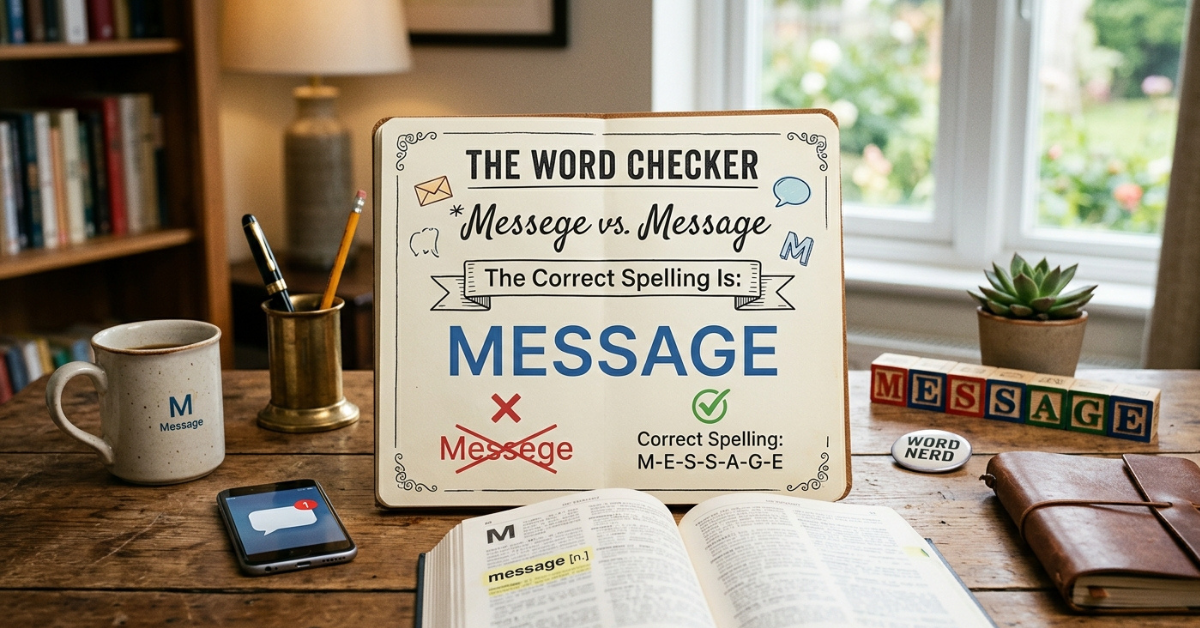
Have you ever typed “messege” and then paused to wonder whether it actually looks right? You’re not alone. Messege or message is a common spelling confusion, especially when typing quickly or writing in English as a second language.
The correct spelling is message. “Messege” is a misspelling and is not the standard English spelling. In this guide, we’ll explain the messege or message meaning, why people make this mistake, how to use “message” correctly, and some simple tricks to remember the spelling.
Messege or Message: Which One Is Correct?
The correct spelling is message.
Messege (Incorrect)
Message (Correct)
The word message is a standard English word used for information, communication, or a piece of communication sent from one person to another.
For example:
- I sent you a message this morning.
- Did you receive my message?
- She left a message for her friend.
- Please message me when you arrive.
Although “messege” may look familiar, it is simply a spelling error. If you’re writing an email, assignment, social media post, professional document, or formal message, always use message.
Messege or Message Meaning
The word message generally means a piece of information or communication given or sent to someone.
Its meaning can change slightly depending on how it is used.
Message as a Noun
As a noun, a message is something communicated from one person to another.
For example:
I received a message from my sister.
Here, “message” refers to the information that was communicated.
A message can be:
- A text sent through a phone
- An email
- A written note
- A verbal communication
- A piece of information
- An important idea expressed through a speech, book, movie, or artwork
Message as a Verb
“Message” can also be used as a verb, particularly in informal and digital communication.
For example:
Message me when you get home.
In this sentence, “message” means to send someone a written or digital communication.
This usage has become especially common with texting, social media, and messaging applications.
Is It Messege or Message?
If you’re asking “is it messege or message?”, the answer is straightforward:
It is message.
The spelling message contains “ss” followed by “age”:
M + E + S + S + A + G + E
A common mistake is changing the “a” to an “e,” creating messege.
Correct spelling
Message
Incorrect spelling
Messege
Other common mistakes can include:
- Messege
- Messsage
- Mesage
- Mesagee
The standard English spelling is simply message.
Why Do People Spell Message as “Messege”?
There are a few reasons this spelling mistake happens.
One major reason is pronunciation. Depending on someone’s accent or familiarity with English, the vowel sound in message can make the spelling less obvious.
Another reason is typing quickly. When people are sending texts or chatting online, they often type based on how a word sounds rather than checking every letter.
Other factors include:
- Phonetic spelling – People may spell the word according to how they hear it.
- Typing mistakes – Fast typing can easily result in an incorrect vowel.
- English learning – Non-native English speakers may not immediately know the standard spelling.
- Visual familiarity – Because “messege” looks somewhat similar to “message,” the mistake can go unnoticed.
That’s why spell-check tools are useful, but knowing the correct spelling yourself is even better.
Message Meaning in Simple English
In very simple terms, a message is something you communicate to another person.
For example:
“Please call me.”
That sentence can be a message.
A message doesn’t always have to be written. Someone can communicate a message through speech, signs, images, gestures, or other forms of communication.
For example, a teacher might give students an important message during class, while a friend might send you a message through a messaging app.
Examples of the Word Message
Seeing the word in context is one of the easiest ways to understand and remember it.
Examples as a Noun
- I got a message from my manager.
- Your message was very helpful.
- She sent me a birthday message.
- There is an important message on the notice board.
- I left a message on your phone.
Examples as a Verb
- Please message me later.
- You can message her on the app.
- I’ll message you when I arrive.
- Don’t forget to message your brother.
- Feel free to message us if you need help.
Message vs. Text Message
People sometimes use message and text message interchangeably, but there can be a small difference.
A message is a broad term for any communication sent to someone. A text message specifically refers to a message sent through a mobile phone’s texting system.
For example:
“I sent her a message.”
This could mean a text, social media message, email, or another type of communication.
“I sent her a text message.”
This specifically suggests a mobile text.
Today, however, people often use “message” as a general term for digital communication.
Is “Messege” a Word?
No. “Messege” is not the standard English spelling of the word.
If you see “messege” online, it is usually just a spelling mistake for message.
For formal writing, avoid using “messege.” Correct it to message instead.
This is particularly important in:
- School assignments
- College or university work
- Business emails
- Job applications
- Professional reports
- Websites and blogs
- Social media posts
Easy Trick to Remember the Spelling
If you frequently confuse message and messege, try remembering the middle of the word.
Think:
mess + age = message
The word begins with mess, followed by age:
MESS + AGE = MESSAGE
The important part to remember is that it contains “age,” not “ege.”
So:
mess + age → message
Not:
mess + ege → messege
This little trick can make the spelling much easier to remember.
Messege or Message Download: What Does It Mean?
You may also come across searches such as “messege or message download.”
This phrase usually isn’t asking for a spelling definition alone. Depending on the context, someone may be looking for a messaging app, a message template, a downloadable message, or information about downloading messages.
If you’re searching for something online, remember that message is the correct spelling.
For example, instead of searching:
“messege download”
try:
“message download”
or, if you’re looking for a specific application:
“messaging app download”
The exact search phrase depends on what you’re trying to download.
Message in Digital Communication
The word message has become even more common with the rise of smartphones and social media.
Today, people send messages through platforms such as:
- SMS
- Social media
- Workplace communication platforms
- Online chat services
- Messaging applications
This has also made spelling mistakes such as “messege” more noticeable because people use the word so frequently.
Whether you’re sending a quick text to a friend or writing a professional email, message is the correct spelling.
Common Questions About Message
Is “messege” or “message” correct?
Message is correct. “Messege” is a misspelling.
Is it “messege” or “message”?
It is message. Remember the spelling as mess + age.
What is the meaning of message?
A message is information or communication sent or given to another person. It can be written, spoken, digital, or conveyed in other ways.
Can “message” be used as a verb?
Yes. For example:
“Message me when you’re free.”
Here, “message” means to send someone a communication.
Why do people write “messege”?
“Messege” is usually a spelling mistake caused by pronunciation, fast typing, or confusion about the vowels in the word.
How do you spell message correctly?
The correct spelling is:
M-E-S-S-A-G-E
Is “messege” accepted in formal English?
No. Messege is not the standard spelling. Use message in formal and informal writing.
Final Answer: Messege or Message?
So, is it messege or message? The answer is message.
“Message” is the correct English spelling and can refer to information communicated between people or to the act of sending that communication. “Messege” is simply a common spelling error.
If you struggle to remember the spelling, use the simple trick “mess + age = message.” Once you get used to seeing the correct form, the mistake becomes much easier to avoid.
Whether you’re writing a text, email, assignment, or professional document, choose message every time.





