
Have you ever typed “flies or flys” and suddenly wondered which one actually looks right? You are not alone. This is a surprisingly common English spelling question, especially when writing phrases such as “time flies,” “she flies,” “the plane flies,” or “the bird flies.”
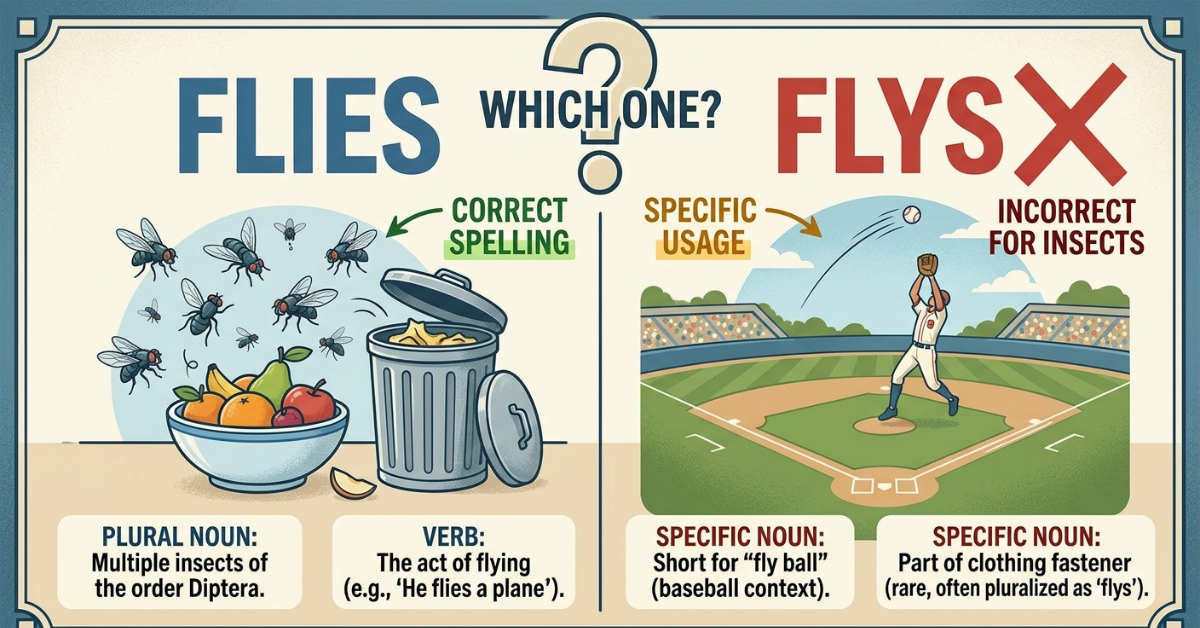
The correct spelling in standard English is flies. The word flys is generally considered incorrect when you are using fly as a verb or as the plural of the insect.
In this guide, we will look at the difference between flies and flys, explain why the spelling changes, and cover the most common phrases people search for.
Flies or Flys: Which One Is Correct?
The correct spelling is flies, not flys, in standard English.
For example:
- Correct: Time flies when you’re having fun.
- Incorrect: Time flys when you’re having fun.
- Correct: She flies to London every month.
- Incorrect: She flys to London every month.
- Correct: The plane flies above the clouds.
- Incorrect: The plane flys above the clouds.
- Correct: There are several flies in the kitchen.
- Incorrect: There are several flys in the kitchen.
The reason is simple: when a word ending in consonant + y needs an -s ending, the y usually changes to i before the -es ending.
So:
fly → flies
The same spelling pattern appears in other English words:
- baby → babies
- city → cities
- story → stories
- party → parties
- country → countries
This is why flies is the standard form.
What Does “Flies” Mean?
The word flies can have more than one meaning depending on the sentence.
1. “Flies” as a verb
Flies is the third-person singular form of the verb fly.
Examples:
- He flies airplanes.
- She flies to Dubai tomorrow.
- The bird flies across the sky.
- A plane flies over the city.
- Time flies when you’re having fun.
In these examples, flies describes an action.
2. “Flies” as a noun
Flies can also be the plural form of fly, referring to the insects.
For example:
There are several flies near the window.
Here, flies does not describe an action. It means more than one fly, the small flying insect.
This distinction is useful because the same spelling can function as either a verb or a plural noun.
Is It Flies or Flys?
If you’re wondering “is it flies or flys?”, the answer is almost always flies in standard English.
Use flies when:
- A person or animal is flying.
- An aircraft is flying.
- You are talking about more than one fly insect.
- You are using the expression “time flies.”
The spelling flys is not the normal standard-English form.
Quick rule
Fly + s = flies
Not:
Fly + s = flys
Remembering this simple rule can help you avoid the mistake in everyday writing.
Is It Time Flies or Flys?
The correct phrase is:
Time flies.
Not:
Time flys.
The expression “time flies” means that time seems to pass very quickly.
For example:
Time flies when you’re having fun.
You might also say:
I can’t believe it’s already September. Time flies!
The phrase is often used when someone is surprised by how quickly days, months, or years seem to pass.
How Time Flies or Flys: Which Is Correct?
The correct expression is “how time flies.”
For example:
It’s crazy how time flies when you’re busy.
Or:
I can’t believe my daughter is already ten. It’s amazing how time flies.
The phrase “how time flies” expresses surprise or amazement about the speed at which time appears to pass.
So, if you’re searching for “how to spell time flies or flys,” remember:
How time flies (Correct)
How time flys (Incorrect)
“Crazy How Time Flies” or “Flys”?
The correct spelling is:
“Crazy how time flies.”
This is a casual expression often used in conversations, social media captions, and messages.
For example:
We graduated five years ago. Crazy how time flies!
It can express nostalgia, surprise, or disbelief about how quickly time has passed.
If you want a complete sentence, you could write:
It’s crazy how time flies.
Again, flies is the correct spelling.
“My How Time Flies” or “Flys”?
Another expression you may come across is:
“My, how time flies!”
Here, my is an interjection expressing surprise or amazement. It is not being used to show possession.
For example:
My, how time flies! It feels like we just started college yesterday.
The correct spelling is flies, not flys.
“Time Sure Flies” or “Flys”?
The correct phrase is:
“Time sure flies.”
It means that time passes surprisingly quickly.
For example:
Time sure flies. It feels like the holidays were only yesterday.
You can also say:
Time really flies.
Both are natural ways to express the same idea.
She Flies or Flys?
The correct form is:
She flies.
For example:
She flies to New York every summer.
Why?
Because she is third-person singular, so the verb fly changes to flies.
Compare:
- I fly.
- You fly.
- We fly.
- They fly.
- He flies.
- She flies.
- It flies.
This is an important English grammar pattern.
Why isn’t it “she flys”?
Because verbs ending in a consonant followed by y generally change y to i before adding -es.
Therefore:
fly → flies
He Flies or Flys?
The correct phrase is:
He flies.
For example:
He flies to different countries for work.
Not:
He flys to different countries for work.
The same rule applies to he, she, and it:
- He flies.
- She flies.
- The bird flies.
- The plane flies.
The Bird Flies or Flys?
The correct sentence is:
The bird flies.
For example:
The bird flies from one tree to another.
Because the bird is singular, the verb needs the third-person singular form flies.
Compare this with:
Birds fly across the sky.
Here, birds is plural, so we use fly, not flies.
This gives us an easy comparison:
| Subject | Correct verb |
| I | fly |
| You | fly |
| We | fly |
| They | fly |
| He | flies |
| She | flies |
| The bird | flies |
| Birds | fly |
| The plane | flies |
| Planes | fly |
The Plane Flies or Flys?
The correct phrase is:
The plane flies.
For example:
The plane flies over the mountains.
Since the plane is singular, the verb is flies.
The incorrect version would be:
The plane flys over the mountains.
Remember that flies is the third-person singular form of fly.
Plane Flies or Flys for Plane?
If you’re searching for “flies or flys for plane,” the correct word is still flies when you’re describing what a plane does.
Examples include:
- The plane flies at a high altitude.
- An airplane flies across the ocean.
- The plane flies from Lahore to Dubai.
- A plane flies through the sky.
However, when the subject is plural, use fly:
Planes fly across the world every day.
So the rule isn’t specifically about airplanes. It depends on the subject of the sentence.
Airplane Flies or Flys?
The correct expression is:
An airplane flies.
For example:
An airplane flies through the atmosphere.
But:
Airplanes fly across the world.
The difference is singular versus plural:
One airplane → flies
Multiple airplanes → fly
This is exactly the same grammar pattern used with people and animals.
A Plane Flies or Flys?
The correct phrase is:
A plane flies.
For example:
A plane flies over the city every few minutes.
Because a plane refers to one plane, the verb takes the third-person singular form:
fly → flies
Flies or Flys as an Insect
When you’re talking about the insect, the correct plural is also flies.
For example:
I saw two flies on the table.
Here, flies is a noun, not a verb.
The singular form is:
one fly
The plural form is:
two flies
So:
- one fly
- several flies
- a fly
- many flies
Again, flys is not the standard plural spelling.
Why Does “Fly” Become “Flies”?
This spelling can seem confusing at first, but it follows a common English rule.
When a word ends in a consonant + y, the y changes to i before adding -es.
For example:
- fly → flies
- cry → cries
- try → tries
- reply → replies
- carry → carries
However, words ending in a vowel + y generally keep the y:
- play → plays
- enjoy → enjoys
- stay → stays
- annoy → annoys
So the spelling depends on what comes before the y.
When Should You Use “Fly” Instead of “Flies”?
Use fly when the subject is I, you, we, or they, or when it follows certain helping verbs.
Examples:
- I fly every summer.
- You fly frequently.
- We fly to Karachi.
- They fly internationally.
- Birds fly south in winter.
- Planes fly above the clouds.
Use flies with a singular third-person subject:
- He flies.
- She flies.
- It flies.
- The bird flies.
- The airplane flies.
- Time flies.
A simple memory trick
If you can replace the subject with he, she, or it, you will usually need flies.
For example:
The plane flies.
The plane = it.
Therefore:
It flies.
Not:
It flys.
Common Mistakes With Flies and Flys
Because flys looks like it should be a simple plural or verb form, it’s easy to type accidentally. Here are some common mistakes to avoid.
Incorrect: Time flys when you’re having fun.
Correct: Time flies when you’re having fun.
Incorrect: She flys to work.
Correct: She flies to work.
Incorrect: The bird flys away.
Correct: The bird flies away.
Incorrect: The plane flys over the city.
Correct: The plane flies over the city.
Incorrect: There are many flys in the room.
Correct: There are many flies in the room.
Flies or Flys: Quick Answer
If you only need the answer, here it is:
“Flies” is the correct standard-English spelling.
Use flies for:
- Time flies
- How time flies
- She flies
- He flies
- The bird flies
- The plane flies
- An airplane flies
- Many flies (the insects)
Avoid flys in standard English writing.
Frequently Asked Questions
Is it flies or flys?
Flies is correct in standard English. Flys is generally an incorrect spelling when referring to the verb fly or the plural noun for the insect.
Is it time flies or flys?
The correct expression is “time flies.” It means that time seems to pass quickly.
How do you spell “time flies”?
It is spelled T-I-M-E F-L-I-E-S: time flies.
Is “how time flies” correct?
Yes. “How time flies” is a correct and common expression used to show surprise about how quickly time passes.
Is it “she flies” or “she flys”?
The correct form is “she flies.” Since she is a third-person singular subject, fly changes to flies.
Is it “he flies” or “he flys”?
The correct form is “he flies.”
Is it “the plane flies” or “the plane flys”?
The correct sentence is “the plane flies.” The subject the plane is singular, so the verb takes the form flies.
Is it “the bird flies” or “the bird flys”?
The correct phrase is “the bird flies.” For a plural subject, however, you would say “birds fly.”
Is “flies” also the plural of fly, the insect?
Yes. The plural of the insect fly is flies.
For example:
One fly is on the wall.
Several flies are on the wall.
Is “flys” ever correct?
In ordinary modern standard English, flys is generally not the correct spelling for either the verb or the plural insect noun. In normal writing, use flies.
Final Thoughts on Flies or Flys
So, flies or flys—which one should you use? In standard English, the answer is flies.
Whether you’re writing “time flies,” “she flies,” “he flies,” “the bird flies,” or “the plane flies,” the spelling remains the same. The word can work as a verb describing movement through the air, or as the plural noun for the familiar flying insect.
The easiest rule to remember is:
fly → flies
Once you understand the consonant + y spelling pattern, phrases like “how time flies” and “crazy how time flies” become much easier to spell correctly.
So next time you’re unsure whether to write flies or flys, go with flies. Your writing will be grammatically correct and much more polished.





