
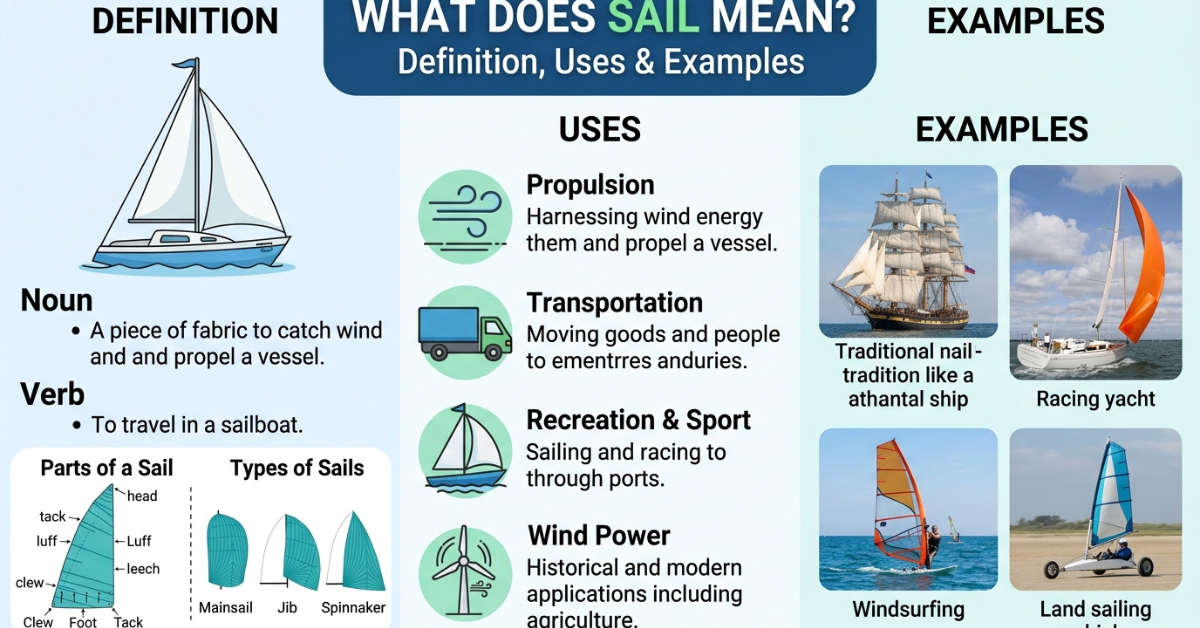
Ever wondered why someone says, “Let’s set sail,” even when they aren’t necessarily talking about a boat? The word sail meaning can be surprisingly broad. It can refer to a piece of fabric that catches the wind, the act of traveling by boat, or even moving smoothly toward a goal.
In everyday English, sail is used as both a noun and a verb. It also appears in phrases, song titles, nautical expressions, and casual conversation. This guide explains the meaning of sail, its common expressions, and several related terms people frequently search for.
What Is the Sail Meaning?
The word sail generally refers to a large piece of fabric attached to a boat, ship, or similar watercraft. Wind pushes against the sail, helping the vessel move across the water.
As a verb, to sail means to travel across water in a boat or ship, usually using sails or another form of propulsion.
Examples:
- The boat has a large white sail.
- They sailed across the lake.
- We plan to sail around the island this summer.
So, depending on the sentence, sail can describe either the object used to catch wind or the action of traveling on water.
Sail as a Noun vs. Sail as a Verb
Understanding the two main uses makes the word much easier to recognize.
Sail as a Noun
As a noun, a sail is the fabric or material attached to a mast that catches wind.
The sailor raised the sail before leaving the harbor.
Sail as a Verb
As a verb, sail means to travel on water by boat or ship.
We sailed along the coast all afternoon.
It can also be used figuratively:
She sailed through her final exams.
Here, sailed through means she completed something easily and without much difficulty.
Set Sail Meaning
The set sail meaning is to begin a journey by boat or ship. The expression is often used when a vessel leaves a harbor or starts traveling across the water.
Example:
The crew set sail before sunrise.
It doesn’t necessarily mean that the boat literally uses sails. Today, set sail can simply mean to begin a voyage.
Setting Sail Meaning
The phrase setting sail meaning is essentially the same idea. Setting sail refers to starting a journey, particularly one involving travel by sea.
For example:
We are setting sail for Greece tomorrow.
The phrase can also have a poetic or metaphorical feeling when describing the beginning of a new adventure.
Set a Sail Meaning
People sometimes search for set a sail meaning, but the more natural expression is usually “set sail.”
Instead of:
We set a sail for the island.
Native speakers would normally say:
We set sail for the island.
However, “set a sail” can be grammatically possible when a sail refers specifically to putting or positioning a particular sail.
Reef a Sail Meaning
The reef a sail meaning relates to reducing the amount of sail exposed to the wind. Sailors do this when the wind becomes too strong or when they want greater control over the boat.
Example:
The captain told the crew to reef the sail as the wind increased.
Reefing isn’t about removing the sail. Instead, part of the sail is folded or secured to make its effective area smaller.
Reef Sail Meaning
A reef sail can refer to a sail that has been reduced in size by reefing. The term may also appear in sailing discussions when people talk about reefing systems, reef points, or different ways of controlling sail area.
Reefing a Sail Meaning
The phrase reefing a sail meaning is simply the process of reducing the sail’s area to handle stronger winds safely and effectively.
In practical sailing, reefing can help:
- Reduce excessive heeling
- Improve control
- Reduce stress on the boat and rigging
- Make sailing more comfortable
- Maintain a manageable sail plan in stronger winds
Jib Sail Meaning
The jib sail meaning refers to a triangular sail positioned toward the front of a sailboat.
A jib is normally attached near the bow and works with the boat’s other sails to help generate forward movement and improve handling.
For example:
The sailor adjusted the jib as the wind shifted.
The jib is one of the most familiar sails on a traditional sailing boat.
Stay Sail Meaning
A staysail is a sail supported by a stay, which is part of a sailing vessel’s rigging. It is commonly positioned between the mast and another structural point on the boat.
The term can describe several sail arrangements depending on the vessel’s design.
Forestay Sail Meaning
The forestay sail meaning generally relates to a sail carried from or near the forestay, the supporting wire or structure running from the mast toward the bow.
A jib is one common example of a sail associated with the forestay area.
The exact terminology can vary depending on the boat’s rig and sailing tradition.
Full Sail Meaning Urban Dictionary
People searching for full sail meaning Urban Dictionary may encounter informal or slang interpretations in addition to the traditional nautical meaning.
In standard English, under full sail means that a sailing vessel has its available sails deployed to catch the wind. Figuratively, it can describe someone or something moving quickly, energetically, or at full capacity.
Because Urban Dictionary entries are user-submitted, their definitions can vary and shouldn’t be treated as authoritative dictionary definitions.
A Ship Without a Sail Meaning
The phrase a ship without a sail meaning is usually interpreted metaphorically.
A ship without a sail can still exist as a physical object, but in traditional sailing imagery, a sail represents direction, movement, purpose, or the ability to travel.
Therefore, describing someone as “a ship without a sail” may suggest that they feel:
- Lost
- Directionless
- Without purpose
- Unable to move forward
- Uncertain about where they are going
Like a Ship Without a Sail Meaning
The expression like a ship without a sail carries a similar metaphorical meaning.
For example:
After losing his sense of purpose, he felt like a ship without a sail.
The comparison creates an image of something that exists but lacks the means to move forward in a chosen direction.
Black Sail Meaning
The black sail meaning depends heavily on context.
Literally, it means a sail that is black or predominantly dark in color. In fiction, literature, symbolism, or popular culture, a black sail may represent ideas such as:
- Mystery
- Danger
- Rebellion
- Death
- Adventure
- Piracy
There isn’t one universal symbolic definition. Its meaning changes according to the story or context in which it appears.
Apres Sail Meaning
Après-sail is a playful term modeled on the French expression après-ski, which refers to social activities after skiing.
In sailing and boating culture, après-sail generally refers to the socializing, eating, drinking, relaxing, or other activities that take place after sailing.
For example:
The yacht club hosted an après-sail gathering after the race.
The spelling may appear as après-sail or apres sail, depending on the publication or context.
AWOLNATION “Sail” Meaning
AWOLNATION’s “Sail” is the title of a well-known song released by the American rock project AWOLNATION. The song uses the word sail in a highly metaphorical way rather than simply describing sailing a boat.
Its lyrics and themes have been widely interpreted in connection with alienation, emotional struggle, frustration, and wanting to escape or move away from overwhelming circumstances.
Because song interpretation is subjective, there isn’t one officially established meaning that explains every line. The nautical idea of sailing away can, however, reinforce the broader feeling of wanting to break away or find another direction.
“Let’s Sail” Meaning
The phrase “let’s sail” simply means “let’s go sailing” or “let’s travel by boat.”
For example:
The weather is perfect. Let’s sail!
Depending on context, it can also be used playfully or metaphorically to suggest starting an adventure or moving forward together.
Ship Sail Meaning
The phrase ship sail meaning generally refers to the function of sails on a sailing vessel.
A sail uses the force of moving air to help propel a boat or ship. Sails come in many forms and are arranged differently depending on the vessel’s design.
Common sailing terms include:
- Mast: A vertical structure that supports sails and rigging.
- Jib: A triangular sail toward the front of many sailboats.
- Mainsail: The primary sail attached to the mainmast.
- Staysail: A sail supported by a stay.
- Rigging: The wires, ropes, and related equipment used to support and control the sails.
Sail Meaning in Telugu
The sail meaning in Telugu depends on whether sail is being used as a noun or a verb.
As a noun, sail can be translated as:
తెర (Tera) — sail of a boat/ship.
As a verb, to sail can be expressed using phrases meaning to travel by boat or ship.
For example:
They sailed across the sea.
The exact Telugu translation can change depending on the sentence and whether the focus is on the sail itself or the act of traveling.
Anchor and Sail Meaning
The phrase anchor and sail meaning often carries a symbolic contrast.
An anchor traditionally represents:
- Stability
- Security
- Grounding
- Staying in place
A sail, by contrast, can represent:
- Movement
- Freedom
- Exploration
- Adventure
- Progress
That’s why anchor-and-sail imagery is popular in tattoos, logos, jewelry, and artwork. Together, the symbols can represent the balance between having something that keeps you grounded and having the freedom to move forward.
Common Sail Expressions
Here are several useful expressions containing sail:
| Expression | Meaning |
| Set sail | Begin a journey by boat or ship |
| Setting sail | Starting a sea journey |
| Sail away | Travel away by boat; sometimes escape metaphorically |
| Under full sail | With all available sails deployed |
| Sail through | Complete something easily |
| Smooth sailing | A situation with few problems |
| Take the wind out of someone’s sails | Reduce someone’s confidence or enthusiasm |
| Sail close to the wind | Take a risky approach or come close to breaking a rule |
| Plain sailing | Something that is easy or uncomplicated |
Sail Meaning in Everyday English
Although sail comes from a strongly nautical context, English speakers often use it metaphorically.
Consider the phrase “smooth sailing.” Someone might say:
After we solved the technical problems, it was smooth sailing.
Nobody is necessarily talking about a boat. The phrase means that things became easy and trouble-free.
Similarly, “sail through” means to accomplish something with little difficulty:
She sailed through the interview.
These expressions show how sailing vocabulary has become part of everyday English.
Sail vs. Sale: What’s the Difference?
One of the most common spelling mistakes involving sail is confusing it with sale.
Sail relates to boats, ships, wind, or traveling by water.
The boat raised its sail.
Sale relates to selling something, especially at a reduced price.
The store is having a summer sale.
A simple trick is to remember:
Sail = sea
Sale = selling
Frequently Asked Questions About Sail Meaning
What does sail mean in simple words?
Sail means a piece of fabric used to catch wind and move a boat, or the act of traveling by boat.
What does “set sail” mean?
Set sail means to begin a journey by boat or ship. It can also be used figuratively for starting a new journey or adventure.
What does “setting sail” mean?
Setting sail means beginning a voyage or leaving a place by boat or ship.
What does “reef a sail” mean?
To reef a sail means to reduce the amount of sail exposed to the wind, usually because the wind has become stronger.
What does “sail through” mean?
Sail through means to complete something easily or without experiencing much difficulty.
What does “a ship without a sail” symbolize?
Metaphorically, a ship without a sail can symbolize a person who feels directionless, stuck, or without a clear purpose.
What does a black sail symbolize?
A black sail can symbolize different things depending on the context, including mystery, danger, rebellion, or death. There is no single universal interpretation.
What is a jib sail?
A jib is a triangular sail generally positioned toward the front of a sailing vessel.
What is a staysail?
A staysail is a sail supported by a stay, a structural part of a sailing vessel’s rigging.
Conclusion
The sail meaning is straightforward at its core: a sail is a fabric structure that catches wind, while to sail means to travel by boat or ship. But the word has grown far beyond its nautical roots.
Expressions such as set sail, setting sail, reef a sail, sail through, and smooth sailing give the word additional meanings in everyday English. Whether you’re reading a book, interpreting a song, learning English, or simply trying to understand sailing terminology, recognizing the context will usually reveal exactly what sail means.
Once you understand the basic nautical meaning, phrases such as “like a ship without a sail” and “anchor and sail” become much easier to interpret too.