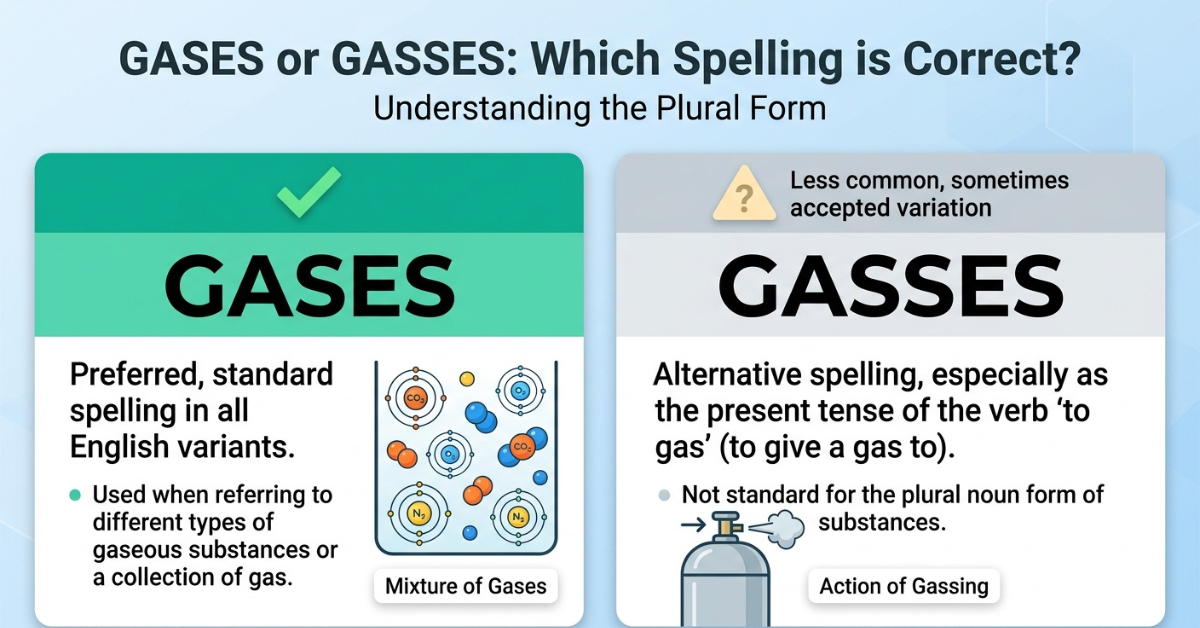
Have you ever stopped while writing “gases” and wondered whether it should actually be “gasses”? You are not alone. The gases or gasses spelling question is surprisingly common because both words exist in English—but they do not mean the same thing.
So, which is correct: gases or gasses?
The short answer is simple: “gases” is usually the plural of “gas,” while “gasses” is a verb. The correct spelling depends entirely on what you are trying to say.
Whether you are writing about greenhouse gases, natural gas, chemistry, or someone releasing or exposing something to gas, understanding the difference will help you avoid a common spelling mistake.
Let’s break it down in a simple way.
Is It Gases or Gasses?
Both gases and gasses are correct English words. However, they are used differently.
Gases
Use gases when referring to more than one type or quantity of gas.
Examples:
- Oxygen and nitrogen are atmospheric gases.
- Scientists study different gases in the atmosphere.
- Cars produce harmful gases.
- Greenhouse gases contribute to global warming.
Gasses
Use gasses as a verb, meaning that someone or something:
- exposes someone to gas,
- fills something with gas,
- or produces gas, depending on the context.
Examples:
- The mechanic gasses the car before the trip.
- The chemical process gasses the chamber.
- The machine gasses the container.
So, when asking “is it gases or gasses?”, the answer is: both can be correct, but they have different grammatical roles and meanings.
How to Spell Gases or Gasses Correctly
The easiest way to remember the difference is to ask yourself one question:
Are you talking about more than one gas, or are you describing an action?
If you mean the plural of gas → use gases
For example:
- Toxic gases
- Industrial gases
- Greenhouse gases
- Atmospheric gases
If you mean an action → use gasses
For example:
- He gasses up the vehicle.
- The system gasses the container.
This is the key rule behind the gases or gasses spelling question.
Why Is the Plural of Gas Spelled “Gases”?
The plural of gas is gases, not gasses.
This follows standard English spelling conventions. Adding -es creates the plural form:
gas → gases
The extra e helps preserve the pronunciation of the word.
Similar plural forms include:
- class → classes
- bus → buses
- box → boxes
Therefore, when referring to multiple gases, gases is the standard and correct spelling.
Gases or Gasses: The Main Difference
Here is a quick comparison:
| Word | Grammar | Meaning | Example |
| Gases | Noun (plural) | More than one gas | Greenhouse gases affect the climate. |
| Gasses | Verb | Performs the action of gassing | He gasses up the car. |
The confusion happens because both words come from gas, but they serve different purposes in a sentence.
Which Is Correct: Gases or Gasses?
If you are referring to substances such as oxygen, carbon dioxide, helium, or methane, gases is correct.
For example:
Oxygen and helium are gases.
The atmosphere contains several gases.
Scientists measure greenhouse gases.
Using gasses in these sentences would be incorrect.
However, if you are using gas as a verb, gasses may be correct.
For example:
She gasses up her car every week.
The answer to “which is correct, gases or gasses?” therefore depends on the sentence.
Greenhouse Gases or Gasses?
One of the most frequently searched versions of this question is “greenhouse gases or gasses?”
The correct term is:
Greenhouse gases
A greenhouse gas is a gas in the atmosphere that can absorb and emit infrared radiation, contributing to the greenhouse effect.
Common greenhouse gases include:
- Carbon dioxide
- Methane
- Nitrous oxide
- Water vapor
- Fluorinated gases
Because greenhouse gases refers to multiple gaseous substances, the spelling is always gases.
Incorrect: Greenhouse gasses
Correct: Greenhouse gases
So, if you are writing about climate change or environmental science, remember that greenhouse gases is the correct spelling.
Gases or Gasses in American English
What about gases or gasses American English?
In American English, the same basic rule applies:
- Gases = plural noun
- Gasses = verb
For example, Americans might say:
- The laboratory studies different gases.
- He gasses up the truck.
One interesting point is that American English often uses “gas” informally to mean gasoline.
For example:
- I need to get gas.
- She gasses up the car.
But when talking about multiple types of gas as substances, the correct plural remains gases.
Gases or Gasses in UK English
The rule is also essentially the same in British English.
Gases or Gasses UK
In the UK:
- gases is the plural of gas.
- gasses is used as a verb.
Examples:
- The factory releases harmful gases.
- He gasses the vehicle.
However, British speakers are more likely to use “petrol” rather than “gas” when referring to fuel for cars. So, the phrase “gasses up the car” is more strongly associated with American English.
Still, from a spelling perspective, the distinction between gases and gasses remains the same.
Gases or Gasses in Canada
The same grammar rules apply in Canadian English.
Gases
Use it for the plural noun:
- Natural gases
- Toxic gases
- Greenhouse gases
Gasses
Use it as a verb:
- He gasses up the vehicle.
Canadian English can contain influences from both British and American English, but this particular spelling distinction is straightforward: gases is the plural, while gasses is generally a verb.
How to Remember the Difference Between Gases and Gasses
A simple memory trick can make this much easier.
Think about what the word is doing in the sentence.
If it names things, use gases.
Oxygen and carbon dioxide are gases.
If it describes an action, use gasses.
He gasses up the car.
Another easy way to remember it:
Gases = plural
Gasses = action
This quick rule will solve most gases or gasses spelling problems.
Gases or Gasses Examples
Here are some examples showing the difference clearly.
Examples of “Gases”
- The atmosphere contains several important gases.
- Scientists monitor harmful gases released by factories.
- Carbon dioxide and methane are greenhouse gases.
- Some gases are invisible to the human eye.
- The experiment involved several compressed gases.
Examples of “Gasses”
- He gasses up the car before a long journey.
- The technician gasses the equipment as part of the process.
- The system automatically gasses the chamber.
Notice that gases refers to substances, while gasses describes something happening.
Is “Gasses” Ever the Plural of Gas?
In standard modern English, gasses is generally not used as the plural noun for gas.
The standard plural is:
gas → gases
For example:
Correct: Different gases react differently under pressure.
Incorrect: Different gasses react differently under pressure.
The double s in gasses appears when gas is being used as a verb in the third-person singular form.
For example:
- I gas the car.
- You gas the car.
- He gasses the car.
That is why the two spellings can look confusing.
Spell Gases or Gasses: A Quick Grammar Rule
If you need a quick answer while writing, use this checklist:
Use gases when:
- You mean more than one gas.
- You are discussing chemistry.
- You are writing about the atmosphere.
- You are referring to greenhouse gases.
- You are describing substances such as oxygen or methane.
Use gasses when:
- You are using “gas” as a verb.
- Someone performs the action of adding or exposing something to gas.
- The sentence describes what one person, machine, or thing does.
This makes the spell gases or gasses question much easier to answer.
Common Mistakes People Make
One common mistake is assuming that adding another s automatically creates the plural.
For example:
Incorrect: The laboratory contains several gasses.
Correct: The laboratory contains several gases.
Another mistake is using gases when the sentence requires a verb.
Incorrect: He gases up the car.
Correct: He gasses up the car.
The correct spelling depends on grammar, not just pronunciation.
Why Do “Gases” and “Gasses” Look So Similar?
The confusion comes from the fact that English uses different spelling patterns for nouns and verbs.
The base word is:
gas
When it becomes a plural noun:
gas → gases
When it becomes a third-person singular verb:
gas → gasses
For example:
- One gas
- Two gases
But:
- I gas
- You gas
- They gas
- He or she gasses
This grammatical difference explains why both spellings exist.
Is It Spelled Gases or Gasses? Quick Answer
If you came here looking for the fastest possible answer:
Gases is the plural of gas.
Gasses is a verb meaning to gas or fill/expose something with gas.
So:
Greenhouse gases
Toxic gases
Natural gases
But:
He gasses up the car.
Frequently Asked Questions
Is it gases or gasses?
Both words are correct, but they have different meanings. Gases is the plural of gas, while gasses is usually a verb.
Which is correct, gases or gasses?
If you mean more than one gas, gases is correct. If you mean the action of gassing something, gasses may be correct.
Is it spelled gases or gasses?
The plural of gas is spelled gases. The spelling gasses is generally used as a verb.
How do you spell gases correctly?
The correct plural spelling is G-A-S-E-S: gases.
Are greenhouse gases or gasses correct?
Greenhouse gases is correct. The word refers to multiple gases in the atmosphere.
Is “gasses” a real word?
Yes. Gasses is a real word and is commonly used as the third-person singular form of the verb gas.
Is gases or gasses used in American English?
Both exist in American English. Gases is the plural noun, while gasses is a verb.
Is gases or gasses used in UK English?
The same spelling distinction generally applies in British English: gases is the plural noun, and gasses is the verb form.
Why does gases have one “s” while gasses has two?
Gases follows the plural form of the noun gas. Gasses is formed when gas functions as a third-person singular verb.
Can I say “different gasses”?
In standard usage, no. When referring to multiple gaseous substances, you should say different gases.
Final Thoughts: Gases or Gasses?
The gases or gasses debate is really a grammar question rather than a regional spelling difference. Both words are valid, but they belong in different situations.
Use gases when talking about more than one gas, such as oxygen, methane, toxic gases, or greenhouse gases. Use gasses when describing the action of gassing something.
If you can remember one simple rule—gases are things, while gasses is usually an action—you will know which spelling to choose almost every time.
Now that you know the difference, you can confidently use gases or gasses correctly in American English, British English, Canadian English, scientific writing, and everyday conversations. For more helpful grammar guides, explore related articles on commonly confused words and English spelling rules.