
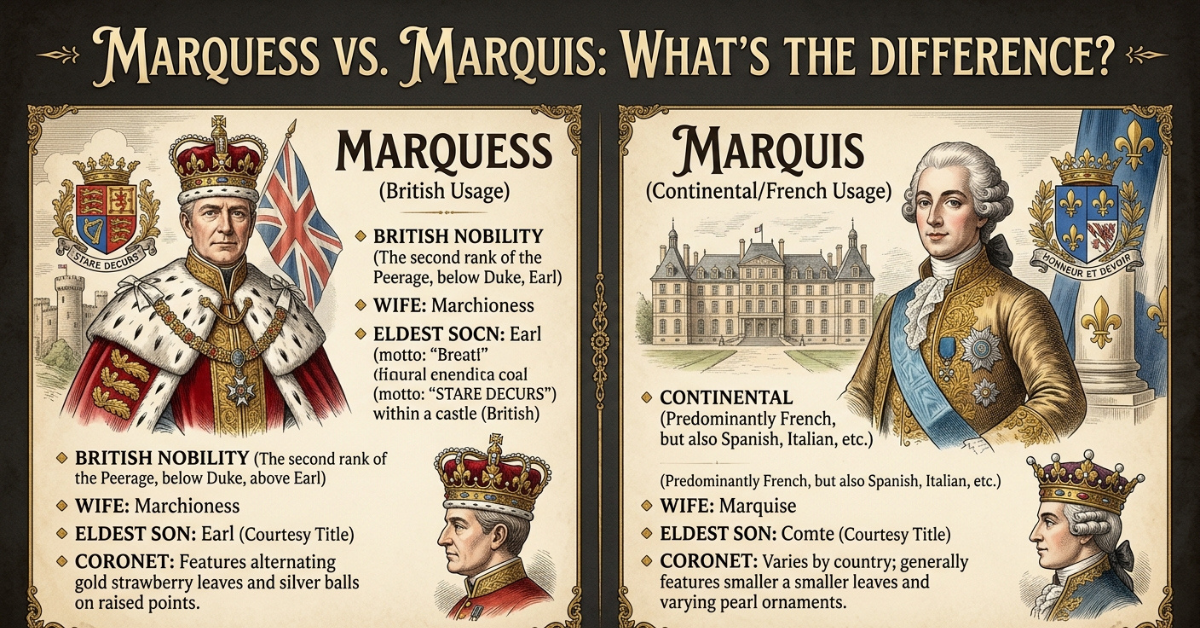
Have you ever seen the titles marquess and marquis and wondered whether they mean the same thing? At first glance, they look like two different aristocratic ranks. In reality, the answer is a little more interesting.
The main difference in marquess vs marquis usually comes down to language, geography, and historical tradition. Both titles refer to a high-ranking member of the nobility, generally positioned below a duke and above an earl or count.
However, marquess is the standard English title used in Britain, while marquis is more commonly associated with French and other European traditions. Understanding the distinction can help when reading history books, royal biographies, novels, or articles about aristocracy.
Let’s break down the meaning, pronunciation, rank, and usage of marquess vs marquis in simple terms.
What Does Marquess Mean?
A marquess is a hereditary noble title in the British peerage system. Traditionally, a marquess ranks:
- Below a duke
- Above an earl
- Among the highest levels of the British aristocracy
The female equivalent of a marquess is a marchioness.
For example:
- Duke
- Marquess
- Earl
- Viscount
- Baron
This ranking is particularly important in the British system of nobility.
Why Is the Title Called Marquess?
The word has historical roots connected to a march, meaning a border region between territories. In medieval Europe, nobles responsible for protecting border areas often held titles connected to these frontier regions.
Because border territories could be strategically important, the people responsible for governing them often held considerable authority.
Over time, the title became part of the formal aristocratic ranking system.
What Does Marquis Mean?
A marquis is essentially the equivalent noble title in French and several other European traditions.
The word is closely related to the English marquess, and both titles developed from the same historical idea involving border territories or marches.
A marquis traditionally ranked highly within the nobility, although the exact position and importance of the title could vary depending on the country and historical period.
The female form of marquis is generally marquise in French.
Marquess vs Marquis: The Main Difference
The simplest way to understand marquess vs marquis is this:
| Marquess | Marquis |
| Primarily used in British English | Primarily associated with French and European traditions |
| Part of the British peerage | Used in France and other countries |
| Female equivalent: Marchioness | Female equivalent: Marquise |
| Usually pronounced “MAR-kwiss” | Often pronounced differently depending on language |
So, marquess and marquis represent closely related noble titles, but the preferred spelling and usage depend largely on the country and language.
Is a Marquess the Same as a Marquis?
In many contexts, yes. A marquess and a marquis occupy essentially the same general level of aristocratic rank.
However, they should not always be treated as interchangeable.
The title marquess belongs specifically to the British system of peerage, while marquis is traditionally used in French and other European systems.
For example, it would be more accurate to refer to a British noble as a marquess rather than a marquis.
Similarly, a French noble would traditionally be called a marquis.
Why Does Britain Use Marquess Instead of Marquis?
The British spelling marquess developed as part of the English adaptation of European noble titles.
Although the titles share similar origins, Britain established its own formal spelling and pronunciation within the peerage system.
This is why you may see:
- Marquess of Salisbury
- Marquess of Ailesbury
- Marquess of Londonderry
These are British aristocratic titles, so marquess is the correct form.
The spelling marquis, on the other hand, is more strongly connected with continental Europe.
Marquess vs Marquis Pronunciation
One reason people get confused about marquess vs marquis is pronunciation.
Marquess Pronunciation
In British English, marquess is generally pronounced:
MAR-kwiss
Even though the spelling contains “-quess,” it does not sound exactly as it looks.
Marquis Pronunciation
The pronunciation of marquis depends on the language and context.
In English, it may sometimes be pronounced:
MAR-kee
However, the French pronunciation differs and is closer to:
mar-KEE
Because aristocratic titles often travel between languages, pronunciation can vary.
Where Does the Word Marquis Come From?
The word marquis has roots in medieval European terminology connected to a march or frontier territory.
A march was an area located near the border of a kingdom or region. These places often required strong military leadership because they could be vulnerable to invasion or conflict.
The noble responsible for governing such an area could receive a title related to the territory.
Similar titles developed across Europe, including:
- Marquis
- Marquess
- Markgraf
- Margrave
Although these titles differ by language and country, many share historical connections to border regions.
What Rank Is a Marquess?
In the British peerage, a marquess is the second-highest hereditary rank, below a duke.
The traditional ranking is:
- Duke
- Marquess
- Earl
- Viscount
- Baron
This means a marquess traditionally held a very prestigious position in the aristocracy.
Is a Marquess Higher Than an Earl?
Yes. A marquess ranks above an earl in the British peerage.
The order is:
Duke → Marquess → Earl
So, if you are comparing noble titles, a marquess has a higher traditional rank than an earl.
Is a Marquis Higher Than a Duke?
No. In traditional European systems where the ranks are comparable, a duke generally ranks above a marquis.
The exact hierarchy can vary by country and historical period, but the common order is similar to:
Duke → Marquis → Count/Earl
Therefore, neither a British marquess nor a European marquis traditionally outranks a duke.
Marquess vs Marquis in British and French Culture
The difference becomes clearer when looking at cultural context.
Marquess in Britain
In Britain, marquess is an official aristocratic title within the peerage system.
A person holding the title may be referred to formally as:
The Marquess of [Place Name]
The title may be hereditary and passed through generations according to the rules attached to that particular peerage.
British titles can be complex because inheritance rules vary depending on the specific title and the legal terms under which it was created.
Marquis in France
In France, marquis was historically a noble title.
Like many European aristocratic titles, its importance changed over time depending on political developments and the structure of French society.
The title became particularly familiar through French history, literature, and popular culture.
Today, references to marquises often appear in:
- Historical books
- French literature
- Period dramas
- Genealogical records
- Discussions of European aristocracy
Marquess vs Marquis: Which Spelling Should You Use?
The correct spelling depends on the context.
Use Marquess When:
- Referring to a British noble title
- Writing about the British peerage
- Discussing British aristocracy
- Referring to a specific British title
Use Marquis When:
- Referring to French nobility
- Discussing many continental European aristocratic traditions
- Using the French form of the title
- Referring to a specific person officially known as a marquis
The easiest rule to remember is:
Marquess is British; marquis is primarily French and continental European.
Marquess vs Marquis vs Marchioness
These related terms can also create confusion.
Marquess
A male holder of a British noble title ranking below a duke and above an earl.
Marchioness
The female equivalent of a marquess or the wife of a marquess.
Marquis
A related noble title used primarily in France and other European traditions.
Marquise
The female form associated with the French title of marquis.
Although the words look similar, their spelling reflects different linguistic traditions.
Are Marquess and Marquis Gender-Specific?
Traditionally, yes.
A marquess or marquis generally refers to a male title holder.
Female forms include:
- Marchioness in the British tradition
- Marquise in the French tradition
However, aristocratic titles and inheritance practices can be legally complicated and depend on the country and specific title.
Why Are Aristocratic Titles So Confusing?
Titles such as duke, marquess, earl, count, viscount, and baron developed across different countries and languages.
That means two titles may represent similar ranks but have different names.
For example:
- Earl is traditionally used in Britain.
- Count is used more widely across continental Europe.
Similarly:
- Marquess is the British form.
- Marquis is the French and continental form.
The differences are often linguistic rather than completely separate ranks.
Common Mistakes When Using Marquess and Marquis
Here are a few mistakes people commonly make.
1. Assuming They Are Completely Different Ranks
They are closely related titles and generally occupy the same level in comparable aristocratic hierarchies.
The main difference is usually geographical and linguistic.
2. Calling a British Marquess a Marquis
Although people may understand what you mean, marquess is the correct title when referring to the British peerage.
3. Assuming Marquis Always Means British
It does not. The British title uses the spelling marquess.
4. Confusing Marchioness With Marquis
A marchioness is the female equivalent in the British system, while marquis is a related male title used in other traditions.
A Simple Way to Remember Marquess vs Marquis
If you struggle to remember the difference, use this quick trick:
British aristocracy = Marquess
French and continental European aristocracy = Marquis
Both titles are historically connected to the idea of governing or protecting important border territories.
The spelling simply changed as the title developed across different languages and countries.
Examples of Marquess and Marquis in a Sentence
Marquess Examples
- The marquess inherited his family’s British title.
- The Marquess of Salisbury was an important figure in British political history.
- In the British peerage, a marquess ranks below a duke.
Marquis Examples
- The French marquis was a member of the historical nobility.
- The novel featured a wealthy marquis living in an elaborate estate.
- The title of marquis appeared in several European aristocratic systems.
Marquess vs Marquis: Quick Comparison
Here is the difference at a glance:
| Feature | Marquess | Marquis |
| Main Usage | Britain | France and continental Europe |
| Type | Noble title | Noble title |
| Traditional Rank | Below duke, above earl | Generally comparable rank |
| Female Form | Marchioness | Marquise |
| Language Connection | English | French |
| Historical Origin | Border territory or march | Border territory or march |
FAQs About Marquess vs Marquis
What is the difference between marquess and marquis?
The main difference is geographical and linguistic. Marquess is the traditional British spelling and title, while marquis is primarily associated with French and other European aristocratic traditions.
Is a marquess higher than an earl?
Yes. In the British peerage, a marquess ranks above an earl and below a duke.
Is marquis the same as marquess?
They are closely related and generally represent equivalent aristocratic ranks in different national traditions. However, the correct term depends on the country and title being discussed.
Why is marquess spelled differently from marquis?
The difference developed through language and national traditions. Britain adopted marquess as the official English form, while marquis remained common in French and other European contexts.
What is the female version of a marquess?
The female equivalent is marchioness.
What is the female version of a marquis?
The French female form is marquise.
Is a marquess royalty?
No. A marquess is generally part of the nobility or aristocracy, not necessarily the royal family. However, noble families may have historical connections to royalty.
Is a duke higher than a marquess?
Yes. In the British peerage, a duke ranks above a marquess.
Conclusion
When comparing marquess vs marquis, the biggest difference is not necessarily their level of importance but where and how the titles are used.
A marquess is the traditional British title, ranking below a duke and above an earl in the peerage system. A marquis is the closely related title most strongly associated with France and other European traditions.
Both titles share historical roots connected to border territories and the nobles responsible for governing or protecting them.
So, the next time you encounter these words in a history book, novel, or period drama, you will know exactly what separates marquess vs marquis: British usage versus French and continental European tradition.
If you enjoy learning about confusing words, historical titles, and differences between similar terms, explore related topics such as duke vs earl, count vs earl, and lord vs nobleman to build an even clearer understanding of aristocratic ranks.





