
Have you ever written an email about a new policy affecting everyone in the business and suddenly paused over one small question: companywide or company wide?
You are not alone. This spelling question comes up often in business writing, workplace communication, reports, and professional emails. Fortunately, the answer becomes much easier once you understand how compound words work.
In most modern English usage, companywide is written as one word. It describes something that applies to, affects, or includes the entire company.
This guide explains the difference between companywide or company wide, which spelling is generally preferred, how to use the word correctly, and how it fits into everyday professional writing.
Companywide or Company Wide: Which Is Correct?
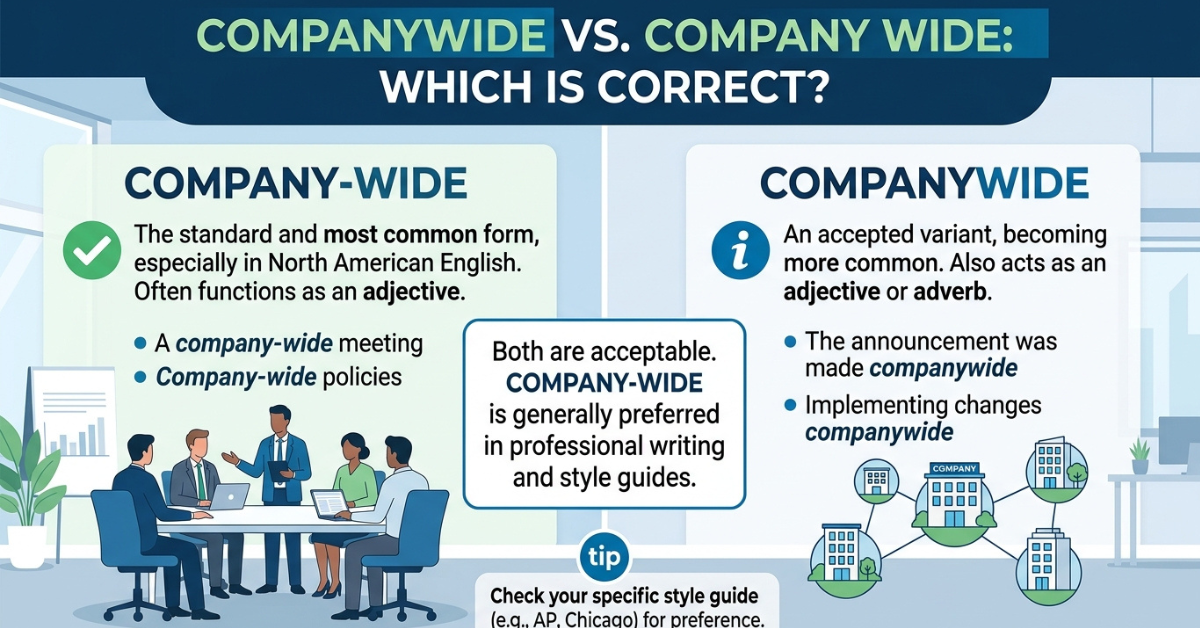
The preferred spelling is generally companywide, written as one word.
As an adjective, companywide describes something involving the entire company. It can also be used as an adverb when describing an action that takes place throughout the organization.
For example:
- The companywide meeting will take place on Monday.
- We introduced a companywide wellness program.
- The CEO announced the changes companywide.
- Employees received the message companywide.
In professional writing, the closed form is usually the cleaner and more natural choice. Therefore, if you are writing a business email, report, policy, or announcement, companywide is a reliable option.
Correct:
- companywide policy
- companywide announcement
- companywide meeting
- companywide changes
Less preferred:
- company wide policy
- company wide announcement
- company wide meeting
Although company wide may occasionally appear, particularly in informal writing, it is generally less preferred than companywide. For polished workplace communication, the one-word form is usually the better choice.
What Does Companywide Mean?
Companywide means throughout an entire company or affecting all parts of an organization.
In other words, the term indicates that something is not limited to one department, office, team, or location. Instead, it reaches the organization as a whole.
For example, imagine a company with departments such as:
- Marketing
- Human Resources
- Finance
- Sales
- Customer Support
- Information Technology
If a new rule applies to every one of these departments, you could describe it as a companywide policy.
Example:
The company introduced a companywide remote work policy.
Here, companywide tells the reader that the policy applies throughout the organization rather than only to one department.
Why Is Companywide Written as One Word?
The spelling companywide follows a common pattern involving compound words in English.
A compound word combines two or more words to create a term with a particular meaning. Over time, some combinations that were once written separately become hyphenated and may eventually develop into closed compounds written as one word.
Similar examples include:
- nationwide
- worldwide
- systemwide
- companywide
The same pattern helps explain why companywide is commonly written as a single word today. As its use became established in business and general English, the closed form became increasingly familiar.
It is worth noting that English spelling conventions can vary between dictionaries, publications, and style guides. Consequently, you may still encounter company-wide, especially where a particular editorial style prefers hyphenation.
Companywide vs. Company-Wide
Another version you may come across is company-wide, with a hyphen.
So, which should you choose: companywide or company-wide?
Both forms can be found in published English. However, the preferred form depends partly on the style guide or editorial convention being followed.
Companywide
This is the closed compound form and is widely used in modern professional writing.
Example:
The companywide initiative focuses on improving employee satisfaction.
Company-Wide
This version uses a hyphen and may appear in publications or organizations that follow a style preference for hyphenated compound modifiers.
Example:
The company-wide initiative focuses on improving employee satisfaction.
The key point is consistency. If your employer, client, school, or publication follows a specific style guide, follow its recommendation. Otherwise, companywide is a straightforward and professional choice.
Is “Company Wide” Ever Correct?
You may occasionally see company wide written as two separate words. While readers can usually understand the meaning, this form is generally less preferred when companywide is being used as a compound modifier.
For example, consider this sentence:
The company wide changes will begin next month.
A more polished version would be:
The companywide changes will begin next month.
Writing the compound as one word makes the structure clearer and follows the form most commonly preferred in modern business writing.
That said, context matters. English has many compound terms whose spelling varies according to usage and editorial preference. Therefore, it is always useful to check the style requirements for a particular publication.
How to Use Companywide in a Sentence
Understanding the definition is helpful, but seeing the word in context makes its usage much easier to remember.
The following examples show how companywide can work in everyday business communication.
Companywide as an Adjective
When placed before a noun, companywide describes something that affects the entire organization.
Examples include:
- The companywide strategy will launch next quarter.
- We are planning a companywide training session.
- The companywide survey received thousands of responses.
- Management announced a companywide restructuring plan.
- The companywide policy applies to all employees.
In each sentence, the word identifies the scope of the noun that follows it. As a result, readers immediately know that the subject concerns the whole company.
Companywide as an Adverb
Companywide can also describe an action that occurs throughout the organization.
For example:
- The CEO shared the announcement companywide.
- The update was communicated companywide.
- The new security procedures were implemented companywide.
- The company introduced the system companywide last year.
Here, the word explains the reach of the action rather than describing a noun directly.
Common Examples of Companywide Communication
The term companywide appears frequently in professional environments because businesses often need to communicate changes across multiple departments.
Here are some common expressions you may encounter.
Companywide Meeting
A companywide meeting involves employees from across the organization.
Example:
The leadership team will host a companywide meeting on Friday.
Such meetings might be used to discuss company performance, future plans, organizational changes, or important announcements.
Companywide Policy
A companywide policy applies throughout the organization.
Example:
The company introduced a companywide policy on workplace safety.
Unlike a department-specific rule, this type of policy is intended to cover employees or operations across the business.
Companywide Announcement
A companywide announcement is shared with employees throughout the organization.
Example:
The CEO sent a companywide announcement about the new leadership structure.
This wording makes it clear that the message was not intended for just one team.
Companywide Initiative
A companywide initiative involves the organization as a whole.
Example:
The sustainability program is part of a larger companywide initiative.
Such initiatives can involve several departments working toward the same goal.
Companywide Training
A companywide training program is provided across the business.
Example:
Cybersecurity awareness training will be rolled out companywide.
This wording tells employees that the training is not restricted to a particular department.
Companywide vs. Organization-Wide
Another common question is whether you should use companywide or organization-wide.
The distinction mainly depends on what you are describing.
Use “Companywide” for Companies
Use companywide when referring specifically to a company or business.
Example:
The companywide policy applies to all employees.
The word works particularly well in corporate communication, business reports, and workplace announcements.
Use “Organization-Wide” for Broader Organizations
Organization-wide can be more appropriate when the entity is not necessarily a company.
For instance, the term may describe:
- Nonprofit organizations
- Government agencies
- Universities
- Charities
- Professional associations
Example:
The organization-wide initiative will improve communication between departments.
Both terms express a similar idea. However, organization-wide has a broader scope because an organization does not necessarily operate as a company.
Companywide vs. Nationwide vs. Worldwide
Companywide belongs to a larger group of words that describe the scope or reach of something.
Companywide
Means throughout an entire company.
The companywide program supports employee development.
Nationwide
Means throughout an entire country.
The campaign launched nationwide.
Worldwide
Means throughout the world.
The product is available worldwide.
Systemwide
Means throughout an entire system.
The systemwide update improved performance.
Although these terms look similar, each one describes a different level of reach.
| Word | Meaning |
| Companywide | Throughout an entire company |
| Nationwide | Throughout an entire country |
| Worldwide | Throughout the world |
| Systemwide | Throughout an entire system |
Knowing this distinction can make your writing more precise, especially when describing the scope of a policy, campaign, or change.
Should You Use a Hyphen With Companywide?
In most general and modern business writing, companywide without a hyphen is a strong choice.
However, spelling conventions can differ between publications and organizations. Some style guides may prefer company-wide, particularly when they consistently hyphenate similar compound modifiers.
If you are writing for a:
- Company website
- Corporate report
- University publication
- Newspaper
- Specific client
check the relevant style guide whenever possible.
A Simple Rule to Remember
If no particular style guide tells you otherwise, companywide is a practical choice.
It is concise, easy to understand, and commonly used in professional communication. More importantly, choosing one form and using it consistently is better than switching between several spellings throughout the same document.
Common Mistakes When Writing Companywide
Although the word itself is simple, a few mistakes are worth avoiding.
1. Writing “Company Wide” as Two Words
Less preferred:
We are launching a company wide campaign.
Better:
We are launching a companywide campaign.
The one-word form treats the expression as an established compound.
2. Switching Between Different Spellings
Avoid moving back and forth between:
- companywide
- company-wide
- company wide
Instead, choose the form that matches your preferred or required style. Then use it consistently throughout the document.
Consistency makes professional writing easier to read and prevents unnecessary spelling questions.
3. Using Companywide for Something Limited to One Department
The meaning of companywide is important. If something affects only one department, describing it as companywide would be inaccurate.
For example, this sentence could be misleading:
The companywide marketing policy requires weekly reports.
If the policy applies only to the marketing department, a clearer sentence would be:
The new marketing department policy requires weekly reports.
Therefore, use companywide only when something genuinely applies across the organization.
When Should You Use Companywide?
Use companywide when discussing something that involves or affects the entire business.
Common examples include:
- Company policies
- Employee announcements
- Training programs
- Business initiatives
- Technology updates
- Organizational changes
- Corporate events
- Workplace rules
- Employee surveys
- Strategic plans
For example:
The companywide survey will help leadership understand employee concerns.
Because the survey involves the organization as a whole, companywide accurately describes its scope.
How to Remember the Correct Spelling
A useful way to remember the spelling is to compare companywide with familiar words such as nationwide and worldwide.
We commonly write:
- nationwide
- worldwide
- systemwide
- companywide
These examples show how -wide can become part of a single compound word.
Quick Memory Tip
Think:
One company = companywide
So:
company + wide = companywide
This is simply a memory aid rather than a strict grammar rule. Still, it can make the preferred spelling easier to remember when you are writing quickly.
Companywide in Professional Writing
Clear communication matters in almost every workplace. Even small spelling and word-choice decisions can influence how polished a document appears.
For that reason, companywide is particularly useful in:
- Business emails
- Employee handbooks
- Corporate announcements
- Press releases
- Internal communications
- Annual reports
- Company policies
- Job descriptions
- Presentations
For example, instead of writing:
We are making changes across the entire company.
you could write:
We are implementing companywide changes.
The second version is shorter and communicates the same idea efficiently.
Alternatives to Companywide
You do not always have to use companywide, especially if the same word appears repeatedly in a report or article.
Depending on the context, alternatives include:
- Across the company
- Throughout the company
- Across the organization
- Organization-wide
- Business-wide
- Across all departments
- Company-wide
Examples
Instead of:
The companywide update was successful.
you could write:
The update was successful across the company.
Another option is:
The update was successful throughout the organization.
Using these alternatives can make longer pieces of writing sound more natural while still preserving the original meaning.
Companywide or Company Wide: Quick Answer
If you only need the short answer, here it is:
Companywide is generally the preferred spelling when you mean something that affects or includes an entire company.
Correct:
The companywide meeting starts at 10 a.m.
Less preferred:
The company wide meeting starts at 10 a.m.
Also used in some style guides:
The company-wide meeting starts at 10 a.m.
For most modern professional writing, companywide is the simplest choice. However, if a particular publication or organization follows a style guide that uses company-wide, follow that convention instead.
Frequently Asked Questions
Is companywide one word or two?
Companywide is generally written as one word. It describes something that applies throughout an entire company.
Is companywide hyphenated?
Usually, companywide is written without a hyphen. However, company-wide is also used by some publications and organizations that follow a hyphenated style.
What does companywide mean?
Companywide means throughout the entire company or affecting all parts of the organization.
For example:
The companywide policy applies to every employee.
How do you use companywide in a sentence?
You can use companywide before a noun:
The company announced a companywide training program.
It can also describe an action:
The new procedures were implemented companywide.
Is companywide an adjective?
Yes. Companywide commonly functions as an adjective when it describes something that affects the entire company.
Example:
The companywide initiative was successful.
It can also function as an adverb in sentences such as:
The changes were introduced companywide.
What is another word for companywide?
Depending on the sentence, alternatives include:
- Across the company
- Throughout the company
- Across the organization
- Organization-wide
- Business-wide
The best alternative depends on the context and the type of organization being discussed.
Should I write companywide in an email?
Yes. Companywide is suitable for professional emails, corporate communication, reports, and workplace announcements when referring to something that affects the entire organization.
For example:
We will announce the companywide policy changes during tomorrow’s meeting.
Conclusion
When deciding between companywide or company wide, the preferred choice for most modern business writing is companywide.
The word describes something that affects, involves, or applies throughout an entire company. Consequently, it works naturally in phrases such as companywide meeting, companywide policy, companywide initiative, and companywide training.
You may still encounter company-wide, particularly in publications or organizations that follow a specific editorial style. Meanwhile, the two-word form company wide is generally less preferred when the phrase functions as a compound term.
The easiest way to remember the preferred spelling is to connect it with familiar words such as nationwide and worldwide: when you mean throughout the entire company, companywide is usually the right choice.
If you are interested in improving your English and professional writing skills, exploring other commonly confused compound words can help you write with greater confidence and consistency.





