
Have you ever typed “to fast or too fast” and stopped to wonder which one is actually correct? You’re not alone. These two phrases sound exactly the same when spoken, but they have completely different meanings in writing.
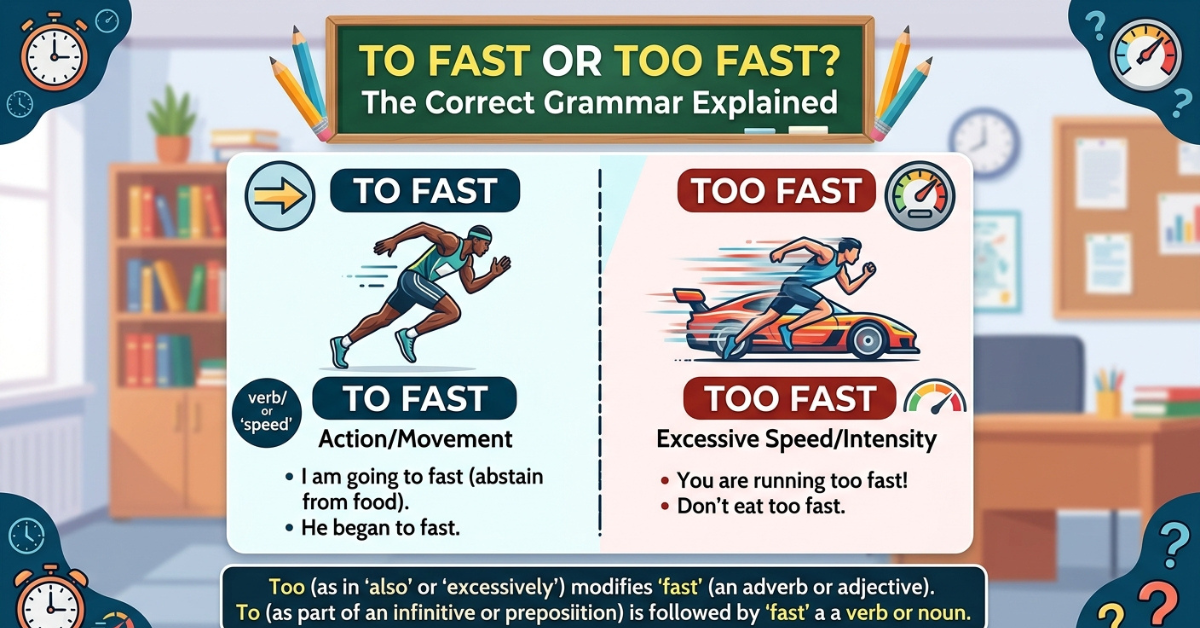
In most situations where you mean “more quickly than is comfortable, expected, or appropriate,” the correct phrase is “too fast.” The word too means “more than necessary” or “excessively,” while to is usually used as a preposition or as part of an infinitive verb.
Understanding this small difference can make your writing much clearer. Let’s look at when to use to fast or too fast, how the words work, and why phrases such as “way too fast,” “going too fast,” and “growing up too fast” use too.
To Fast or Too Fast: Which One Is Correct?
If you’re describing something that happens at an excessive speed, “too fast” is correct.
For example:
- The car is going too fast.
- You’re walking too fast.
- This music is playing too fast.
- Time is passing too fast.
- My children are growing up too fast.
Here, too means “more than is desirable or appropriate.”
On the other hand, “to fast” can be grammatically correct when fast is being used as a verb. In this case, fast means to deliberately avoid food, usually for a religious, cultural, health, or personal reason.
For example:
- I decided to fast during Ramadan.
- She plans to fast before the medical procedure.
- He wants to fast for a day.
So, the difference isn’t simply about spelling. The meaning and grammatical role of the words are different.
What Does “Too Fast” Mean?
Too fast means something is happening at a speed that is greater than what is considered suitable, safe, comfortable, or expected.
The word too adds the idea of excess.
For example:
The driver is going too fast.
This means the driver is driving at an excessive speed, perhaps making the situation unsafe.
Another example:
You’re speaking too fast.
This means the person is speaking more quickly than the listener can comfortably understand.
More examples of “Too Fast”
- The train is moving too fast.
- You’re typing too fast for me to keep up.
- The video is playing too fast.
- Don’t eat too fast.
- The water is flowing too fast.
- Everything seems to be changing too fast.
In each sentence, too fast describes excessive speed or pace.
What Does “To Fast” Mean?
To fast has a different meaning because fast is functioning as a verb.
To fast means to intentionally go without eating for a certain period.
The word to is used before the base form of the verb:
to + fast = to fast
For example:
- I need to fast before my appointment.
- They chose to fast for religious reasons.
- She decided to fast until sunset.
Here, replacing to with too would change the meaning and make the sentence incorrect.
“To Fast” in a Sentence
Consider this sentence:
I need to fast tomorrow.
The meaning is that the person needs to avoid eating.
Compare it with:
I need to drive too fast tomorrow.
That means the person needs to drive at an excessive speed.
The two phrases may sound similar, but their meanings are completely different.
Is It “To Fast or Too Fast”?
If you’re asking “is it to fast or too fast?” because you want to describe excessive speed, choose “too fast.”
A simple rule is:
If you mean “excessively fast,” use “too fast.”
Examples:
- Is the car going too fast?
- Am I walking too fast?
- Why is this happening too fast?
- Are we moving too fast?
Use “to fast” when fast means deliberately going without food:
- I want to fast tomorrow.
- She decided to fast this week.
This distinction solves most confusion between the two expressions.
“Way Too Fast” or “Way to Fast”?
The correct expression is “way too fast.”
When way is used informally as an intensifier, it means much more than is appropriate.
For example:
You’re driving way too fast.
This means:
You’re driving much faster than you should.
Other examples include:
- That’s way too fast.
- The lesson went way too fast.
- You’re talking way too fast.
- Time is going way too fast.
- This car accelerates way too fast.
Therefore, when you’re searching for “way to fast or too fast,” the correct spelling in this context is “way too fast.”
Why Is “Way Too Fast” Correct?
Think of the phrase in parts:
way + too + fast
- way = much
- too = excessively
- fast = quickly
Together, way too fast means much faster than appropriate.
“Going Too Fast” or “Going To Fast”?
The correct phrase is “going too fast” when you mean moving at excessive speed.
For example:
You’re going too fast.
This could refer to a car, bicycle, person, conversation, project, or even the pace of life.
Other examples:
- The car is going too fast.
- We’re going too fast through this project.
- You’re going too fast with the explanation.
- Life feels like it’s going too fast.
Why “Going to Fast” Is Usually Wrong
In “going to fast,” the word to would normally need to be part of another grammatical structure.
For example:
I’m going to fast tomorrow.
This sentence can technically be correct if the speaker means:
I’m going to fast tomorrow.
Here, to fast means “to abstain from food.”
But if you mean that someone is moving at excessive speed, you need:
I’m going too fast.
The context determines which word is appropriate.
“Growing Up Too Fast” or “Growing Up To Fast”?
The correct phrase is “growing up too fast.”
This is one of the most common situations where people wonder whether to use to or too.
For example:
My children are growing up too fast.
The speaker means that the children seem to be becoming older more quickly than the speaker would like.
You can also say:
They’re growing up way too fast.
This adds emphasis and suggests that the change feels especially quick.
Growing Up Too Fast: Examples
- I can’t believe how quickly you’re growing up.
- My little sister is growing up too fast.
- Kids seem to grow up too fast these days.
- Sometimes I wish life wouldn’t move so fast.
- They are growing up way too fast.
The same rule applies to the keyword variation “growing to fast or too fast.” When you mean developing or becoming older at an excessive rate, use “growing too fast.”
To Fast or Too Fast Grammar Rule
The easiest way to remember the difference is to understand what to and too normally do in a sentence.
When to Use “To”
To is commonly used:
- Before a verb to create an infinitive.
- As a preposition showing direction, relationship, or connection.
Examples:
- I want to run.
- She needs to study.
- He decided to fast.
- We went to school.
- Give the book to me.
In to fast, fast is the verb.
When to Use “Too”
Too commonly means:
- More than necessary
- Excessively
- Also or additionally
Examples:
- The coffee is too hot.
- You’re driving too fast.
- This bag is too heavy.
- It’s too expensive.
- I want to come too.
In too fast, too modifies the word fast and indicates excessive speed.
A Simple Trick to Remember “To” vs. “Too”
Try replacing too with “excessively” or “more than necessary.”
If the sentence still makes sense, too is probably correct.
For example:
You’re driving too fast.
Replace too:
You’re driving excessively fast.
The meaning still works, so too fast is correct.
Now consider:
I need to fast.
Replace to with excessively:
I need excessively fast.
That doesn’t make sense.
Therefore, to fast is correct in the original sentence because fast is being used as a verb.
Common Mistakes With “To Fast or Too Fast”
These mistakes are particularly common because to and too sound alike.
| Incorrect | Correct | Meaning |
| You’re driving to fast. | You’re driving too fast. | Excessive speed |
| You’re talking to fast. | You’re talking too fast. | Excessive speaking speed |
| Life is moving to fast. | Life is moving too fast. | Life feels excessively quick |
| They’re growing to fast. | They’re growing too fast. | Growing more quickly than expected |
| I want too fast. | I want to fast. | Intend to avoid food |
| She decided too fast. | She decided to fast. | Intends to abstain from food |
The key is to focus on meaning rather than pronunciation.
“Too Fast” vs. “So Fast”
Although too fast and so fast are sometimes used in similar situations, they don’t mean exactly the same thing.
Too fast generally suggests that the speed is excessive or undesirable.
You’re driving too fast.
So fast emphasizes the degree of speed without necessarily saying that it is a problem.
You’re driving so fast!
The first sentence can sound like a warning. The second can simply express surprise or admiration.
Compare These Examples
Too fast:
The children are growing too fast.
This suggests the speaker feels they’re growing faster than desired.
So fast:
The children are growing so fast!
This emphasizes how quickly they’re growing and can express amazement.
“Too Fast” vs. “Very Fast”
These expressions are also different.
Very fast means something happens at a high speed.
The cheetah runs very fast.
Too fast means the speed is excessive for the situation.
The car is going too fast.
A thing can be very fast without being too fast.
For example, a professional runner may run very fast, and that’s exactly what they’re supposed to do. But if someone runs too fast during a warm-up, they may be moving faster than appropriate.
Why Do “To” and “Too” Cause So Much Confusion?
The main reason is pronunciation.
In many varieties of English, to and too sound the same or nearly the same when spoken naturally. This makes the difference difficult to notice in conversation.
Writing is different because the spelling carries the meaning.
A useful way to think about it is:
to = direction or action
too = excess or addition
Examples:
- I want to learn.
- I went to work.
- I need to fast.
- It’s too hot.
- You’re moving too fast.
- I want to come too.
Once you recognize the function of each word, the distinction becomes much easier.
How to Choose the Correct Phrase
When you’re unsure whether to write to fast or too fast, follow these steps:
1. Ask What You Mean
Do you mean excessively quickly?
If yes, use:
too fast
2. Check Whether “Fast” Is a Verb
Does fast mean to deliberately avoid eating?
If yes, use:
to fast
3. Try “Excessively”
If you can replace the phrase with “excessively fast,” use too fast.
For example:
This is happening too fast.
→ This is happening excessively fast.
The meaning works.
4. Look at the Sentence as a Whole
Never choose between to and too based only on how the words sound. Look at what the sentence is trying to say.
Examples in Everyday English
Here are some natural examples you might hear or write:
Talking About Speed
Slow down! You’re going too fast.
Talking About Conversation
Could you speak more slowly? You’re talking too fast.
Talking About Time
This year is going too fast.
Talking About Children
They’re growing up too fast.
Talking About a Project
We’re moving too fast. We need more time to review the details.
Talking About Eating
I need to fast before my appointment.
Talking About Religion
She decided to fast during Ramadan.
These examples show why context matters.
Frequently Asked Questions
Is it “to fast” or “too fast”?
Both can be correct, but they have different meanings. “Too fast” means excessively quickly, while “to fast” means to abstain from eating.
Is it “way to fast” or “way too fast”?
The correct phrase is “way too fast” when you mean something is happening much faster than appropriate.
Example:
You’re driving way too fast.
Is it “going to fast” or “going too fast”?
Use “going too fast” when you mean moving at excessive speed.
Example:
The car is going too fast.
Is “growing up too fast” correct?
Yes. “Growing up too fast” is the correct phrase when you mean that someone seems to be getting older more quickly than expected or desired.
Is “growing to fast” correct?
Not when you mean something is growing excessively quickly. In that context, the correct phrase is “growing too fast.”
Can “to fast” ever be correct?
Yes. “To fast” is correct when fast is a verb meaning to deliberately abstain from food.
Example:
I plan to fast tomorrow.
Or:
I need to fast before the test.
Why do “to” and “too” sound the same?
In ordinary English speech, to is often pronounced weakly, making it sound very similar to too. This is why the difference is much easier to notice in writing than in conversation.
Is “too fast” grammatically correct?
Yes. Too functions as an adverb modifying fast, indicating that something is happening at an excessive speed.
Is “very fast” the same as “too fast”?
No. Very fast simply describes high speed, while too fast suggests that the speed is excessive or inappropriate for the situation.
Final Takeaway: To Fast or Too Fast?
The easiest rule is simple:
Use “too fast” when you mean “excessively fast.”
You’re driving too fast.
Use “to fast” when “fast” is a verb meaning to abstain from food.
I decided to fast.
So, if you’re wondering about “to fast or too fast,” “is it to fast or too fast,” “way to fast or too fast,” “going to fast or too fast,” or “growing up to fast or too fast,” remember that the correct choice depends on the meaning.
When you’re talking about excessive speed, too fast is the phrase you want. When you’re talking about abstaining from food, to fast is correct.
Once you connect too = excessive and to = infinitive/direction, this common grammar mistake becomes much easier to avoid.





